The Curry Wrapped in Bread That Trinidad Gave the Islands
The first time I ate a Caribbean roti I was standing on a pavement in west London with the paper going soft in my hands. The Trinidadian woman behind the counter had asked “dhalpuri or buss up shut?” and I had no idea what either word meant. I said dhalpuri because it sounded like food. What came back was a warm, soft flatbread folded tight around curried chicken and potato, the gravy soaking into the bread, pepper sauce on top because I had nodded when she asked.
I grew up in Guadeloupe. We do not make roti at home, and I will explain why further down, because the reason is the best part of the story. But I have eaten a lot of it since, and I have learned the words. So let me walk you through Caribbean roti: what it is, where it comes from, the three breads to know, what goes inside, and what to do with one in a British kitchen.
What is Caribbean roti?
Caribbean roti is an Indian flatbread, brought to the islands by indentured labourers from the Indian subcontinent, and the curry wrap built around it. In Trinidad, where the wrap was invented, a soft dhalpuri or paratha is folded around curried chicken, goat, potato or chickpeas and eaten in the hand, with pepper sauce on top.
Where roti came from: the ships, and a shop in San Fernando
Roti came to the Caribbean the way colombo came to Guadeloupe: on ships, with people who had no choice about the journey. From 1845 to 1917, around 147,000 Indian indentured labourers arrived in Trinidad to work the cane fields after slavery ended. They brought their flatbreads with them. A plain sada roti was breakfast and dinner in Indo-Trinidadian homes, cooked on a flat iron tawa, and it still is.
The wrap is a later idea, and it is a Trinidadian one. The story most people tell puts it in San Fernando, in the south of the island, somewhere between 1937 and the mid 1940s. A shop owner had customers who wanted their curry to take away, so instead of serving the bread on the side, the roti was spread flat, filled and folded into a parcel. One version names Sackina Karamath and the Hummingbird Roti Shop on Coffee Street. Whoever folded the first one, the idea was simple: a hot meal you could eat walking, with clean hands.
From San Fernando the wrap went across Trinidad, then to Guyana, Suriname and Jamaica. When Trinidadians emigrated they opened roti shops wherever they landed, especially in North America and Britain. That is why my first one was sold to me in London.

Sada, dhalpuri and buss up shut: the three breads to know
When a Trinidadian says roti they might mean three breads, and the counter will ask you which. From the plainest up:
- Sada roti is flour, water and baking powder, nothing else. It is the simplest roti and the one Trinidad eats most, a daily bread served with cooked vegetables rather than a saucy curry.
- Dhalpuri is the one to ask for if you want a wrap. The dough is stuffed with yellow split peas that have been boiled with turmeric until just tender, ground with garlic and seasoning, and spiced with roasted ground cumin, which Trinidad calls geera. The stuffed ball is rolled thin so the filling becomes a layer inside the bread, then cooked on the tawa and brushed with oil. It is soft, savoury, and it holds a curry without falling apart.
- Paratha, which Trinidad calls buss up shut, is the flaky one. The dough is rolled thin, brushed with fat, rolled into a cone, rolled out again and cooked on a hot griddle with more fat until it is layered and golden. Then the cook beats it with two flat wooden spoons, called dablas, until the layers burst apart. The name is the Trinidadian way of saying “busted up shirt”, because that is what it looks like. It goes with a curry that has a lot of gravy, and it is the bread of weddings and prayers.
There is also pepper roti, with the chilli cooked into the bread, and in Guyana a dosti roti with a little fat worked into the dough. But sada, dhalpuri and buss up shut are the three words that will get you fed.
In Trinidad the counter asks "dhalpuri or buss up shut?" before it asks what you want inside. The bread is the decision, the curry is the detail.
JP
What goes inside a roti
The classic wrap is curried chicken with potato, and chicken is still the one most people order. After that comes goat, beef, shrimp, duck and, on the islands, conch. The curry is cooked down until the gravy is thick, because a thin curry runs out of the bottom of the bread and down your arm.
Potato and chickpeas, which Trinidad calls channa, turn up in almost every filling. Because so many Indo-Trinidadians are Hindu, meatless rotis are not an afterthought: curried channa and potato, pumpkin, curried mango. A vegetable roti in Trinidad is as serious as the chicken one.
On the counter there are two things to add: pepper sauce, made with Scotch bonnet and hot enough to need a decision, and mango chutney, sweet and sharp. I take both. Then the wrap is folded like a parcel and wrapped in paper so the gravy has somewhere to go.

Roti or doubles: the other Trinidad bread with chickpeas
People in Britain often mix the two up. Doubles are two small, soft, fried breads called bara, laid one over the other and filled with curried chickpeas, then topped with tamarind, mango or cucumber chutney. They are a street breakfast, eaten in a few bites, from the same Indo-Trinidadian kitchen as roti.
A roti is bigger, it is a wrap not a sandwich, and the bread is cooked on a griddle, not fried. Doubles are always chickpeas; a roti can be anything. A quick bite on the way to work, doubles. Lunch, roti.
Divali on 8 November: the day roti goes without meat
In Trinidad and Tobago, Divali is a national holiday, celebrated by most of the island whatever their religion, and in 2026 it falls on Sunday 8 November. In the weeks before, the markets sell deyas, the little clay lamps lit in rows on the night. Then the food comes out, and it is a meatless table: curried vegetables, dhal, curried channa, bodi beans, pumpkin choka, rice, and a stack of soft roti to carry it all. Afterwards come the sweets, and the bag you take home nearly always has barfi in it.
I love this about roti. It is a street food on a Tuesday and a festival food on Divali, and the bread does not change, only what you fold into it. If you have a Trinidadian shop near you, the week of 8 November is a good one to visit.
Guadeloupe got the same ships, and made colombo instead
Now the reason my mother never made roti. The same movement of people reached my island. On 24 December 1854 the ship Aurélie landed 314 Indian labourers at Pointe-à-Pitre, and by 1889 more than 42,000 had been brought to Guadeloupe to work the cane after slavery ended. There is a monument on the quay where they stepped off.
In Trinidad the Indian kitchen kept its bread. In Guadeloupe it met the French and Creole kitchen, and what survived most strongly was the spice. Our colombo powder, turmeric, coriander, cumin, fenugreek, clove, black pepper and mustard seed, went into a pot with local chicken, goat or pork and our vegetables, christophine, yam and sweet potato. The result is colombo, the dish Guadeloupe eats on Sundays, and I have written how an Indian curry became the national dish of Guadeloupe. We eat it with rice, not bread.
So roti and colombo are cousins. Same arrival, different islands, different colonial kitchens. When I eat a dhalpuri in London I always want to fold a colombo into one. Sometimes I do.
How I eat roti at home
You can buy dhalpuri and buss up shut ready made from a Caribbean grocer or a roti shop, and freeze them flat. Warm one in a dry pan, and the only job left is the curry, cooked down until the gravy is thick enough to stay inside the bread. Three curries already on the blog do the job.
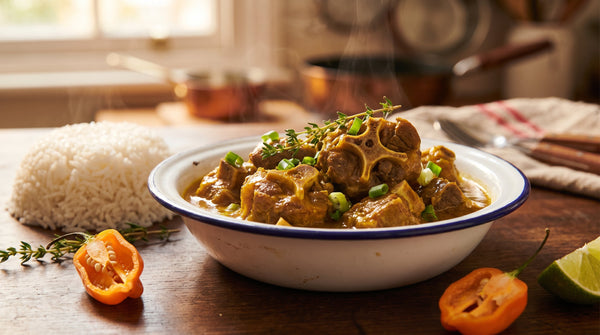
- My curry goat, the slow Sunday pot I grew up on is the Trinidad roti filling in all but name. Reduce the gravy a little more than the recipe says, then shred the meat off the bone.
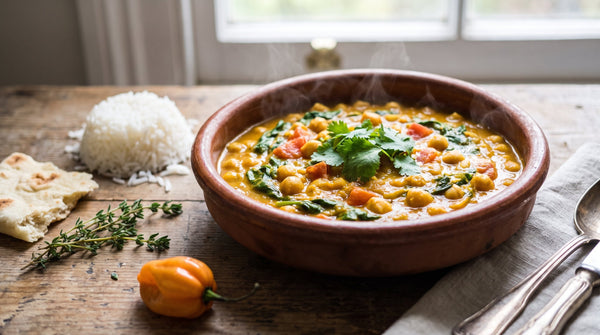
- My Caribbean chickpea curry is the channa filling. Add a diced potato with the chickpeas and let it go thick. This is the one to make for a Divali table.
- My poulet colombo, my mother’s Sunday curry is how I bring Guadeloupe into a Trinidad bread. The potato and christophine in it are already roti-shaped.
To fold one: lay the warm bread flat, spoon the curry along the middle, fold the two sides in, then fold the bottom up and roll it over. Wrap it in greaseproof paper straight away. The paper is structural.
If you cannot face the cooking, London has Trinidadian roti shops in Shepherd’s Bush, Finsbury Park, Stratford, Stoke Newington, Acton and Hanwell. Order buss up shut with a curry, pepper sauce on the side if you are new to it.
The pepper sauce on the counter
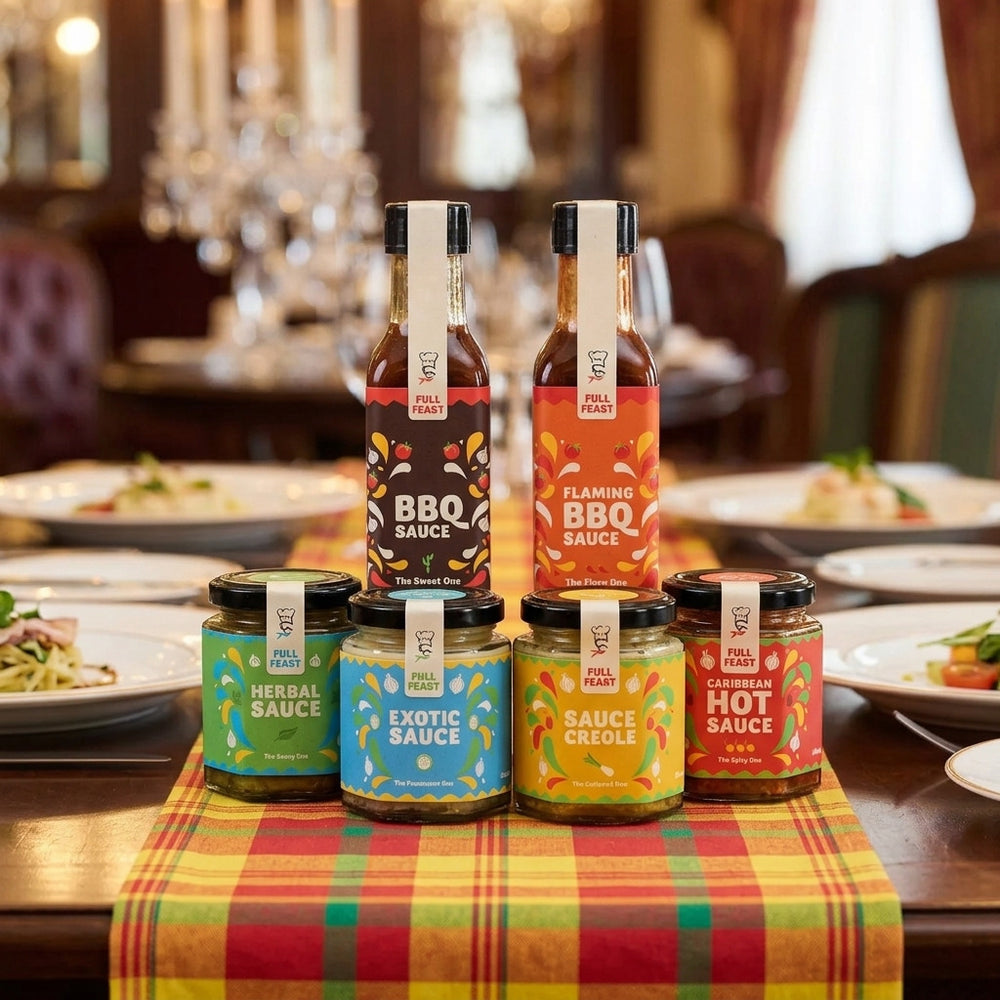
The last thing that goes on a roti before the paper is a spoon of pepper sauce, and in the Caribbean that means Scotch bonnet. It is the chilli I wrote about in my guide to the warm, the hot and the green spices of a Guadeloupe kitchen, and it is the whole point of the Full Feast Caribbean Hot Sauce: forty percent Scotch bonnet, slow-cooked white onion, garlic, vinegar, salt and white pepper. No fruit, no tomato, no allspice, no thyme. It is the fruity, fierce heat a roti wants.
Use it the Trinidad way: a thin line along the curry before you fold, so every bite has a little, not a puddle on the end. The same bottle does the same job on doubles, on a plate of colombo, and on the griot and pikliz I wrote about from Haiti, because the islands all agree on one thing: the pepper goes on at the end, and you choose how much.
FAQ
What is roti in Trinidad? In Trinidad, roti is both the Indian flatbread cooked on a tawa and the wrap made by folding that bread around a curry. The breads are sada, dhalpuri and paratha, called buss up shut. The wrap was invented in San Fernando in the 1930s or 1940s.
What is the difference between roti and doubles? Doubles are two small fried breads called bara filled with curried chickpeas and chutney, eaten in a few bites. A roti is a larger griddle-cooked flatbread wrapped around any curry, chicken, goat, shrimp or vegetable, and eaten as a meal.
What is buss up shut? Buss up shut is the Trinidadian name for paratha roti. The flaky bread is beaten with two wooden spoons after cooking until it tears apart, and the name means “busted up shirt”. It is eaten with saucy curries.
Is roti Jamaican or Trinidadian? Roti came to the Caribbean with Indian indentured labourers, and the wrap was invented in Trinidad. It is eaten most in Trinidad and Tobago, Guyana and Suriname, and spread to Jamaica later.
What sauce goes on a Caribbean roti? Pepper sauce, made with Scotch bonnet chillies, and mango chutney are the two things on every roti counter. The pepper sauce goes on in a thin line along the curry before the bread is folded.
One small thing to try this week
Find a Caribbean grocer and buy a pack of dhalpuri or buss up shut. Make a pot of my chickpea curry with a potato in it and let it go thick, thicker than you think.
Warm a bread in a dry pan, spoon the curry down the middle, a thin line of Caribbean Hot Sauce along it, fold the sides in and roll it up in greaseproof paper. Eat it standing up.
That is a roti. Then, on 8 November, make it again without meat and light a candle on the table. You will be eating what half of Trinidad is eating that night.
JP