Crisp Skin, a Sticky Rum Glaze and Plenty of Patience
I will tell you a secret about roast duck. Most people get it wrong, and they get it wrong in the same way every time. They cook it like a chicken. Hot oven, bird in, bird out, and then they wonder why the skin is soft and the meat is sitting in a pool of fat.
A duck is not a chicken. A duck is a bird wearing a winter coat. Your job is to take that coat off slowly, in the oven, until all that is left is a thin, crackling skin you can hear when the knife goes in.
Back home in Guadeloupe, Christmas was never about a bird. It was the ham, glazed and shining in the middle of the table. It was pois d’Angole, the pigeon peas, green and fresh from the market in December. It was boudin, eaten standing up, with a glass in the other hand, while my aunts sang the old carols. My mother cooked for seven children, and on those nights she cooked for half the street as well.
Then I came to England, and the first Christmas I cooked for an English family, somebody asked me for duck. Not turkey. Duck. I said yes, of course, because a cook always says yes. Then I went home and thought very hard about how to make a duck taste like my island.
The answer was in the cavity and in the glaze. Inside the bird: orange, onion, garlic, thyme and a few berries of allspice, the smell of my mother’s kitchen. On the outside, in the last twenty minutes: my BBQ Sauce, loosened with orange juice, painted on until the skin goes dark and sticky. There is rum in that sauce, and balsamic, and brown sugar. Against the richness of duck, it is exactly right.
This is my roast duck recipe. Give it time and it will give you everything.
Recipe at a glance
- Cuisine: Caribbean fusion (Guadeloupe flavours, a European roast)
- Prep: 20 minutes • Cook: 1 hour 40 minutes • Total: 2 hours 15 minutes, including resting
- Serves: 4
- Featured sauce: BBQ Sauce
- Heat level: 4/10, sweet and tangy rather than hot
- Diet: Gluten free, dairy free
What you’ll need
You need one good duck and not much else. Buy a whole duck of about 2 to 2.2kg; that feeds four people properly, with a little left over. If it comes with the giblets in a bag inside, take them out and keep the neck for a stock another day.
For the duck
- 1 whole duck, about 2 to 2.2kg, giblets removed
- 2 tsp flaky sea salt
- 1 tsp freshly ground black pepper
- 1 orange, halved
- 1 onion, peeled and quartered
- 4 garlic cloves, lightly crushed in their skins
- 6 sprigs of fresh thyme
- 6 allspice berries, lightly crushed
For the glaze
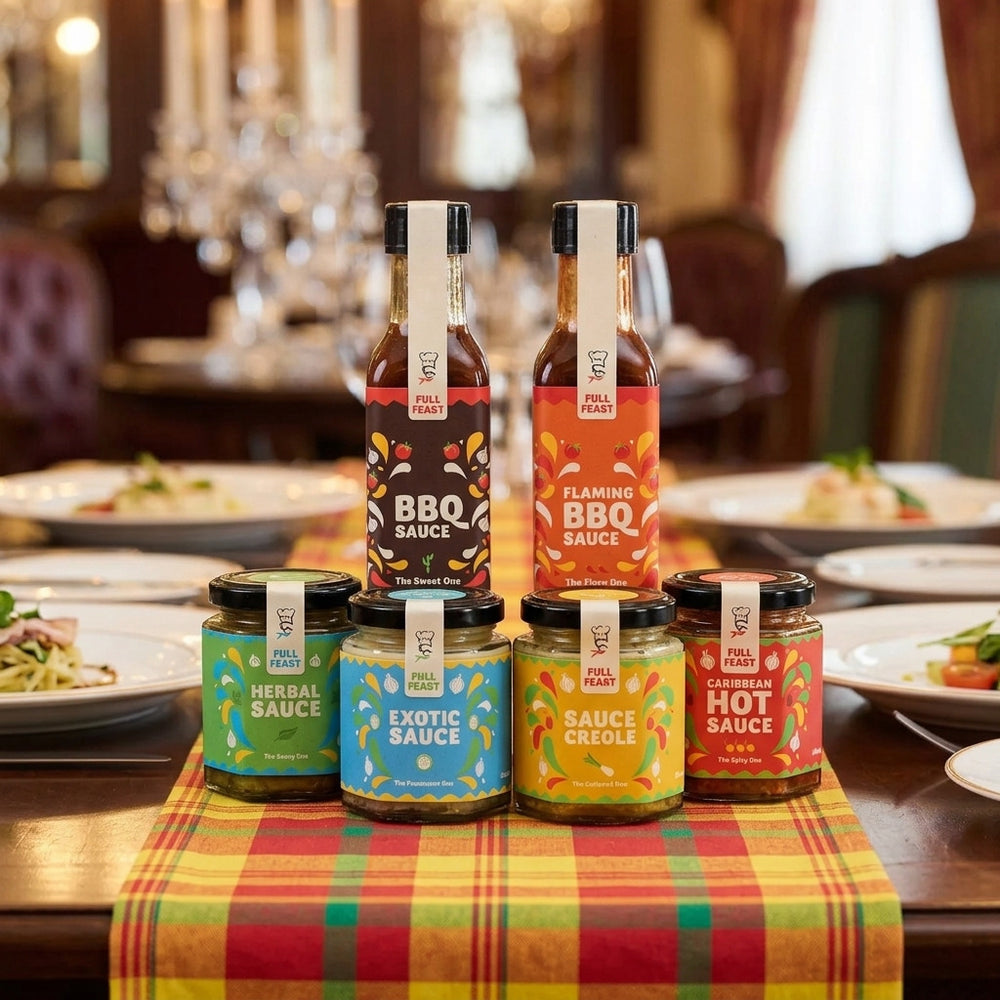
- 6 tbsp Full Feast BBQ Sauce
- 3 tbsp fresh orange juice (from a second orange)
- 1/4 tsp ground allspice
- Leaves from 2 sprigs of fresh thyme
You will also need
- A roasting tin with a rack, or a few thick slices of onion to lift the bird off the tin
- A clean heatproof jar for the duck fat
- A meat thermometer, if you have one. I strongly suggest you do.
How I make it
-
Dry the duck. If you can, do this the day before. Unwrap the duck, pat it very dry with kitchen paper, and put it on a plate in the fridge, uncovered, overnight. The cold air dries the skin, and dry skin is crisp skin. If you are cooking the same day, pat it dry and give it at least an hour uncovered in the fridge.
-
Warm the oven, take the chill off. Take the duck out of the fridge 30 minutes before cooking. Heat the oven to 200°C (180°C fan), gas mark 6. Pull away any loose lumps of fat from just inside the cavity; you can render those in a pan later for cooking.
-
Prick the skin. This is the part people skip. Take a skewer or the tip of a small sharp knife and prick the skin all over, especially on the legs and around the base of the breast where the fat is thickest. Go through the skin and the fat, but not into the meat. You are making doors for the fat to escape. Then lightly score the breast skin in a diamond pattern.
-
Season it. Rub the salt into the skin all over, really work it in, then the pepper. Fill the cavity with the orange halves, the onion, the garlic, the thyme sprigs and the crushed allspice berries. Already your kitchen smells like Sunday back home.
-
First roast, high. Put the duck on the rack in the roasting tin, breast side up, and roast for 30 minutes. You will hear it start to sizzle and spit. That is the fat leaving. Good.
-
Pour off the fat, then go low. Carefully lift the tin out and pour the fat from the tin into your heatproof jar. Turn the oven down to 180°C (160°C fan), gas mark 4. Roast for another 50 minutes, and pour off the fat once more halfway through. Do not throw that fat away. It is gold.
-
Make the glaze. While the duck roasts, put the BBQ Sauce, orange juice, ground allspice and thyme leaves in a small pan. Warm it for a minute over a low heat, stirring, until it is glossy and loose enough to brush. Keep about a third back for the table.
-
Glaze, twice. Take the duck out and brush half of the remaining glaze all over the skin. Back in the oven for 10 minutes. Brush on the rest, and give it 10 minutes more. Stay close now. There is sugar in the glaze and you want the skin dark and sticky, not black. If the wing tips start to catch, cover them with a little foil.
-
Check that it is cooked. Push the thermometer into the thickest part, between the leg and the breast, without touching the bone. You want 75°C. No thermometer? Pierce the same place with a skewer: the juices must run clear, with no pink, and the leg should feel loose when you wiggle it.
-
Rest it. Move the duck to a board and leave it for 15 minutes. Do not wrap it tight in foil or the steam will soften all that skin you worked for. Just leave it alone. The juices settle back into the meat.
-
Carve. Take off the legs first, then cut down either side of the breastbone and lift each breast away in one piece. Slice the breasts thickly, split the legs into thigh and drumstick, and pull out the orange and onion from the cavity to squeeze over. Warm the glaze you kept back and spoon it over at the table.
The role of BBQ Sauce in this dish
Duck is rich. Even when you have rendered it well, there is a depth to the meat that wants something sharp and something sweet to lean against. That is why the old French kitchens put orange with duck, and why my mother would have put fruit with it too.
My BBQ Sauce does both jobs at once. The balsamic vinegar brings the sharpness. The brown sugar and the tomato go sticky and dark in the heat of the oven and cling to the skin like lacquer. The rum gives a warm, round note underneath, the kind that makes people at the table ask what you did. The garlic and the English mustard keep it savoury, so the glaze never tastes like a dessert.
Thinned with fresh orange juice and finished with allspice and thyme from my own spice cupboard, it becomes a Caribbean glaze for a European roast. Two kitchens, one bird.
Roast duck for Christmas: planning the day
A whole duck is the easiest Christmas centrepiece I know, because it is small enough to fit in the oven next to everything else. Here is how I plan it.
- Christmas Eve: dry the duck in the fridge, uncovered, overnight. Make the glaze and keep it in a jar in the fridge.
- Two and a half hours before dinner: duck out of the fridge, oven on.
- The last hour: your potatoes go in the duck fat you have just poured off. Your vegetables go in alongside.
- While it rests: the oven is free and hot for 15 minutes. Finish the potatoes, warm the plates.
For four people, one duck is enough. For six or eight, roast two side by side rather than one giant bird. They cook evenly and you get four legs, which saves an argument.
Tips from my kitchen
- Never skip the drying. Wet skin steams. Dry skin crackles. A night in the fridge, uncovered, does more for your roast duck than anything you do in the oven.
- Glaze late, never early. If the glaze goes on at the start, the sugar burns long before the duck is cooked. Twenty minutes at the end is all it needs.
- Save every spoon of fat. Strain it, cool it, keep it in the fridge in a clean jar. It keeps for weeks and it makes the best roast potatoes you will ever eat.
- Defrost properly. If your duck is frozen, thaw it completely in the fridge before you start, which takes a day or more. Never roast it from frozen; the outside is done before the middle is safe.
- If you love this glaze, try it on my Caribbean glazed ham, the one that sits in the middle of every Christmas table back home. And if you only want duck for two on a weeknight, my Caribbean duck breast is done in half an hour.
What to serve it with
Roast duck wants something to soak up the juices and something sharp to cut through the richness.
- Roast potatoes in the duck fat. Par-boil them for 8 minutes, rough them up in the pan, and roast them in very hot duck fat for 45 minutes to an hour. Nothing else comes close.
- Honey roast parsnips. Sweet and soft at the centre. My honey roast parsnips share the oven happily.
- Rice and peas. If you want the table to taste of the Caribbean, my rice and peas is the side I would make. It drinks up the glaze.
- Something green and sharp. Braised red cabbage with a splash of vinegar, or watercress with orange segments and a little olive oil.
FAQ
How long to roast a duck?
For a 2 to 2.2kg duck, I roast it for about 1 hour 40 minutes in total: 30 minutes at 200°C (180°C fan), then about 50 minutes at 180°C (160°C fan), then 20 minutes more while I glaze it. As a rough guide, allow about 40 minutes per kilo plus 10 minutes, then trust the thermometer, not the clock.
What temperature should roast duck be when cooked?
For a whole roast duck, check the thickest part between the leg and the breast and look for 75°C. The juices should run clear with no pink. Duck breast cooked on its own in a pan is a different story, but a whole roasted bird should be cooked right through.
Why is my roast duck tough?
Usually it is one of two things. Either it was not cooked long enough for the fat under the skin to melt away, so the meat stays chewy and greasy, or it was carved straight out of the oven without resting. Give it the full time, low and slow after the first half hour, and rest it for 15 minutes before you cut it.
How do you get crispy skin on a roast duck?
Three things. Dry the skin overnight in the fridge, uncovered. Prick it all over so the fat can escape. And pour the fat off during the roast, so the bird is roasting, not frying in its own fat. Roast duck with crispy skin is all about that patience at the start.
Is this roast duck recipe gluten free?
Yes, as written. Full Feast BBQ Sauce is gluten free by lab test, and nothing else here contains gluten. Do note the allergens in the glaze: the BBQ Sauce contains mustard and sulphites (from the balsamic vinegar). If you serve it with gravy, check your stock is gluten free too.
Rich duck wants something sharp beside it, and for me that is my Caribbean red cabbage, braised with apple, orange and passion fruit until it shines.
Final word from me
A roast duck looks like a lot of work and it is not. It is mostly waiting, and the waiting is the best part, because the whole house starts to smell of orange, thyme and allspice. Dry it, prick it, give it time, and glaze it at the end. Then put it on the table and watch everybody go quiet.
Joyeux Noël from my kitchen to yours.
JP