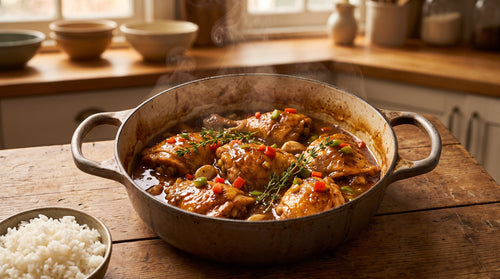
The Creole Stew My Mother Made on Fridays
When I was a boy in Guadeloupe, Friday belonged to fish. Every week, without fail. The boats came in to Pointe-à-Pitre in the early morning, and by the time the sun was high my mother had already been to the market and come home with something silver and fresh in her basket. Snapper, mostly. Sometimes a parrotfish if the man on the corner had one for her. She would carry it home wrapped in newspaper, and the whole walk back the kitchen was already cooking in her head.
I can still hear it. The lime hitting the fish. The garlic going under the knife. The pot warming on the stove while she hummed to herself. Court-bouillon was not a fancy dish in our house. It was a Friday dish. A family dish. The kind of food you make when you have six children to feed and not much money, but you have the sea, and you have time, and you have your mother's hands.
People hear "court-bouillon" and they think of the French thing, a thin liquid for poaching. That is not what I am talking about. In Guadeloupe, court-bouillon de poisson is a whole different animal. It is a stew. A rich, red, glossy creole broth, sharp with lime and warm with chilli, and the fish sits right in the middle of it soaking up everything. You eat it with white rice, and you mop the plate, and nobody says a word until the pot is empty.
Let me show you how my mother made it. The proper way. The way I still make it now, in my kitchen, thousands of miles from that market in Pointe-à-Pitre.
Recipe at a glance
- Cuisine: French Caribbean (Guadeloupe)
- Prep: 20 minutes • Cook: 30 minutes • Total: 50 minutes
- Serves: 4
- Featured sauce: Caribbean Sauce Creole
- Heat level: 2/10, mild and aromatic, not spicy
- Diet: Dairy free, pescatarian
What you’ll need
The beauty of court-bouillon is that it asks for very little. Fresh fish, a few aromatics, lime, and a good creole base. That base is where most people lose their way. Back home my mother built it from scratch every single time, with roucou (annatto) oil and a long list of herbs. I love her for it, but I will tell you the truth: a jar of Caribbean Sauce Creole gives you that same deep, traditional Guadeloupe flavour in one spoon, because that is exactly what it was made from. It is the dish in a jar.
Buy your fish whole if you can, and ask the fishmonger to gut and scale it and cut it into thick steaks. Snapper, sea bream, or grey mullet all work beautifully here.
- 1 whole snapper or sea bream (about 800g), gutted, scaled, cut into 4 thick steaks
- 3 limes (2 juiced, 1 for the table)
- 4 tablespoons Caribbean Sauce Creole
- 3 tablespoons vegetable oil
- 1 large onion, finely sliced
- 4 cloves garlic, crushed
- 4 ripe tomatoes, roughly chopped (or 1 x 400g tin chopped tomatoes)
- 1 tablespoon tomato purée
- 4 spring onions, chopped
- 2 sprigs fresh thyme
- 2 bay leaves
- 1 small bunch flat-leaf parsley, chopped
- 400ml water or fish stock
- Salt and black pepper
Method
You do not rush court-bouillon. The fish needs a little time to sit, and the broth needs a little time to find itself. Give it both and it will reward you.
-
Wash and season the fish. Put the fish steaks in a bowl and squeeze over the juice of one lime. Rub it into the flesh with your hands, then rinse under cold water and pat dry. This is how my mother taught me to clean fish, and I have never stopped doing it. Season the steaks well with salt and pepper and set them aside.
-
Make a quick marinade. In a small bowl, mix 2 tablespoons of Caribbean Sauce Creole with the juice of the second lime and a crushed clove of garlic. Spoon this over the fish and let it sit for 15 minutes while you start the broth. You do not skip this part. This is where the fish learns the flavour.
-
Start the base. Heat the oil in a wide, heavy pan over a medium flame. When it shimmers, add the sliced onion and a pinch of salt. Cook it gently for 5 minutes, until it goes soft and sweet. Listen to it. You want a slow sizzle, not a fierce one.
-
Build the creole flavour. Add the crushed garlic and the spring onions and stir for a minute, until the kitchen starts to smell of home. Now add the tomatoes, the tomato purée, the thyme, and the bay leaves. Let it all cook down for 5 minutes, pressing the tomatoes with your spoon until they collapse into a soft red sauce.
-
Add the sauce and the liquid. Stir in the remaining 2 tablespoons of Caribbean Sauce Creole, then pour in the water or fish stock. Bring it up to a gentle simmer and let it tick away for 8 to 10 minutes. Taste it. It should be rich, a little sharp, gently warm. Adjust the salt now, not later.
-
Lay in the fish. Slide the fish steaks into the broth in a single layer, along with any marinade left in the bowl. Spoon a little of the broth over the top of each piece so they are half covered. Do not stir from here. You let it be.
-
Simmer low and slow. Cover the pan and let the fish poach gently for 10 to 12 minutes. Low heat. No boiling. You want the flesh to cook through and stay together, not break apart. When it flakes at the touch of a fork, it is ready.
-
Finish with lime and parsley. Turn off the heat. Scatter over the chopped parsley and a final squeeze of lime. Let it rest, covered, for 2 minutes before you bring it to the table. That short rest lets everything settle into itself.
The role of Caribbean Sauce Creole in this dish
Court-bouillon lives or dies on its base. Back home that base took my mother years to perfect, layer upon layer of herbs, roucou, garlic and chilli, built slow over a low flame. That is the soul of Guadeloupe cooking, and it is exactly the soul we bottled in Caribbean Sauce Creole.
It is rich and warming, made for slow cooking, and in this dish it does two jobs. In the marinade it gets into the fish and seasons it from the inside. In the broth it gives you that deep, traditional creole backbone, the red colour and the rounded warmth, without you standing over the stove for an hour grinding spices. The heat is gentle here, around a 2 out of 10. This is a mild, aromatic sauce, built for flavour rather than fire, the kind of warmth that makes you reach for another spoon, not a glass of water.
So the only thing standing between you and a proper Guadeloupe fish stew is a good piece of fish and a little patience.
Tips from my kitchen
- Buy the freshest fish you can, whole if possible. The eyes should be clear and bright, the flesh firm. A whole fish cut into steaks holds together far better in the broth than thin fillets, which tend to fall apart.
- Do not stir once the fish goes in. I know it is tempting. Resist. Spoon the broth over the top instead. Stirring breaks the flesh and you lose those lovely whole pieces.
- The lime is not optional. That final squeeze at the end lifts everything. Without it the broth is flat. With it, it sings.
- Make it ahead if you can. Like most creole stews, court-bouillon is even better the next day, once the flavours have had a night to settle. Reheat it gently, never at a boil.
- Taste your salt early. Fish broth needs proper seasoning. Get it right at step five, before the fish goes in, so you are not fighting it at the end.
What to serve it with
In our house there was only ever one answer: white rice. Plain, fluffy, ready to soak up that red broth. You take a spoon of rice, a piece of fish, and a good ladle of the sauce over the top, and that is dinner. A simple green salad on the side, dressed with a little lime and oil, keeps it fresh.
If you want to go fully Guadeloupe with it, serve some boiled green bananas or a little provision, like yam or breadfruit, alongside. And if you like a fresh, herby lift on your rice or salad, a spoon of Fresh Herbal Sauce on the side is lovely, all green and bright against the rich red stew. Want to keep a few jars on hand for the week? Have a look at the full range.
FAQ
What is court-bouillon de poisson?
It is a Caribbean fish stew from Guadeloupe and Martinique, not to be confused with the French poaching liquid of the same name. The fish is simmered in a rich creole broth made from tomato, onion, garlic, lime, thyme and chilli. It is served with white rice and eaten as a main meal. In my home it was a Friday dish, every week.
What fish is best for court-bouillon?
Traditionally we use snapper, parrotfish or grouper back home. Here in the UK, snapper, sea bream or grey mullet all work beautifully. The key is freshness and thickness. Whole fish cut into thick steaks holds together in the broth far better than thin fillets.
Is this court bouillon recipe spicy?
No, it is mild and aromatic rather than spicy, around a 2 out of 10. Caribbean Sauce Creole brings gentle warmth and depth rather than heat. If you want more kick, add a little fresh chilli to the broth. It is a good choice if you are cooking for children or anyone who prefers a milder dish.
Can I make court-bouillon ahead of time?
Yes, and I would encourage it. Like most creole stews, the flavour deepens overnight. Make the broth and cook the fish, then cool it and keep it in the fridge for up to two days. Reheat gently, never at a hard boil, or the fish will break up.
Is court-bouillon gluten free?
This dish is dairy free and pescatarian. It is not suitable for a gluten-free diet, as Caribbean Sauce Creole contains cereals containing gluten. If you need this dish to be gluten free, please check with us before cooking, and always check your stock or stock cubes too.
Final word from me
This is the dish that taught me patience. You cannot rush it, you cannot fuss it, you just have to trust the pot and let it do its work, the way my mother did every Friday of my childhood. Make it once and you will understand why it stayed with me all these years. Cook it slow, eat it with people you love, and mop your plate clean. That is the Guadeloupe way.
JP