How Guadeloupe Pours It, and My Planteur for Eight
Ask for a rum punch in Barbados and somebody will recite you a rhyme. Ask for one in Guadeloupe and somebody will slide a bottle, a saucer of cut limes and a jar of cane syrup across the table, and leave you to it.
Same sea, same sugar cane, two different ideas of what a rum punch is. I grew up with the second and have lived in England long enough to love the first. So here are both, and then the rum punch recipe I make at home: a planteur, in a jug for eight.
One of sour, two of sweet
The English-speaking islands have a rhyme for it, and it is a good one: one of sour, two of sweet, three of strong, four of weak.
Sour is lime. Sweet is sugar syrup. Strong is rum. Weak is water, juice, or the ice melting into it. Some versions carry on with a dash of bitters and a sprinkle of spice, usually nutmeg grated over the top. You hear it in Barbados and in Jamaica, and if you have had a Jamaican rum punch at a party in Britain, there is a fair chance somebody was counting under their breath while they made it.
What I like about the rhyme is that it is a ratio, not a recipe. One glass or a bucket, with whatever rum is in the house. That is exactly why it travelled.
In the French islands, the rum comes first
On our side of the Caribbean, the rum is different before anybody has squeezed a lime.
Most rum is made from molasses, the dark syrup left behind once the sugar has been taken out of the cane. Rhum agricole is made from the fresh juice of the cane, pressed, fermented and distilled. It tastes green, like cut grass, with a peppery edge. The white version is usually bottled at 50 per cent, and it is meant to be.
Guadeloupe makes both kinds. Its rum is protected by a geographical indication, Rhum de la Guadeloupe, which covers agricole and molasses rum made on the islands. Martinique went further: its rhum agricole has held an appellation d’origine contrôlée since 1996, the same French system that protects Champagne.
That rum changes what you do with it. You do not drown agricole in four parts of weak. You let it talk.
Ti’ punch: each one prepares his own death
Ti’ punch is short for petit punch, small punch, and it is the drink of the French Antilles. White rhum agricole, a coin of lime, cane syrup. No juice, no water. Traditionally no ice either, though plenty of people take it with ice now.
The coin of lime matters: a small disc cut from the side of the fruit, mostly peel with a little flesh, pressed into the syrup so the oil from the skin comes out. Then the rum.
Then there is the custom. Chacun prépare sa propre mort: each one prepares his own death. The host puts the bottle, the limes, the syrup and the glasses on the table, and makes nobody’s drink. You build your own, as strong or as sweet as you like, and whatever happens next is your own business.
It is a joke, and it is also good manners. Nobody is ever poured more than they wanted.
Ti’ punch is what comes out before the meal, with something hot beside it: a plate of accras, a few slices of boudin.
Planteur: the jug for the whole table
The planteur is the other one, and it is what I make when there are more than four people in the house.
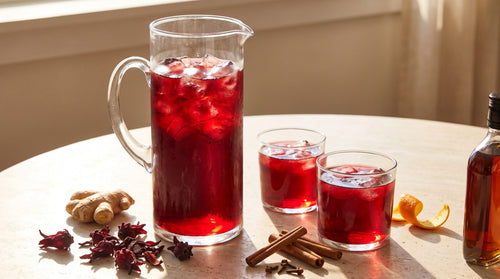
Planteur is French for planter, and the drink is a cousin of the planter’s punch. It is rum with fruit (orange, pineapple, guava, passion fruit), sweetened with cane syrup and perfumed with cinnamon, nutmeg and vanilla. Every family has its own version.
Where the ti’ punch is a short glass for the rum lover, the planteur is a long one for everybody. The rum sits underneath the fruit instead of out in front, which is its charm and its danger.
And at Christmas, shrubb
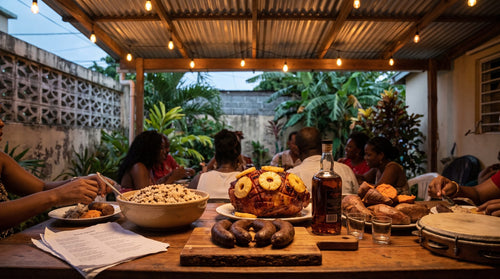
In December the bottle on a Guadeloupean table is shrubb: rum left for weeks with orange peel, sugar and spice until it turns amber and sweet. The whole season, from the chanté Nwèl singing at the end of November onwards, is in Christmas in the Caribbean. The English-speaking islands have the red hibiscus drink instead, and sorrel has its own story.
Shrubb needs starting weeks ahead. A planteur needs an afternoon. If you are hosting this Christmas and want our side of the Caribbean in the glasses, this is the one to make.
My rum punch recipe, at a glance
My party jug. It is stronger than it tastes, so keep an eye on it.
- Cuisine: French Caribbean (Guadeloupe)
- Makes: about 1.7 litres, 8 glasses over ice
- Prep: 15 minutes • Warm the syrup: 5 minutes • Chill: at least 2 hours
- Strength: about 2 UK units per glass with 40% rum
- For: adults 18 and over, with an alcohol-free version below
What you’ll need
A big UK supermarket has almost all of this. The exceptions are the cane syrup, which has an easy swap in the list, and the rum I like best: a golden rhum agricole (ambré), which independent spirits shops and online merchants carry. A golden molasses rum from the supermarket works too, rounder and sweeter, and it still makes a fine punch. Guava juice sits in the world food aisle or with the juices, and mango juice does the job if there is none.
- 400ml golden rum, 40% ABV (rhum agricole ambré if you can find it)
- 500ml orange juice, freshly squeezed or not from concentrate
- 400ml pineapple juice
- 200ml guava juice (or mango juice)
- 4 ripe passion fruit
- Juice of 2 limes (about 60ml)
- 80ml cane syrup (sirop de canne), or 60g demerara sugar dissolved in 40ml hot water
- 1 cinnamon stick
- 1 vanilla pod, split lengthways
- ¼ whole nutmeg, finely grated, plus extra to serve
- Plenty of ice
- Orange slices, lime slices and pineapple wedges, to serve
How to make rum punch, the planteur way
-
Warm the spice into the syrup. Put the cane syrup (or the sugar and hot water) in a small pan with the cinnamon stick, the split vanilla pod and the grated nutmeg. Warm it gently for 5 minutes without letting it boil, until the kitchen smells of December. Take it off the heat and let it cool completely.
-
Passion fruit into the jug. Halve the passion fruit and scrape the pulp and seeds into a jug that holds at least 2 litres. The seeds stay in. They are part of the drink.
-
Add the lime. Squeeze in the lime juice. Sour goes in early so you can judge everything else against it.
-
Pour in the fruit juices. Add the orange, pineapple and guava juice and stir well.
-
Sweeten to taste. Pour in three quarters of the cooled syrup, with the cinnamon stick and vanilla pod. Stir and taste. You want brightness with a little sharpness at the edges. If it coats your tongue, it is already too sweet. Add the rest of the syrup only if it needs it.
-
Now the rum. If you want an alcohol-free jug as well, pour its share off first (see below). Then pour the rum into the main jug and stir.
-
Chill. Cover and put the jug in the fridge for at least 2 hours, overnight if you can. The spice keeps working the whole time. Lift out the cinnamon stick and vanilla pod before serving.
-
Serve it cold. Fill the glasses with ice. Stir the jug, because the fruit settles, and pour. Grate a little fresh nutmeg over each glass and finish with a slice of orange or lime and a wedge of pineapple.
The ti’ punch variant
One glass, and here the rum has to be white rhum agricole. That is the whole point of it.
- 40ml white rhum agricole, 50% ABV
- 1 to 2 teaspoons cane syrup
- 1 coin of lime, cut from the side of the fruit with the peel on
Put the lime and the syrup in a small, heavy glass and press the lime with the back of a spoon to release the oil from the peel. Add the rum and stir with the spoon until the syrup disappears into it. Ice if you like it, none if you want it the old way.
Better still, put everything on the table and let your guests prepare their own.
At 50 per cent, those 40ml are 2 units on their own, in a glass you can finish in three sips. Treat it with respect.
Alcohol-free planteur for drivers and children
Do not make a sad version for the people who are not drinking. Make it from the same base, so it tastes like the same drink.
For two small glasses, follow the method to the end of step 5, then pour a quarter of the jug (about 330ml) into a separate jug before any rum goes near it. Use 300ml of rum in what is left, so the main jug keeps the same strength for six.
For a whole alcohol-free jug of eight, leave out the rum completely and remember three things:
- Add 3 thin slices of fresh ginger to the syrup while it warms, for the bite the rum would have given
- Use the vanilla pod, not vanilla extract, because extract is made with alcohol
- Just before serving, top up with 400ml cold sparkling water or ginger ale
Serve it in the same glasses, with the same ice and the same fruit, so nobody feels they are at the children’s table. And label the jugs. You will thank me at ten o’clock.
How strong is it?
Here is the arithmetic, because a fruit punch hides its rum better than anything else you will pour this year.
A UK unit is 10ml of pure alcohol. My jug has 400ml of rum at 40 per cent, which is 160ml of alcohol: 16 units shared across 8 glasses, so 2 units a glass. That is about the same as a 175ml glass of 12 per cent wine. Made with a 50 per cent agricole, it goes up to 2.5 units a glass. For a gentler jug, use 300ml of rum and add 100ml more pineapple juice, and you are at 1.5 units a glass.
The UK guideline is not to drink more than 14 units a week on a regular basis, spread over three days or more. Planteur is for adults, 18 and over. And if you are driving, the alcohol-free jug is yours for the evening. Not one small glass of the other. That is all I will say about it.
What to eat with it
Rum on an empty stomach is how a good party goes wrong, so put the food out from the start.
With a ti’ punch, nothing beats accras de morue, the little saltfish fritters, straight from the oil. Mine carry a spoonful of Caribbean Hot Sauce in the batter, and I put a small dish of it on the table for dipping as well. Beside the planteur, try bananes pesées, green plantain fried twice until crisp: salt against all that fruit.
FAQ
What are the ingredients in rum punch?
At its simplest: rum, lime, sugar and something to lengthen it, whether juice or water, with a little grated nutmeg on top. That is the rhyme. A planteur adds orange, pineapple, guava and passion fruit, with cinnamon and vanilla warmed into the syrup.
What rum is best for rum punch?
It depends which punch. For a ti’ punch it has to be white rhum agricole, nothing else. For a planteur I reach for a golden agricole, and a golden molasses rum is a perfectly good second choice. For the rhyme, use whatever decent rum is in the house. That was always the point of it.
Can I make rum punch the day before?
Yes, and it is better for it. Make the jug the day before, keep it covered in the fridge, and only put ice in the glasses, never in the jug, or the second round will be watery.
Last word from me
The rhyme and the custom are saying the same thing in two languages. Make it balanced, and let people choose for themselves.
Put the jug in the middle of the table, get the food out early, and look after whoever is driving. Santé.
JP