A Sticky Caribbean Glaze for the Christmas Table
I will tell you a secret about pigs in blankets. On Christmas Day in a British house, nobody is really there for the turkey. The little sausages in bacon are the first thing to go, picked off the tray by people who swear they are only having one.
I did not grow up with them. Christmas in Guadeloupe is a pork Christmas too, but it looks different. There is the ham, glazed and finished in the oven until the top goes dark and sticky. There is boudin créole, there is pork stew, and there is rice with pois d’Angole, the pigeon peas that tell you it is December and not just another Sunday. I wrote about our Christmas table in Christmas in the Caribbean, if you want to see what our table looks like.
So the first time a plate of pigs in blankets came round at an English Christmas, I understood them straight away. Pork, salt and smoke, and something you can eat with your fingers while you talk. Small food for a long day.
A word on the name, because it changes when you cross the Atlantic. In America, pigs in a blanket are sausages wrapped in pastry or dough. Here in Britain the blanket is bacon, usually smoked streaky wound around a chipolata. I am with the British on this one.
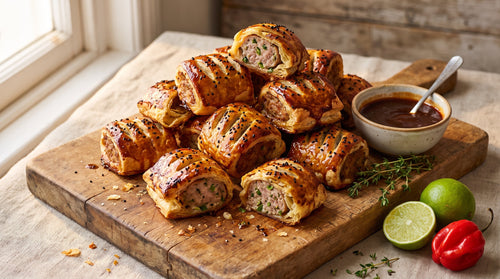
What I brought to them is the thing we do to the Christmas ham back home: sugar on the outside, finished hot so it turns to lacquer. I roast the pigs in blankets plain until the bacon has started to crisp, then brush them twice with a glaze of my Caribbean BBQ Sauce and honey for the last few minutes. That timing is everything. Put a sweet glaze on at the start and it burns long before the sausages are cooked. Put it on at the end and it goes sticky and glossy, dark only at the edges, and the tray is empty before the gravy reaches the table.
Let me show you how I do it.
Recipe at a glance
- Cuisine: Caribbean fusion (a British Christmas classic with an island glaze)
- Prep: 15 minutes • Cook: 30 minutes • Total: 45 minutes
- Serves: 8 as a Christmas side (24 pigs in blankets, three each)
- Featured sauce: Caribbean BBQ Sauce
- Heat level: 4/10, mild, more smoke and sweetness than fire
- Diet: dairy free if your sausages are (check the pack); not gluten free as written
What you’ll need
Three things make this dish: chipolatas, smoked streaky bacon and the glaze. Streaky has the fat to wrap and crisp, and the smoke is what makes a pig in blankets taste like Christmas.
Buy the best chipolatas you can afford, with a high pork content. Cheap ones shrink and go soft inside the bacon. Two packs of twelve gives you 24, enough for eight people.
A plain word on allergens before you shop. Most chipolatas contain rusk, which is made with wheat flour, and a sulphite preservative. My Caribbean BBQ Sauce declares wheat, mustard and sulphites on its label. So this recipe is not gluten free as written, and it is not for anyone avoiding wheat, mustard or sulphites. Read every pack you buy, the bacon included, because recipes change.
For the pigs in blankets
- 24 pork chipolatas (two packs of 12)
- 12 rashers smoked streaky bacon
- Freshly ground black pepper
For the sticky glaze
- 4 tbsp Caribbean BBQ Sauce
- 2 tbsp runny honey
- 1 tsp lime juice
- ½ tsp fresh thyme leaves, finely chopped (or a pinch of dried)
- A pinch of ground allspice
You will also need a large roasting tray lined with baking paper. The glaze is mostly sugar, and sugar welded to a bare tray at nine o’clock on Christmas night is nobody’s idea of a present.
How I make it
-
Heat the oven. Set it to 200°C (180°C fan), gas 6, and line your largest roasting tray with baking paper. On Christmas Day I cook these while the turkey rests, so the oven is free and they reach the table hot.
-
Stretch and halve the bacon. Lay each rasher flat on a board and run the back of a knife firmly along it two or three times. It gets thinner and longer, so it wraps tighter and crisps faster. Then cut every rasher in half across the middle, so you have 24 short pieces.
-
Wrap the chipolatas. Take a chipolata and wind a piece of bacon around it in a spiral, overlapping a little as you go. Sit it on the tray with the loose end of the bacon underneath, where the weight of the sausage holds it shut. You do not need cocktail sticks. Grind over some black pepper, but no salt: the bacon and the sausage have plenty already.
-
Give them room and roast. Space them out on the tray with a finger’s width between each one. Crowded together they steam, and the bacon stays pale and soft. Roast for 20 minutes, until the bacon is starting to crisp and the fat is running.
-
Mix the glaze. While they roast, stir the Caribbean BBQ Sauce, honey, lime juice, thyme and allspice together until smooth and loose enough to brush. If your honey is the set kind, warm it for a few seconds first. Then divide the glaze between two small bowls, one for each coat.
-
Turn and glaze. Take the tray out, turn each one over with tongs, and brush them with the first bowl of glaze. Back into the oven for 5 minutes.
-
Glaze again and watch. With a clean brush, paint on the second bowl of glaze, letting it pool a little on top, and return the tray for a final 3 to 5 minutes. Stay close for this part. You want the glaze bubbling and sticky, dark at the edges, not black. The moment the kitchen smells of caramel rather than of sauce, the glaze is done.
-
Check they are cooked. Cut into the thickest one. The sausage should be steaming hot all the way through, with no pink in the middle, and the juices should run clear. If you have a probe thermometer, look for 75°C in the centre. Chipolatas are thin and will usually be there by now, but on Christmas Day I check anyway.
-
Rest and serve. Leave them on the tray for 2 minutes so the glaze sets and stops being molten. Then pile them onto a warm plate and spoon any sticky glaze from the paper over the top.
How long to cook pigs in blankets
It is the question everybody asks in December, so here it is in one place, for standard chipolatas wrapped in half a rasher of streaky bacon. Every oven runs a little differently: treat the times as a guide and the checks in step 8 as the rule.
- Oven, straight from the fridge: 200°C (180°C fan), gas 6. Roast for 20 minutes, glaze, give them 5 minutes, glaze again, then 3 to 5 minutes more. About 30 minutes in total.
- Air fryer: 180°C for 10 minutes, turning halfway, then glaze and give them 2 to 3 minutes more. About 13 minutes in total.
- Frozen at home: defrost fully in the fridge first (more on this below), then cook exactly as the oven method.
- Full-size sausages: wrapped in a whole rasher, they need longer. Go by the checks in step 8, not the clock.
Air fryer pigs in blankets
On Christmas Day the oven is full and the air fryer is sitting on the counter doing nothing. Put it to work. It crisps bacon beautifully.
Heat the air fryer to 180°C. Lay the pigs in blankets in the basket in a single layer, seam side down, with a little space between them. In most baskets that means two or three batches, which is fine, because the first batch keeps warm on a plate under foil. Cook for 10 minutes, turning them halfway.
Then brush them with glaze, spooning a fresh portion into a small bowl for each batch, and give them 2 to 3 minutes more. Not longer. The fan drives hot air straight at the sugar, so the glaze darkens much faster than it does in the oven. One coat is enough here, and keep the basket where you can see it.
Air fryers vary a lot from one model to the next, so check the first batch with the test in step 8.
Make ahead and freezing
Christmas morning is not the time to be wrapping 24 sausages.
The day before. Wrap the chipolatas, lay them seam side down on the lined tray, cover it well and keep it on the bottom shelf of the fridge, below anything cooked or ready to eat. Mix the glaze, put it in a jar with a lid and keep that in the fridge too. On the day, the tray goes straight from the fridge into the hot oven and you carry on from step 4. Wrap them well inside the use-by date on the sausage pack, not on the last day of it.
Freezing them raw. Pigs in blankets freeze well before they are cooked. Wrap them no later than the use-by date on the sausage pack, lay them on a lined tray so they are not touching, and freeze until solid. Then tip them into a labelled freezer bag (freezing them on the tray first stops them welding into one pork brick) and use them within the freezing time printed on your sausage pack. If either pack says the meat has been frozen before, do not freeze it again.
Cooking from frozen. UK food safety advice is to defrost frozen raw meat thoroughly before cooking, unless the manufacturer’s instructions say it can be cooked from frozen. A sausage you froze yourself has no such instructions, and an icy middle cooks unevenly. So I defrost mine overnight in the fridge, on a plate on the bottom shelf, and cook them within 24 hours, using the oven method. If you buy pigs in blankets ready-made and frozen, follow the instructions on that pack instead. And once raw meat has defrosted, it does not go back in the freezer.
How many pigs in blankets per person
My rule for Christmas dinner is three each, when they sit beside a full roast with turkey and all the trimmings. Two looks mean. Four, and nobody finishes their sprouts, which some people would call a win.
At a party, where they go round with the drinks, I count two each per round and expect at least two rounds. And always make a few extra for the cook.
So the 24 in this recipe feed eight at the Christmas table. For sixteen, double everything, use two trays, and swap them between shelves halfway through so they cook evenly.
The role of Caribbean BBQ Sauce in this dish
A plain pig in blankets is pork and salt and smoke. Lovely, but it is all one note, and by the third one your mouth is asking for something else.
My Caribbean BBQ Sauce is that something else. It is built on tomato and brown sugar, with balsamic vinegar, rum, garlic and mustard, so when it meets hot bacon it does two jobs at once. The sugar caramelises onto the fat and turns it sticky. The vinegar and the mustard cut straight back through the richness, so the fourth one tastes as good as the first.
The honey helps the glaze cling and deepens the shine. The lime stops it tasting like pudding. The allspice brings a warm, clove-like note that sits beautifully with pork, and it is the quiet Caribbean accent in the bowl.
That sugar is also why the glaze waits until the end. Eight to ten minutes in a hot oven turns it to lacquer. Thirty minutes turns it to charcoal.
It is a mild glaze, so the children and the grandparents can eat these with everyone else. The tips below show you how to push it hotter.
Tips from my kitchen
Stretch the bacon. It sounds fussy. It takes one minute, and it is the difference between bacon that clings and crisps and bacon that unravels in the oven.
Seam side down, every time. That is your cocktail stick. The sausage sits on the loose end and holds it shut while the fat sets.
For more fire. Swap half the sauce in the glaze for my Spicy Caribbean BBQ Sauce, which has the same smoky depth with real chilli heat behind it. Or keep the glaze as it is and put a jar of Caribbean Hot Sauce on the table for the brave.
Two bowls, two brushes. The first coat goes onto sausages that are not yet cooked through, so that brush never goes back into the glaze for the second coat. Split the glaze before you start and pick up a clean brush for round two.
What to serve it with
On Christmas Day, everything: turkey, roast potatoes, sprouts, gravy. If you are cooking a ham this year, my gammon glaze uses the same idea with passion fruit, and the two together make a proper pork Christmas, much closer to the way we keep it back home.
At a party, put them out on a board with cocktail sticks and something cold and sharp alongside, like pickled onions or cornichons. They go with a glass of rum punch better than they have any right to, and in December I like them next to a jug of sorrel.
If the honey in this glaze has you thinking about honey with real heat, make a jar of my hot honey and drizzle it over a tray of plain roasted ones for a change.
And if any survive to Boxing Day, which I doubt, cool them quickly, keep them covered in the fridge, then slice them into my leftover turkey curry and heat until steaming hot.
FAQ
How long do you cook pigs in blankets in the oven?
About 30 minutes at 200°C (180°C fan), gas 6, for standard chipolatas in half a rasher of streaky: 20 minutes plain, then two coats of glaze over the last 8 to 10. Check the thickest one is steaming hot through, with no pink and clear juices.
Can I make pigs in blankets the day before?
Yes, and I would. Wrap them on Christmas Eve, cover the tray and keep it on the bottom shelf of the fridge, with the glaze in a jar beside it. On the day they go straight from the fridge into the oven.
Can you freeze pigs in blankets and cook them from frozen?
You can freeze them raw, and they freeze well. But defrost home-frozen ones overnight in the fridge and cook them within 24 hours, rather than cooking them from frozen. Only a pack whose instructions say it can be cooked from frozen should go straight into the oven.
How many pigs in blankets per person?
Three each beside a full Christmas dinner, and two each per round at a party. Then add a few for the cook, because there is always somebody hovering by the oven.
Are pigs in blankets gluten free?
Usually not, and this recipe is not. Most chipolatas contain rusk made with wheat flour, plus sulphites, and my Caribbean BBQ Sauce declares wheat, mustard and sulphites. Gluten-free chipolatas do exist, but swapping the sausages alone does not make this dish gluten free, because the glaze still contains wheat.
Final word from me
Pigs in blankets are not a clever dish. They are a small, generous one, and Christmas is built out of small generous things. Wrap them the day before, glaze them at the very end, and put the tray down where people can reach it.
Then step back. They will be gone before you sit down, and that is how you know you did it right.
Joyeux Noël. Come and cook with me.
JP