Carrots on the Same Tray and a Hot Glaze at the End
It is Christmas morning, and the kitchen is the busiest room in the house. The turkey has the middle shelf, the potatoes are waiting for the hot fat, and on the counter sits a bag of parsnips that everybody forgets until the last half hour. Then the honey roast parsnips reach the table, and they are the first dish to empty.
I did not grow up with parsnips. Back home in Guadeloupe the roots on the table are igname and patate douce, yam and sweet potato, and madère, which is our name for taro. The parsnip is something I met in England, and the first one I roasted properly surprised me. It tasted as if it already knew about sugar.
It does. Gardeners here are told to wait until after the first heavy frost to lift them, because the cold brings out their sweetness. So honey on a parsnip is an easy idea to love. The trouble is that too many end up burnt, because the honey goes on at the start and spends forty minutes catching on the tray.
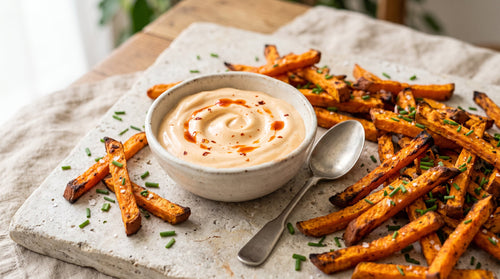
I do it differently. I roast parsnips and carrots plain in hot oil until they are crisp at the edges and soft in the middle. Only then do they get the glaze: runny honey warmed with my Caribbean Hot Sauce and a little thyme, spooned over for the last five to eight minutes. It goes sticky without burning, and the scotch bonnet arrives a second after the sweetness, warm rather than fierce. On a plate of rich Christmas food, that is exactly what you want.
Let me show you how I make it.
Recipe at a glance
- Cuisine: Caribbean fusion (a British Christmas side with an island glaze)
- Prep: 15 minutes • Cook: 40 minutes • Total: 55 minutes
- Serves: 6 as a Christmas side
- Featured sauce: Caribbean Hot Sauce
- Heat level: 7/10 in the jar, but one tablespoon spread across a whole tray of roots is a gentle glow, not a burn
- Diet: vegetarian and dairy free (not vegan, because of the honey). For allergens, check the label on the jar of sauce
To par-boil or not: my answer
Par-boiling means a few minutes in boiling salted water before the oven. You drain the vegetables, let them steam dry and shake the colander so the outsides go rough. Those rough edges turn crisp in the hot oil, and the half-cooked middle roasts up soft and fluffy. It also saves oven time on the day: about 25 minutes before the glaze, against 35 to 40 from raw.
Roasting from raw is simpler, with less washing up. The edges come out chewier and more caramelised. On an ordinary Sunday, this is often what I do.
On Christmas Day, I par-boil. Every time. The texture is better, and it lets me do nearly all the work the day before. If you would rather roast them raw, there is a note under the method.
What you’ll need
Choose parsnips that are firm, not bendy, and of a medium size. The very big ones can have a tough, woody core. I use roughly three parts parsnip to two parts carrot, because the parsnips are the ones people fight over.
For the glaze, use a mild runny honey from any supermarket. The Caribbean Hot Sauce brings the scotch bonnet, the vinegar and the garlic, so there is nothing to chop but a little thyme. Shake the jar well before you measure.
Use sunflower or rapeseed oil, which can take the high heat. If you keep goose fat for the potatoes, it works here too, but then the dish is no longer vegetarian.
If you are cooking for anyone with an allergy, check the label on the jar of sauce for allergens, and do the same for everything else on the Christmas table.
For the vegetables
- 750g parsnips (about 5 medium)
- 500g carrots (about 5 medium)
- 4 tbsp sunflower or rapeseed oil
- 1 tsp fine sea salt, plus more for the cooking water
- Freshly ground black pepper
- 4 sprigs fresh thyme
For the hot honey glaze
- 4 tbsp runny honey
- 1 tbsp Caribbean Hot Sauce, shaken well (2 tbsp for proper heat)
- Leaves from 2 sprigs fresh thyme (or ¼ tsp dried)
- A squeeze of lime, to finish (optional)
If you already have a jar of my hot honey in the fridge, use 5 tablespoons of it in place of the honey and the sauce, and warm it with the thyme in step 6.
You will also need your largest roasting tin, or two smaller ones.
How I make it
-
Heat the oven and the oil. Set the oven to 200°C fan (220°C, gas 7). Pour the oil into your largest roasting tin and put it in the oven to get properly hot while you prepare the vegetables.
-
Peel and cut to even sizes. Top and tail the parsnips and carrots and peel them. Cut each parsnip where the thick top meets the thin tail. Halve the tail lengthways and cut the top into quarters lengthways, so you have batons about 1.5cm thick at the widest point and 7 to 8cm long. If a big parsnip has a hard, woody centre, cut it out. Cut the carrots to the same length but a little thinner, because they are denser and take longer to soften. Even thickness is what makes the whole tray finish at once.
-
Par-boil. Bring a large pan of well-salted water to the boil. Add the carrots first and give them 2 minutes, then add the parsnips and boil for 3 minutes more. The edges should be just soft, while the point of a knife still meets resistance in the middle.
-
Steam dry and rough them up. Drain everything in a colander and leave it for 3 to 5 minutes, so the steam carries the water away. Then give the colander two or three gentle shakes to fluff the outsides. Wet vegetables stew in the oil instead of crisping.
-
Into the hot oil. Take the tin out carefully and tip in the vegetables. They should sizzle as they land. Turn them with tongs so every piece is coated, spread them out in a single layer with a little space between them, then season with the salt and plenty of black pepper and tuck in the thyme sprigs. Roast for 25 minutes, turning them once halfway, until they are golden at the edges and nearly tender.
-
Warm the glaze. While they roast, put the honey, hot sauce and thyme leaves in a small pan over the lowest heat and stir for a minute, just until the honey is loose and the sauce is stirred through. Do not let it boil. Short bursts in the microwave work too.
-
Glaze for the last minutes only. Take the tin out and close the oven door so you keep the heat. (No glazed pieces for a baby under 12 months: see my note on honey further down.) Spoon the warm glaze over the vegetables and turn them quickly so everything shines. Back into the oven for 5 to 8 minutes, and look at them after 5. You want the glaze bubbling and sticky, dark at the thin tips but not black. Honey is mostly sugar, and at this heat it goes from caramel to bitter very quickly, which is why it waits until now.
-
Check and finish. Push the tip of a knife into the thickest piece of carrot, because the carrots are always the last to soften. It should slide in with no resistance. Pick out the thyme stalks, add a squeeze of lime if you like a little brightness, and taste for salt.
-
Serve straight away. Tip everything into a warm dish and scrape the sticky bits from the tin over the top. The cook is allowed the first piece.
Roasting from raw instead. Skip steps 3 and 4. Toss the raw batons in the hot oil, season them and roast for 35 to 40 minutes, turning once or twice, until golden and tender. Then glaze exactly as in step 7.
Honey glazed carrots on the hob
When there is no space left in the oven, I make honey glazed carrots in a frying pan. Cut 500g of carrots into batons or 1cm coins. Put them in a wide pan with 150ml of water, 1 tablespoon of oil and a pinch of salt. Bring it to the boil, cover and simmer for 5 to 6 minutes, until the carrots are just tender. Take the lid off, turn up the heat and let the water bubble away to a couple of tablespoons. Add 2 tablespoons of runny honey, 1 teaspoon of Caribbean Hot Sauce and a few thyme leaves, then keep the pan moving for 2 to 3 minutes until it turns into a glossy glaze. Take it off the heat the moment it looks syrupy, before it catches. That serves four.
Honey roast parsnips on Christmas Day
With one oven, Christmas lunch is a juggle. This is how I run it.
The turkey comes out first, to rest under foil. While it rests, I turn the oven up to 200°C fan and heat the tin of oil. The par-boiled parsnips and carrots go in and roast for 25 minutes, a few more if they came straight from the fridge, and the gravy gets made in that window. Then the glaze goes on for the last 5 to 8 minutes, and everything reaches the table hot.
If your roast potatoes have the top shelf, give the parsnips the shelf below and swap the trays when you turn them. My pigs in blankets are a last-half-hour job too, but their recipe uses a slightly lower heat, so put them on the lowest shelf and check them a few minutes early.
They can share the oven with the turkey from earlier on, too. If the turkey is roasting at a lower temperature, they will take longer, so start them sooner and judge them by colour and the knife, not the clock. The glaze still goes on at the very end.
Make ahead, freezing and reheating
The day before. Peel, cut and par-boil the vegetables on Christmas Eve, then steam dry them as in step 4. Spread them on a tray to cool quickly, then put them in the fridge in a covered container within two hours. On the day they go straight from the fridge into the hot oil, with a few extra minutes in the oven. Mix the glaze in a lidded jar and keep it in the fridge too, then warm it gently, because honey thickens in the cold.
Freezing. Par-boiled parsnips and carrots freeze well. Once they have steamed dry and cooled, freeze them on a lined tray so the pieces do not touch, then tip them into a labelled freezer bag and use them within a month for the best texture. Roast them from frozen in the hot oil (stand back, because they spit) and allow about 10 minutes more before the glaze.
Leftovers. Cool any leftovers and get them into the fridge within two hours, then eat them within two days. Reheat them only once, until they are steaming hot all the way through. A tray in a hot oven for about 10 minutes brings back some crispness. Leftover parsnips are lovely in bubble and squeak on Boxing Day, and if that is where they go, the frying pan is their one reheat.
A note on honey and babies
Never give honey to a baby under 12 months. The NHS explains that honey can occasionally contain bacteria that produce toxins in a baby’s gut, which can lead to infant botulism, a very serious illness. If there is a little one at the table, cook a few pieces of parsnip and carrot for them separately, with no glaze and no salt, because the NHS also says not to add salt to a baby’s food or to its cooking water. For older children it is only the heat to think about. If they are not used to scotch bonnet, spoon a little plain warm honey over one corner of the tin instead of the hot glaze.
The role of Caribbean Hot Sauce in this dish
Honey on roasted roots is sweet on sweet. Lovely for one mouthful, but by the third you want something to push against.
My Caribbean Hot Sauce brings that in three ways. First the heat. Scotch bonnet is the first ingredient on the label, and it has fruit in it before it has fire, so it sits beside honey without fighting it. It builds slowly, which is why one tablespoon across a whole tray reads as warmth rather than a challenge.
Then the sharpness. The vinegar in the sauce cuts through the sugar, so the glaze tastes bright instead of cloying.
Then the savoury depth from the onion and garlic, so the glaze tastes like part of a dinner and not a pudding. The thyme ties it together. It is one of the herbs in the green Creole seasoning that goes into nearly every pot back home, and next to a parsnip it tastes of Christmas.
Tips from my kitchen
The thin tips burn first. The skinny ends of the parsnips cook fastest. Cut those tail pieces a little longer than the rest, or tuck them into the middle of the tin, where the heat is gentler than at the edges.
Listen for the sizzle. If the vegetables go into the oil without a sound, the oil is not hot enough. Give the tin a few more minutes first.
For a vegan tray. Swap the honey for the same amount of maple syrup. My Caribbean Hot Sauce is vegan, so the whole dish becomes vegan. Maple syrup is thinner than honey and coats more lightly, so turn the vegetables well in it and check them after 5 minutes.
What to serve it with
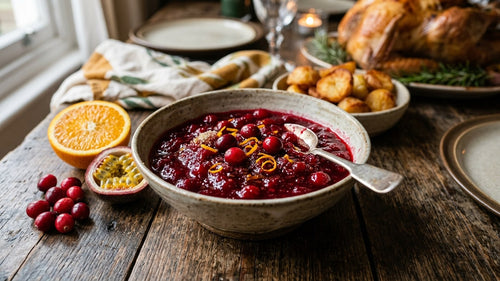
On Christmas Day, everything: turkey, roast potatoes, sprouts, gravy. A spoon of my cranberry sauce next to these is a very good idea, because the sour fruit against the sticky roots makes both taste brighter. Add a plate of pigs in blankets and you have the three things everybody reaches for first.
If you are cooking a ham this year, my gammon glaze belongs on the same table. Away from Christmas, they are just as good next to my Caribbean Sunday roast chicken.
And put the jar on the table. Anybody who wants more fire can shake a few drops of Caribbean Hot Sauce over their own plate and leave the children’s alone.
FAQ
Should you par-boil parsnips before roasting?
You do not have to, but for Christmas I always do. A 3-minute par-boil, a good steam dry and a shake in the colander give you crisper edges and fluffier middles, and let you do the work the day before.
How long do you roast parsnips at 200°C fan?
For batons about 1.5cm thick, par-boiled parsnips need about 25 minutes, then 5 to 8 minutes more with the glaze. Raw parsnips need 35 to 40 minutes before the glaze. Go by colour and a knife through the thickest piece, not only the clock.
When should you add honey to roast parsnips?
At the end, for the last 5 to 8 minutes only. Honey is mostly sugar, and if it goes on at the start it burns long before the parsnips are cooked. Roast them plain first, then glaze them hot.
Can I make honey roast parsnips the day before?
Yes. Par-boil and steam dry them on Christmas Eve, cool them quickly and keep them covered in the fridge. On the day, roast them from cold in hot oil, adding a few minutes, and glaze them at the end.
Why are my roast parsnips not crispy?
Usually the vegetables were wet, the oil was not hot, or the tin was crowded. Steam dry them properly, heat the oil before they go in, and give every piece a little space, using two tins if you need to.
Final word from me
A parsnip is a humble thing, and nobody puts it on the Christmas menu to show off. But roast it properly and give it a glaze at the right moment, and it is the dish people talk about on the way home.
So par-boil them on Christmas Eve, glaze them at the very end, and stand by the oven for those last few minutes. Then carry the tray to the table and watch what disappears first.
JP