The Plates a Guadeloupe Cook Loves Most, From Breakfast to Sunday Dinner
Guadeloupe and Jamaica sit in the same sea, but we grew up speaking different languages at the table. In my mother’s kitchen the salt cod was morue and it went into accras. In a Jamaican kitchen the same fish is saltfish, and it goes into a pan with ackee.
When I came to London, Jamaican dishes were everywhere: the patty shop on the corner, the jerk drum smoking at a summer party, the Sunday pot of rice and peas at a friend’s house. I tasted them as a cousin tastes another branch of the family. Familiar, and new at the same time.
So this is my list. Not a ranking, just the Jamaican dishes I think everybody should know, where they come from, and how I like to eat them. If you cook Caribbean food at home, half of these are already within reach.
What are the most popular Jamaican dishes?
The most popular Jamaican dishes are ackee and saltfish (the national dish), jerk chicken and pork, rice and peas, curry goat, brown stew chicken, oxtail, escovitch fish, the beef patty, run down and callaloo. Around them sit the sides: festival, fried dumpling, bammy, hard dough bread and fried plantain.
Where Jamaican food comes from
Every Jamaican plate tells you who passed through the island. The Taíno, the first people of Jamaica, were already roasting fish, smoking meat over pimento wood and making bammy from cassava. Enslaved Africans brought their own cooking and made a cuisine out of the cheapest food they were given: salt fish, off-cuts, ground provisions.
The Spanish left escovitch fish. The British left pastry and Sunday dinners. Indian indentured workers, about 36,000 of them between 1845 and 1917, brought curry and turmeric. Chinese workers, mostly Hakka, brought soy sauce and ginger, and hard dough bread.
It is the same story as Guadeloupe, with different names. Our first Indian workers landed at Pointe-à-Pitre on 24 December 1854, and from them came our colombo. Same sea, same history, two pots.
1. Ackee and saltfish, the national dish
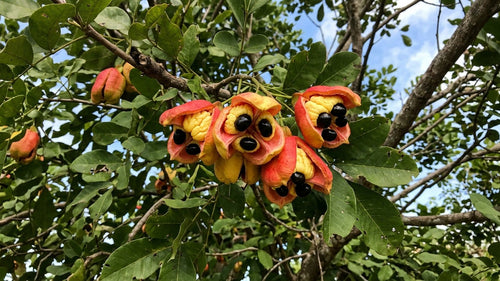
If you learn only one Jamaican dish, learn this one. Salt cod is soaked to draw out the salt, then cooked gently with boiled ackee, onion, tomato and Scotch bonnet. Ackee is soft and creamy, a little like scrambled egg in the pan but nothing like egg on the fork.
It is a breakfast dish, served with fried dumplings, boiled green banana, breadfruit or hard dough bread. One rule matters more than any recipe: ackee is only safe when the pod has opened on the tree by itself, and the seeds and pink membrane are never eaten. In the UK you buy it ready to use in tins. I wrote a whole guide to ackee, the fruit behind the national dish, and another on saltfish and how salt cod reached the islands.

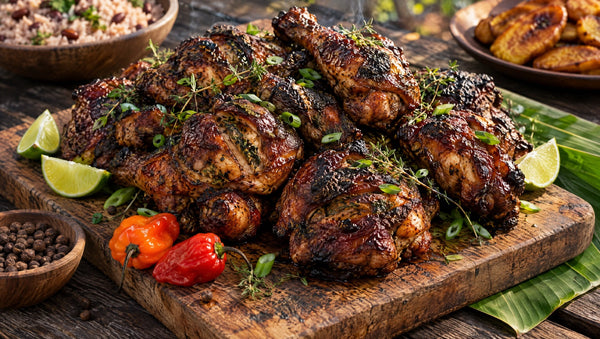
2. Jerk chicken and jerk pork
Why is it called jerk? The word is said to come from charqui, a Spanish word of Quechua origin for dried meat. The method goes back to the Taíno, and it was carried on by the Maroons, the people who escaped slavery and lived free in Jamaica’s mountains.
Jerk seasoning is mainly allspice, which Jamaicans call pimento, and Scotch bonnet. The meat is cooked slowly over pimento wood. Once it was pit fires; from around the 1960s cooks began cutting old oil barrels in half lengthways to make the jerk drums you see today. Boston Bay, in the parish of Portland, is famous for its jerk pits.
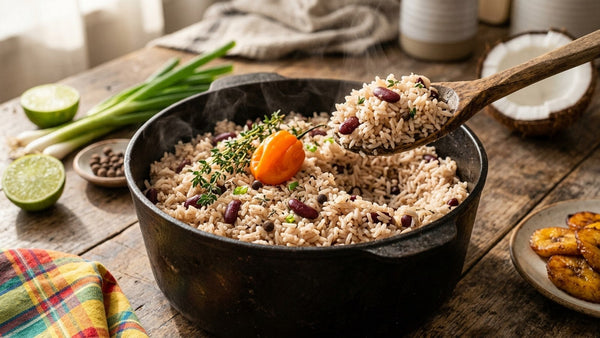
3. Rice and peas
In Jamaica “peas” usually means red kidney beans. They are cooked with long-grain rice, coconut milk, spring onion, garlic and thyme until every grain is soft and rich. It is especially a Sunday dinner dish. At Christmas, many cooks make it with gungo peas, the Jamaican name for pigeon peas.
Back home in Guadeloupe my mother kept the rice and the red beans apart. The Jamaican pot cooks them together in coconut milk, and that is what makes it so gentle and round.
Every Jamaican plate tells you who passed through the island. You just have to taste slowly enough to hear it.
JP
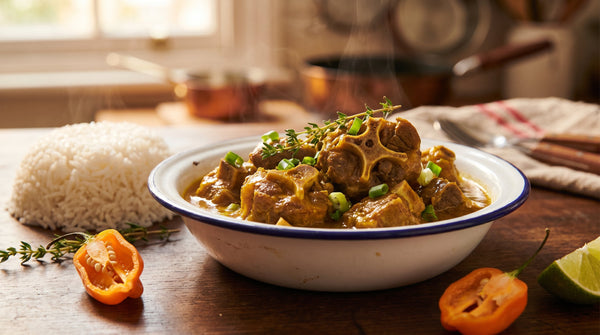
4. Curry goat, brown stew chicken and oxtail
These are the big pots, the dishes of parties and special days.
- Curry goat came with the Indian diaspora and is now part of every celebration. Cooks often “burn” the curry powder in hot oil first so it loses its raw taste, and mutton takes the place of goat when goat is hard to find.
- Brown stew chicken is chicken browned dark and simmered in a thick gravy. Soy sauce, ginger and spring onion show the Chinese hand in it.
- Oxtail was once an off-cut given to people who had nothing better. Stewed slowly with butter beans and a whole Scotch bonnet, it became one of the most prized and pricey cuts at the butcher.
When I eat curry goat, I think of our colombo de cabri. Different spice blends, same family memory.

5. Escovitch fish, run down and callaloo
The sea gives Jamaica three of its best dishes.
- Escovitch fish comes from the Spanish escabeche. The fish is fried, then covered with a hot pickle of vinegar, onion, carrot, chayote, pimento and Scotch bonnet. It is often eaten with festival.
- Run down is salt mackerel cooked in coconut milk with thyme, pimento and Scotch bonnet. The name comes from cooking the coconut milk down until the oil separates and the sauce turns thick. Another breakfast dish, with boiled yam, dumplings or green banana.
- Callaloo in Jamaica is amaranth leaves, steamed with onion, tomato, thyme and Scotch bonnet, often with a little saltfish. In Guadeloupe our calalou is a different plant and a different pot, made with madère leaves and crab at Easter. I explain the difference in my guide to callaloo across the islands.
6. The patty and the sides
The Jamaican patty is a half-moon of flaky pastry, coloured golden with egg yolk, annatto or turmeric, and filled with seasoned minced beef, chicken or vegetables. You can see the Cornish pasty in it, and the Spanish turnover, and the Indian curry. In Jamaica it is often a full meal, pressed inside soft coco bread. In Britain you find patties in every city with a West Indian community.
And then the sides, which for me are half the pleasure:
- Festival: a sweet fried dumpling made with flour, cornmeal and a little sugar.
- Fried dumpling: the plain version, with little or no sugar.
- Bammy: a flat cassava bread, made on the island since Taíno times.
- Hard dough bread: the dense, slightly sweet loaf from the Chinese Jamaican bakeries.
How to cook Jamaican dishes at home
You do not need a jerk drum to start. Start with the dishes that forgive you.
My jerk chicken recipe works in a home oven and finishes under a hot grill, so you still get the dark, sticky edges. Make a pot of rice and peas with coconut milk on the side and you have a Sunday plate.
For a party, my curry goat recipe feeds a crowd and tastes better the next day. And on a weekend, a pot of brown stew chicken takes a little over an hour, mostly simmering, and asks only for rice.
The sauce I put on the table
Almost every dish on this list has one thing in common: Scotch bonnet. In Jamaica it goes into the jerk, the escovitch pickle, the run down, often whole into the pot so it gives its perfume without bursting.
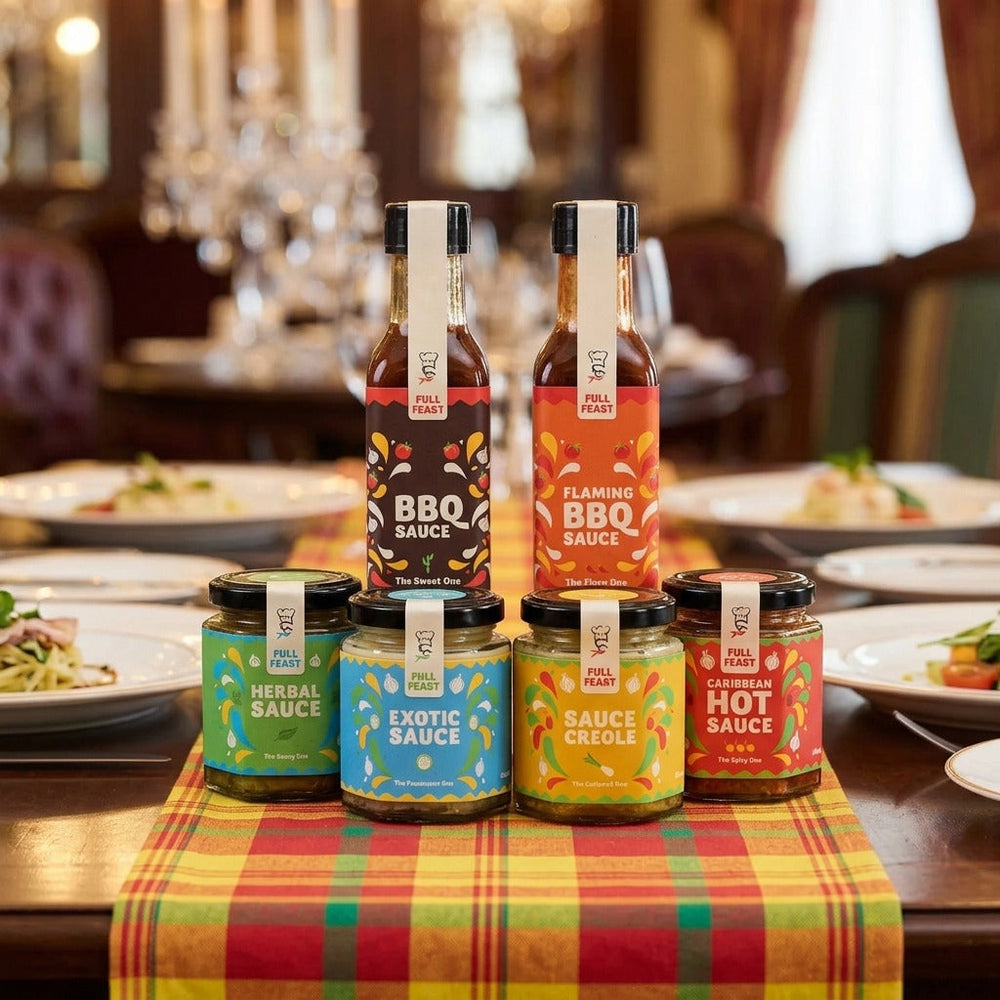
That is why, when I cook Jamaican food, I put a jar of Full Feast Caribbean Hot Sauce on the table. It is mostly Scotch bonnet, 40.6 per cent, with white onion and garlic, and nothing else fighting for attention: no allspice, no thyme, no fruit. So it adds heat and that fruity chilli taste without changing the seasoning you worked on. A few drops on ackee and saltfish, a spoon beside the jerk, a little stirred into the escovitch pickle if you like it hotter.
FAQ
What is the national dish of Jamaica? Ackee and saltfish. Salt cod is soaked, then cooked with boiled ackee, onion, tomato and Scotch bonnet, and it is usually eaten for breakfast with dumplings, green banana or breadfruit.
Why do Jamaicans call it jerk? The word is said to come from charqui, a Spanish word of Quechua origin for dried meat. The cooking method itself goes back to the Taíno and was carried on by the Maroons.
What are some traditional Jamaican dishes? Ackee and saltfish, jerk chicken and pork, rice and peas, curry goat, brown stew chicken, oxtail, escovitch fish, run down, callaloo and the beef patty, with festival, bammy and fried dumplings on the side.
Are Jamaican dishes very spicy? Many use Scotch bonnet, a very hot chilli, but cooks control the heat. Often the pepper goes in whole and comes out before serving, so the dish smells of it without burning.
What do Jamaicans eat for breakfast? Ackee and saltfish, run down, callaloo with saltfish, with fried dumplings, boiled green banana, yam or hard dough bread.
One small thing to try this week
Buy a tin of ackee and a small piece of salt cod. Soak the fish overnight, changing the water twice, and on Saturday morning cook it with an onion, a tomato and half a Scotch bonnet. Fold the ackee in at the end, gently, so it keeps its shape.
Eat it with fried dumplings or toast. Then you will understand why a whole island chose this plate to say who they are.
JP