The Leafy Green Three Islands Cook Three Ways, and What Guadeloupe Does With It at Easter
Easter Monday in Guadeloupe does not smell of chocolate. It smells of the sea, of woodsmoke on a beach, and of a big pot of green going soft over a fire. That green is callaloo, or kalalou as we say it at home, and on Easter Monday it is cooked with land crab until the whole thing turns thick and dark and silky. My mother would send us to wash the madère leaves in a basin while she dealt with the crabs, which were still alive and still angry. By the time the rice was done, the pot had gone from a heap of leaves to something you ate with a spoon and a lot of quiet.
In the UK people ask me about callaloo all the time, usually holding a tin of it. Is it spinach? Is it a soup? Why does a Jamaican friend describe something completely different from a Trinidadian one? The short answer is that one word has been doing several jobs for a very long time. Let me untangle it the way I would at my own table.
What is callaloo?
Callaloo is both a leafy green and the dish made from it. In Jamaica the green is a type of amaranth, cooked quickly with onion, tomato and Scotch bonnet. In Trinidad, Grenada, Dominica and Guadeloupe it means the young leaves of the dasheen (taro) plant, simmered down with okra, coconut milk and often crab into a thick, smooth, spoonable green.
One word, several plants
The first thing to understand is that nobody is wrong. The word travelled around the Caribbean and attached itself to whichever big green leaf was growing nearby.
- Jamaica, Belize, Saint Lucia, Guyana: callaloo is amaranth, a soft-leaved annual that grows 60 to 80 cm tall and is eaten as a green from India to West Africa. In a Jamaican kitchen it is stripped, chopped and steamed with garlic, onion, tomato, thyme and Scotch bonnet, very often with saltfish.
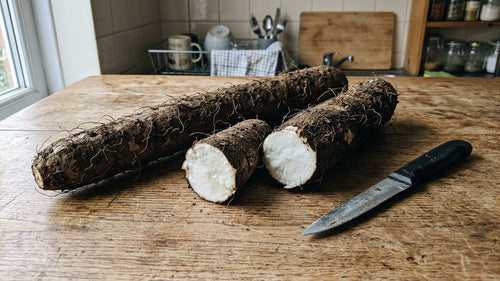
- Trinidad and Tobago, Grenada, Dominica: callaloo is the young leaf of the dasheen plant, what Trinidadians call dasheen bush. The same leaves go by madère in Guadeloupe. The dish is cooked slowly with okra and coconut milk.
- Haiti: kalalou is okra itself, and a sauce made with it. I wrote about that pot in my piece on Haitian food, from griot to the soup of freedom.
- Elsewhere: tannia leaves, water spinach and a few other greens all carry the name in one island or another.
If you want to know the dasheen plant itself, root and leaf, I wrote a whole guide to dasheen, the taro root Guadeloupe calls madère.

Where the word callaloo comes from
Callaloo is an African word that crossed the Atlantic. The strongest account traces it to the Kimbundu word kalulú, spoken in Angola, where it meant okra or a vegetable dish made with it. The same root survives in Haitian Creole and in the Portuguese of São Tomé. A second theory points to the Tupi word caárurú, meaning thick leaf, which is where the Brazilian caruru comes from.
Back home the linguist Hector Poullet put kalalou in his historical dictionary of Guadeloupean Creole among the African survivals, noting that a dish of the same name is still everyday food in Côte d’Ivoire and Benin. I like that very much. When my mother shouted “kalalou!” from the kitchen, she was using a word older than the island’s French.
You will see it spelled callaloo, calaloo, kallaloo, calalou and kalalou. They are all the same pot.
What does callaloo taste like?
Think of spinach with its volume turned up. The botanist Joseph Maiden, writing about amaranth more than a century ago, called it an excellent substitute for spinach that tasted like boiled nettle leaves, and that is still the best short description I know. Amaranth callaloo is grassy and a little sweet, and it softens in minutes.
The dasheen leaf is bolder. Cooked, it has the texture of spinach but a deeper, almost earthy flavour, and when you simmer it with okra the okra does something that no other vegetable does. It gives the pot a smooth, silky body, the kind that coats a spoon. In Trinidad they say the okra gives callaloo its characteristic smooth texture, and in Guadeloupe we would not dream of leaving it out.
If you have only ever had the tinned version, which is amaranth in salted water, the dasheen pot will surprise you.
Jamaica, Trinidad and Dominica: three islands, three pots
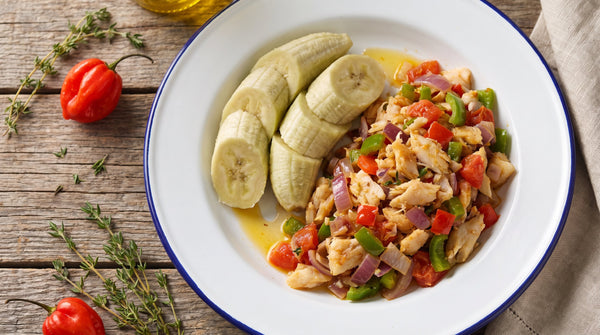
Jamaica cooks callaloo fast. The amaranth is washed, chopped and steamed in its own water with onion, garlic, tomato, thyme and a piece of Scotch bonnet. It is breakfast food, served with saltfish, fried dumplings or boiled green banana, and it also fills patties.
Trinidad and Tobago cooks it slow. Dasheen bush, okra, pumpkin, onion, chives, thyme, pimento peppers and coconut milk go into the pot with a whole Scotch bonnet that must come out unbroken. Crab or salted pigtail goes in for the people who want it. After an hour everything is broken down with a swizzle stick, or blended smooth, and spooned over white rice as a side at Sunday lunch, next to stewed chicken and macaroni pie. It is one of the country’s national dishes.
Dominica made callaloo soup its official national dish in 2013, when it replaced mountain chicken, which is not a chicken at all but a large frog that had become endangered. The Dominican pot is built on dasheen or tannia leaves with local crab and smoked meat, and it comes out for Independence and for Jounen Kwéyòl, Creole Day. Grenada eats callaloo soup on Saturdays, and in Saint Lucia crab callaloo is a Creole Day favourite too.
Every island will tell you its callaloo is the real one. They are all right, and they are all talking about a different leaf.
JP

Kalalou in Guadeloupe: the Easter crab pot
In Guadeloupe callaloo belongs to Easter. On Easter Monday families leave town and head for the sea, to the beaches around Port-Louis, Sainte-Rose, Anse-Bertrand, Trois-Rivières, Marie-Galante and La Désirade, and many camp there for the whole weekend. The holiday is built around land crab. Live crabs are sold in wooden cages, there is a crab festival in Morne-à-l’Eau with crab races, and the two great dishes are matété, crab cooked slowly with rice, and calalou de crabe, crab cooked with madère leaves.
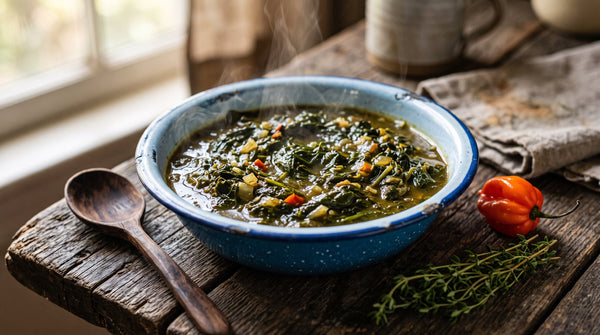
Here is how the pot works in a Guadeloupe kitchen. The madère leaves, three good bunches for six crabs, are boiled in salted water for 15 to 20 minutes, then rinsed, drained and blended to a purée. The crabs are brushed clean and opened, and the fat inside the shell is kept because that is where the flavour lives. Onion, garlic, spring onion, thyme, parsley and one chilli are fried in oil, the crabs go in with a little salted pig tail or smoked bacon, and then the green purée is stirred through with the crab fat. It simmers gently until it is one thick, dark, glossy thing, and it is finished with lime and eaten with white rice.
That is the pot of my childhood: no okra in that version, just leaves, crab and time, and six children fighting over the claws.
Cooking the leaves safely
One rule, and it matters. Dasheen leaves must always be cooked, never eaten raw. Like the root, they contain calcium oxalate in the form of fine needle-shaped crystals that make the raw leaf harsh and unpleasant in the mouth. Cooking deals with it, and boiling is the method that works: a New Zealand study of taro leaves found that boiling removed about a third of the soluble oxalate while baking left it almost unchanged.
So do what every Guadeloupe grandmother does. Strip the stalks and thick midribs, wash the leaves well, boil them in salted water for 15 to 20 minutes, drain, rinse and only then build your pot. Amaranth callaloo does not need this treatment, but wash it twice, because it holds grit.
Finding callaloo in the UK
You have three routes.
- Tins. Big supermarkets stock 540 g tins of Jamaican callaloo in salted water in the world food aisle, and every Caribbean grocer has them. Drain, rinse and treat it like cooked spinach. It is amaranth, so it suits the quick Jamaican style best.
- Fresh leaves. From July to October, Caribbean grocers sell fresh amaranth, sometimes labelled Jamaican spinach, and South Asian grocers sell the same plant as chaulai. Fresh dasheen leaves are harder to find, so ask.
- Grow it. Amaranth is easy in a British summer. Sow indoors from mid April, plant out from mid May, and sow straight into the ground in June once the soil is warm. Cut the plants about 15 cm above the base from July and they grow back several times.
How I cook callaloo at home
Three recipes on this site use the leaf, the pot or the plate it belongs to.
- My Guadeloupe callaloo, the green soup my mother simmered every Sunday is the kalalou of this post made with greens you can buy in any UK supermarket, with okra, coconut milk and a whole Scotch bonnet floating on top.
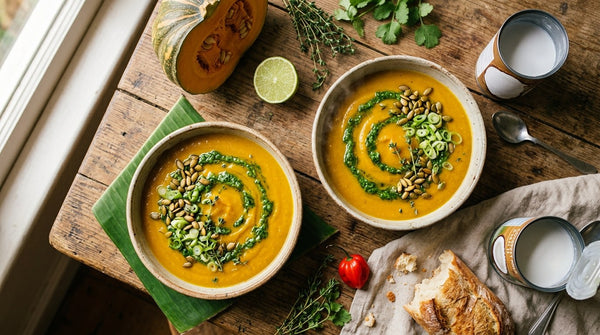
- My Caribbean pumpkin soup is the giraumon that goes into the Trinidad pot, cooked on its own the Guadeloupe way.
- My green banana and saltfish is the Jamaican breakfast plate; a spoon of steamed callaloo beside it and you have the whole island on one plate.
The green sauce that belongs with greens
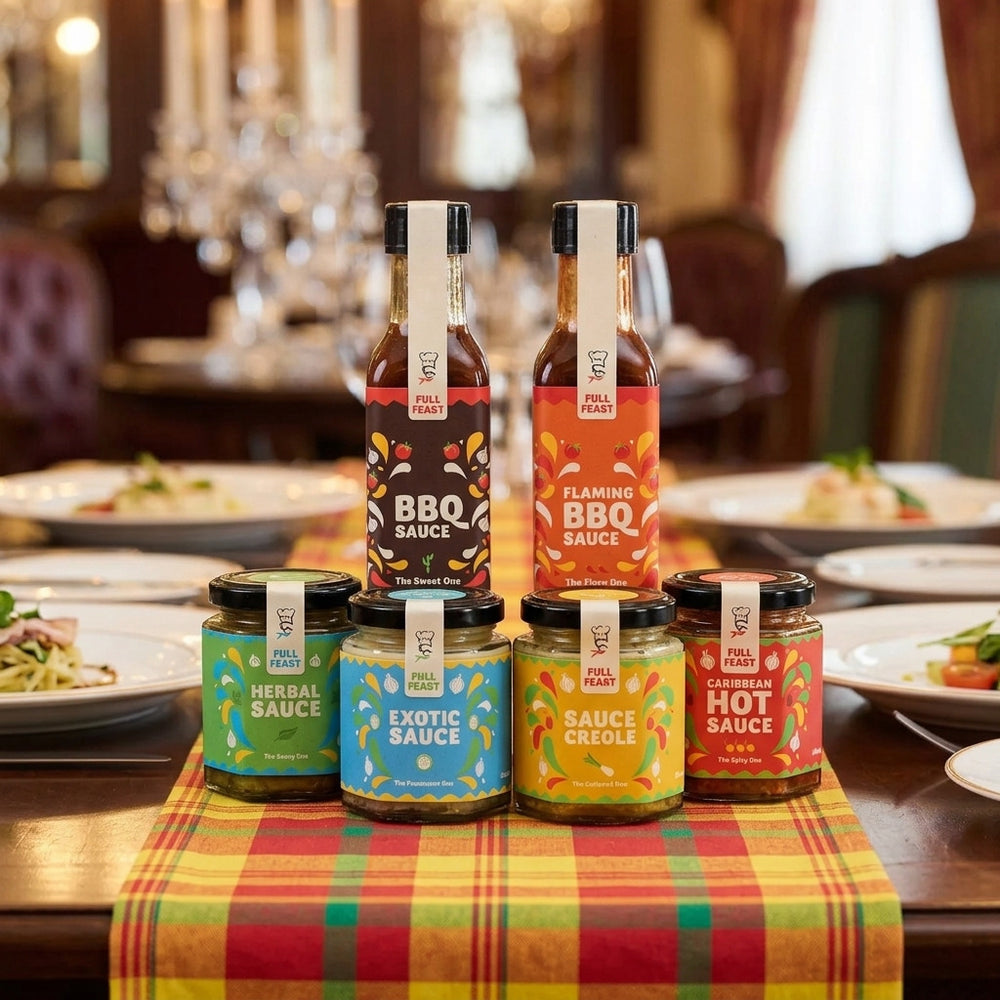
A pot of callaloo wants something sharp and herbal at the end, not something hot. In Guadeloupe that was a squeeze of lime and a handful of chopped cive. In my kitchen it is a spoon of Fresh Herbal Sauce, which is shallots, basil, coriander, a little French mustard and white wine vinegar. There is no chilli in it at all, so it lifts the pot without fighting the Scotch bonnet already sitting in there.
Stir a tablespoon through the finished callaloo off the heat, or set the jar on the table so people can add their own.
FAQ
What is callaloo in English? There is no single English word, because callaloo names two different plants. The Jamaican leaf is amaranth. The Trinidad, Dominica and Guadeloupe leaf is the young leaf of the dasheen, or taro, plant. The dish made from either is also called callaloo.
Are callaloo and spinach the same? No, though they cook in similar ways. Callaloo is amaranth or dasheen leaf, both bolder in flavour than spinach and sturdier in the pot. Spinach is the usual stand-in when you cannot find either.
What does callaloo taste like? Like strong spinach with a hint of nettle. Amaranth callaloo is grassy and a little sweet. Dasheen callaloo is deeper and earthier, and when it is simmered with okra it becomes smooth and silky.
Is callaloo the same as collard greens? No. Collard greens are a cabbage relative. Callaloo is amaranth or dasheen leaf, softer and quicker to cook, with an earthy rather than cabbagey flavour.
What does callaloo mean? The word most likely comes from the Kimbundu word kalulú, spoken in Angola, meaning okra or a vegetable dish. In Guadeloupean Creole, kalalou is counted among the words that came from Africa with the people who were enslaved and brought to the island.
If the okra in that pot is a mystery to you, I wrote a whole guide to okra, the green pod Guadeloupe calls gombo, and how to cook it without the slime.
One small thing to try this week
Buy one tin of callaloo. Drain it, rinse it, and warm it in a pan with a little oil, half a chopped onion, one chopped tomato and a sprig of thyme. Five minutes, no more. Salt, black pepper, a squeeze of lime.
Put it next to a fried egg, or a piece of grilled fish, or a slice of toast if that is what you have. Then taste it slowly and decide for yourself whether it is spinach. I promise you it is not.
JP