The Fruit Guadeloupe Eats Green as a Vegetable and Ripe With a Squeeze of Lime
There was a papaya tree at the end of my grandmother’s garden, back home in Guadeloupe, and it never looked like a proper tree. A single pale trunk, straight as a broom handle, with a crown of big lobed leaves at the top and the fruit hanging in a cluster just underneath them, like green lanterns. We picked them at two different moments. Hard and green, for my mother, who would peel them under running water and boil them for a gratin. Soft and orange, for us children, who ate them with a spoon and a squeeze of lime, sitting on the step.
In the UK, people ask me how do you eat a papaya as if there is one answer. There are two, and they depend entirely on the colour of the skin. One is a fruit. The other is a vegetable. Let me walk you through both, the way my family does it.
What is papaya?
Papaya is the fruit of Carica papaya, a fast-growing tropical plant from southern Mexico and Central America that is botanically a giant herb rather than a tree. The fruit is a long berry, usually 15 to 45 cm, with a central cavity full of black seeds. Ripe, the flesh turns yellow, orange or red and tastes sweet and soft, a little like melon. Green, it is firm and bland and is cooked as a vegetable.
Where papaya comes from, and why the word is Caribbean
Papaya is American. Botanists place its home in Mesoamerica, in southern Mexico and the neighbouring parts of Central America, where it was domesticated long before any European arrived. The Spanish carried seeds across the region quickly: they reached Panama and then the island of Hispaniola, today’s Dominican Republic and Haiti, before 1525, and from there spread through the West Indies.
So papaya was already in my part of the world when the Spanish took it to the rest of it. Seeds went to the Philippines around 1550, then to Malacca and India, and from India to Naples in 1626. Today India grows more papaya than anyone, about a third of the world crop, with the Dominican Republic in second place.
The word itself is Caribbean too. Papaya comes from the Arawakan languages of the West Indies, the languages spoken on these islands before Columbus, and it arrived in English around 1600 through Spanish. In Guadeloupe we say papaye in French and papay in Creole, the same word worn smooth.
Papaya or pawpaw: what is papaya called in the UK?
In the UK you will see both names on the same shelf. Pawpaw is the word my older customers and the Caribbean grocers use, and dictionaries mark that sense as Australian and South African too. It is the same fruit.
The confusion comes from America, where pawpaw means something else entirely: Asimina triloba, a tree native to the eastern United States whose fruit has nothing to do with Carica papaya. An American pawpaw recipe is not this fruit. A London grocer’s box marked pawpaw is.

How to tell if a papaya is ripe
An underripe papaya is a disappointment and an overripe one is a puddle. Here is what I check in the shop.
- Colour. The skin goes from fully green to yellow, sometimes with red patches. The more yellow, the riper. A fruit with no yellow on it at all will not ripen reliably on your counter, so look for at least a patch.
- Give. Press gently with your thumb. A ripe papaya yields the way a ripe avocado does, soft but not collapsing.
- Smell. Put your nose to the stem end. Ripe fruit smells faintly sweet. No smell, not ready.
- Size. The small pear-shaped papayas, half a kilo to a kilo with golden flesh, are the Solo type, a variety that travelled from Barbados to Hawaii in 1911. The big red-fleshed ones are mostly grown in Mexico and Belize. Both are good. The small ones are sweeter to my taste.
If you bring one home that is half yellow, leave it on the counter, not in the fridge, and it will finish ripening in a few days. Once it is soft, I move it to the fridge and eat it soon.
How do you eat a papaya when it is ripe?
The simplest way, and the way we ate them as children: cut it in half lengthways, scoop the seeds out with a spoon, squeeze lime over the flesh and eat it from the skin. Lime is not decoration. Papaya on its own is sweet and a little flat, and the acid wakes it up. You can peel it with a vegetable peeler and cube it for a fruit salad instead, or slice it thin and sprinkle it with lime and a little brown sugar, which is how it was served at my grandmother’s table on a Sunday.
In Guadeloupe we also drink it. Ripe papaya blended with milk makes what my island calls a bavaroise, a thick cold smoothie. We boil it down into confiture too, often with maracudja or coconut, and it is steeped with vanilla into a rhum arrangé, though that is a drink for the end of a long evening, not a breakfast.
One thing papaya cannot do: set a jelly. The fruit carries an enzyme that stops gelatin from firming, so keep it out of anything that needs to hold its shape.
The seeds: chew them or spit them out?
Eat a few. Papaya seeds are small, black and wrapped in a slippery clear coating, and raw they taste sharp and peppery, close to cress or a mild peppercorn. In my kitchen I rinse a spoonful, dry them slowly in a low oven for a few hours, and grind them in the pepper mill. They give a salad dressing a gentle heat that is not chilli.
Do not eat the whole cavity in one sitting. A few is the right amount, and that is how the growers’ guides put it too.
Back home nobody asked whether papaya was a fruit or a vegetable. Yellow, it was pudding. Green, it was supper.
JP
Green papaya: the vegetable Guadeloupe cooks
Here is the half of the story British shops leave out. A green papaya is not an unripe fruit waiting to be sweet. It is a vegetable in its own right, and across the Antilles we cook it that way. In Guadeloupe you will find it on every market stall, from Pointe-à-Pitre to the smallest roadside table, and the rule is simple: the yellow one is eaten as fruit, the green one as a vegetable.
Green papaya is firm, pale and almost neutral, somewhere near a courgette or a christophine, which is why the two swap in and out of the same recipes. We cut it into strips for a salad, or boil it for a gratin de papaye verte, which to me is the dish. You peel a kilo of green papaya, cut it into chunks and boil it for about half an hour in salted water with a leaf of bois d’inde, our West Indian bay. Drain it, mash it roughly, and fold it into a béchamel you have started by frying chopped garlic, cives and flat parsley in butter. Into a dish, grated cheese on top, into the oven until it is golden. My mother served it with a grilled fish. If you have made a gratin de christophine, the dish Guadeloupe builds on chayote, you already know the method.
Two things to know before you cook it. First, a cut green papaya leaks a white, sticky latex that can irritate skin, so peel it with gloves on or under a running tap, as the Creole recipes tell you. Second, that latex is why we cook it, or at least boil and chill it before it goes into a salad. Thai cooks grate it raw for som tam; that is their tradition, and ours is the pot.

The meat tenderiser in the market bag
The sticky latex has a use. It contains papain, an enzyme that breaks down protein, and Caribbean cooks have long known that rubbing tough meat with green papaya, or cooking a few chunks in the pot with it, softens it. Commercial meat tenderiser powders are built on the same enzyme. If you try it, keep it brief and cook the meat thoroughly afterwards, which stops the enzyme working. I would not do it to a good steak. I would do it to a goat shoulder.
How I eat papaya at home in the UK
I buy the small ones ripe and eat them the childhood way, with lime. When I find a green one, it goes into the gratin above. In between, papaya stands in for other fruit in recipes I already make:
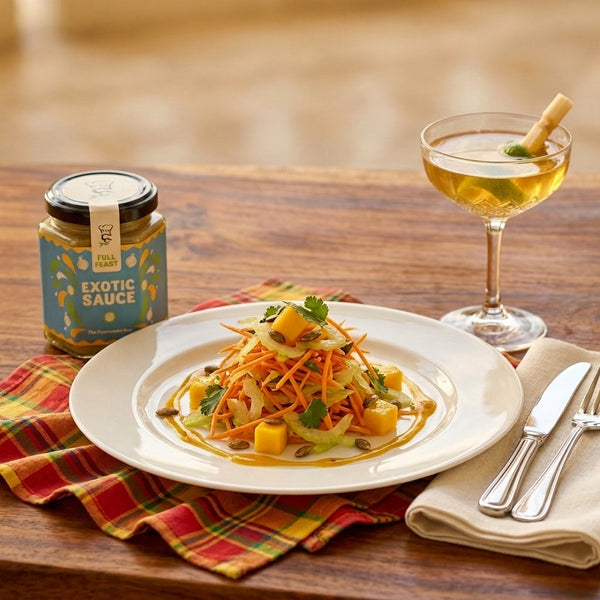
- Cubed ripe papaya swapped for the mango in my exotic mango crunch salad, where its softness against the crunch is even better.
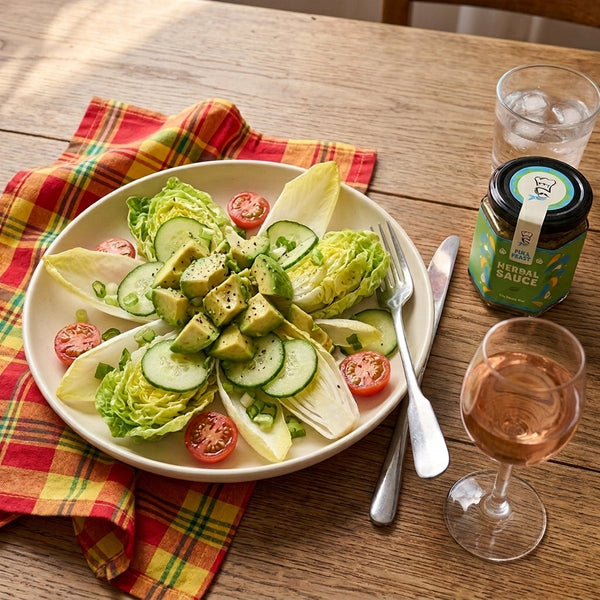
- Slices of ripe papaya laid next to avocado in my herbal avocado salad, a starter that looks like the islands.
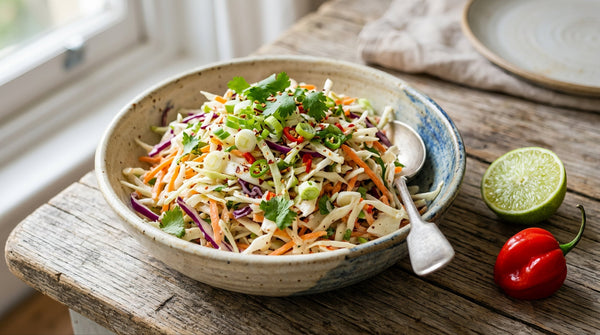
- Boiled, chilled and cut into strips, green papaya works in place of half the cabbage in my Caribbean coleslaw, dressed the same way.
- The gratin de papaye verte next to a whole roasted red snapper, exactly as my mother served it.
The sauce for a green papaya salad
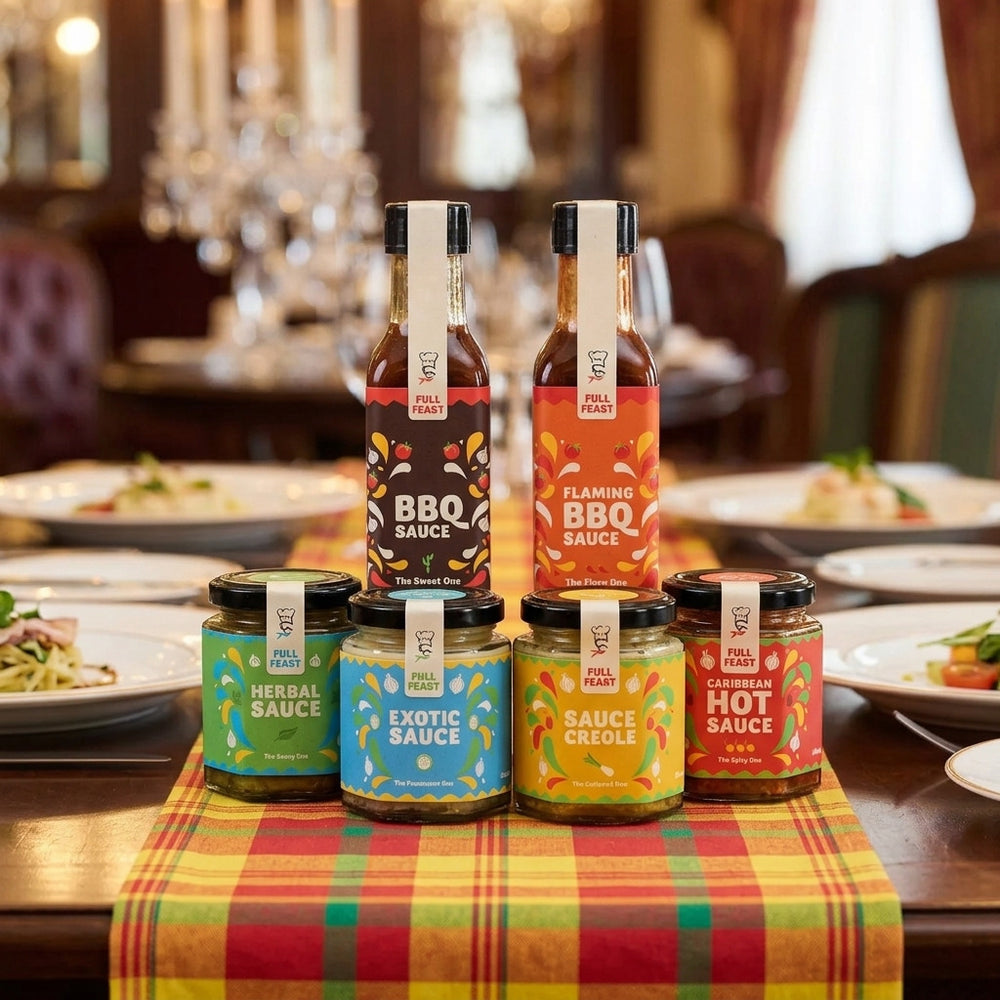
A Guadeloupe green papaya salad is dressed sharp: lime, a little garlic, chilli and fresh herbs over the cold, boiled strips. In the UK I take a shortcut that keeps the point of it. I toss the chilled papaya with a spoonful of Full Feast Fresh Herbal Sauce, which is shallots, white wine vinegar, French mustard, basil and coriander, then add my own squeeze of lime and a few ground papaya seeds for pepper. The sauce has no chilli, so the heat is yours to decide, and no garlic, which lets the herbs sit lightly on a vegetable this delicate.
The ripe side of papaya pairs with the island fruits I have written about before. Papaya cooked down with passion fruit, the maracudja of our markets, is one of our classic confitures, and a bowl of papaya and pink guava is a Guadeloupe breakfast in two spoons.
FAQ
How do you eat a papaya? Cut a ripe papaya in half lengthways, scoop out the black seeds with a spoon, squeeze lime over the flesh and eat it straight from the skin. Or peel it and cube it for fruit salad. A green papaya is cooked as a vegetable.
What does papaya taste like? Ripe papaya is sweet and soft, close to cantaloupe melon, sometimes a little musky, which is why it wants lime. Green papaya is firm and neutral, nearer a courgette, and takes on the flavour of whatever it is cooked with.
How do you tell if a papaya is ripe? The skin is mostly yellow, sometimes with red patches, the fruit gives gently under your thumb like a ripe avocado, and the stem end smells faintly sweet. A papaya that is entirely green with no yellow on it will not ripen reliably at home.
Can you eat papaya seeds? Yes, a few. They taste peppery, like cress. Rinse them, dry them in a low oven and grind them like pepper, or scatter a spoonful raw over a salad. Eat them in small amounts, not the whole fruit’s worth.
What is papaya called in the UK? Papaya, and often pawpaw, especially in older usage and at Caribbean grocers. Be careful with American recipes: in the United States, pawpaw is a different fruit altogether, from a small native tree called Asimina triloba.
One small thing to try this week
Buy one small papaya that is more yellow than green. Leave it on the counter until the stem end smells sweet and the skin gives under your thumb, two or three days at most.
Cut it lengthways, scoop the seeds into a cup, and eat the flesh from the skin with half a lime squeezed over. Then rinse the seeds, dry them on a tray in the lowest oven, and put them through the pepper mill over your next salad. Two meals and one small discovery from one fruit.
JP