Oil Down, Nutmeg and the Packed Pot of the Spice Isle, Seen From a Guadeloupe Kitchen
There is a smell I know from home that I did not expect to find on another island. Coconut milk cooking slowly with breadfruit and salt fish, the pot left alone, the whole yard waiting. In Guadeloupe we would call that a Sunday. In Grenada they call it oil down, and it is the heart of Grenada food.
Grenada sits far to the south of us, the last of the Windward Islands before Trinidad. It is small, three islands really: Grenada itself, Carriacou and Petite Martinique. Yes, Petite Martinique. You will see in a moment why that name makes a Guadeloupe cook smile.
People call it the Isle of Spice, and when you stand in a kitchen there you understand. Nutmeg and mace go into everything, even the ice cream. But the island’s cooking is not only spice. It is starch and coconut and salt fish, African one-pot cooking, Indian curry and French names, all in the same pot.
So let me take you through it the way I would if you came to eat with me: the national dish first, then the spice, then the street food, and finally what to cook in your own kitchen this week.
What is Grenada food?
Grenada food is Caribbean Creole cooking built on breadfruit, dasheen, green banana, coconut milk and salted fish or meat, seasoned with nutmeg, mace and turmeric. The national dish is oil down, a one-pot stew. Indian roots bring aloo pie, doubles and curry wrapped in dal puri, and the island is famous worldwide for its nutmeg.
Oil down: the national dish of Grenada
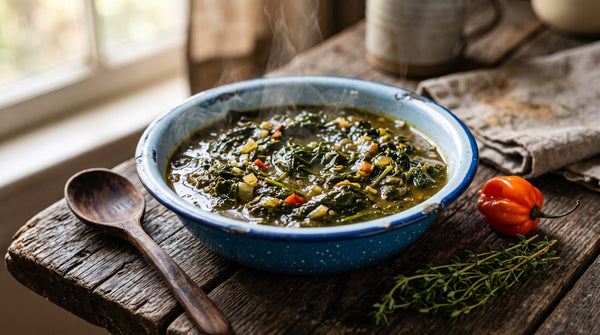
If you ask what the national food of Grenada is, everyone gives the same answer: oil down. It is a stew of breadfruit, salted meat, chicken, dumplings, callaloo and other vegetables, all cooked in coconut milk with herbs and spices.
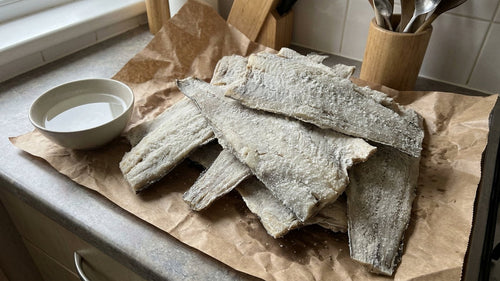
The salted part changes from house to house. It can be saltfish, which is salted cod, or smoked herring, or salt beef. The golden colour comes from turmeric, which Grenadians call saffron even though it is not saffron at all. The pot is often a big one that locals call a karhee, or curry pot.
And there is no single recipe. Every household, every parish, makes oil down its own way. Some families add conch and crab. There is a vegetarian version too. What stays the same is the spirit of it: oil down is cooked when people gather, and everyone brings something for the pot.
That is the part that touches me most. In Guadeloupe we have the same habit with our big Sunday pots. You do not cook a dish like this for one.

Why is it called oil down?
The name puzzles everyone in Britain, and visitors to Grenada too. It sounds like something from a garage, not a kitchen.
It comes from the coconut milk. As the stew cooks, the liquid slowly disappears. The oil from the coconut milk is either soaked up by the breadfruit and dumplings or settles at the bottom of the pot. All the liquid is cooked down, hence oil down.
How to pack the pot
Here is what makes oil down different from most stews: you do not stir it. The pot is packed, in layers, and left to simmer.
- Breadfruit and the meat or fish go at the bottom.
- Most of the vegetables go in the middle.
- The callaloo leaves and the dumplings sit on top, steaming.
Exactly how to pack the pot is a matter of taste and tradition, and sometimes of argument. The dish is ready when all the liquid has been absorbed, which takes at least an hour, longer for a big pot.
I love this. It is the same patience my mother had. You put the lid on, you trust the pot, you do not keep lifting it to look.
You put the lid on, you trust the pot, and you wait. That is the whole secret of oil down, and of half my mother's kitchen.
JP
Oil down on the other islands
Oil down is not only Grenada’s. Trinidad makes it too, simpler, usually without dumplings and with hot peppers, while Grenadians like dasheen, dumplings and turmeric in theirs. Guyana has a similar stew called mettagee, or mettem, and Jamaica has run down, a seafood version cooked in coconut milk. I wrote about the Trinidad kitchen in my piece on Trinidad food, from doubles to pelau, and you will see how close the two islands are.
The Isle of Spice: nutmeg and mace
Grenada has nutmeg on its national flag. Look at the green triangle near the flagpole and you will see it. The flag was raised on 7 February 1974, the day Grenada became independent, and the nutmeg stayed on it because it was the island’s great export. Grenada is the second largest nutmeg producer in the world, after Indonesia.
Nutmeg and mace come from the same fruit. Nutmeg is the seed. Mace is the red, lacy covering around the seed, dried until it turns orange or tan. The tree is native to the Banda Islands in Indonesia, and it is a patient tree: the first harvest comes seven to nine years after planting.
That patience mattered in 2004, when Hurricane Ivan hit Grenada and badly damaged the nutmeg industry. A tree that takes years to bear fruit cannot be replaced in a season.
In the kitchen, nutmeg and mace are used in abundance, in sweet things and savoury, and nutmeg ice cream is one of the island’s best-known desserts. If you only know nutmeg from a dusting on custard, Grenada will change your mind about it.

Why Grenada feels like family to a Guadeloupe cook
Now for that smile. In 1649, a French expedition of around 200 men sailed from Martinique and founded a settlement on the island. The French called it La Grenade. It passed to Britain in 1763, but the French names stayed, and you still hear them.
My favourite is Gouyave, a fishing town on the west coast. The French renamed it for its guava trees. Back home on Basse-Terre we have a town called Goyave, named for the same fruit, which I wrote about in my piece on guava and the Guadeloupe town that carries its name. Two islands, far apart, both naming a town after a guava tree.
Gouyave is also the centre of the nutmeg trade. Its nutmeg processing station is still the largest building in Grenada. And every Friday the town holds Fish Friday, a street festival of fish cooked every way you can imagine. On 29 June, fishermen come from all over the island for Fisherman’s Birthday, with boat races and fish to eat.
Cocoa is part of the story too. Cocoa beans were brought to Grenada in 1714, and today the island holds a Chocolate Festival every May, with events at Belmont Estate.
The ingredients that tell Grenada’s history
What I find beautiful about Grenada food is that one pot of oil down holds the whole history of the island:
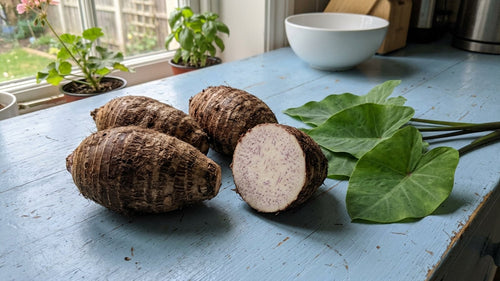
- Callaloo and dasheen were grown by Grenada’s earliest Amerindian people.
- The one-pot method came with enslaved West Africans brought to work the sugar estates.
- Salt fish, originally cod, was imported as cheap food for the enslaved. It became a staple, as it did across the islands.
- Breadfruit came from the South Pacific on an expedition led by Captain Bligh, after the famous mutiny on the Bounty in 1789. My guide to breadfruit, which Guadeloupe calls fruit à pain, tells that story and how to buy one in the UK.
- Turmeric arrived with Indian workers after emancipation. The first ship, the Maidstone, reached Grenada from Calcutta on 1 May 1857, and 3,206 Indian people had arrived by 1885.
That Indian thread runs through the street food. In Grenada you will find aloo pie, doubles, and dal puri wrapped around a curry, often goat. There are fried bakes and fish cakes. For something sweet: kurma, guava cheese, fudge, tamarind balls, currant rolls, rum-raisin ice cream and Grenadian spice cake.
How to cook Grenada food at home
You can cook a very good oil down in a British kitchen. Breadfruit and dasheen turn up at Caribbean grocers, and when they do not, there are honest swaps that even many Grenadians accept:
- Use spinach if you cannot find callaloo.
- Leave out the dasheen if it is not in the shop.
- Use yam or potato in place of breadfruit.
- If you use bananas, use green ones.
- Soak the salt meat or fish overnight so the pot is not too salty.
The simple recipe published by the Government of Grenada uses a Scotch bonnet, chive, thyme, carrots, coconut milk and turmeric with the breadfruit, dumplings and salt meat. Pack it as I described, lid on, and give it at least an hour.
If you want to practise the parts before you build the whole pot, start here:
- My Guadeloupe callaloo, the green soup my mother simmered every Sunday, teaches you how to cook the leaves.
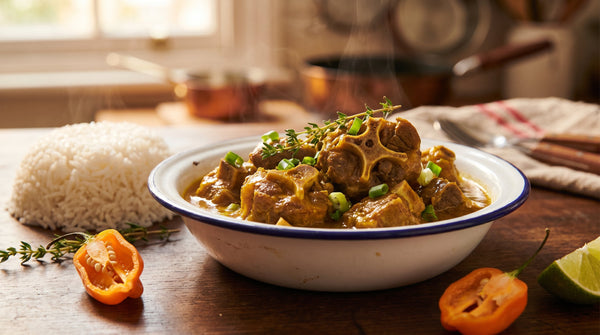
- My Caribbean curry goat is the curry you would wrap in dal puri at a Grenada roadside stall.
- My Caribbean fish cakes are the closest thing to a Grenada fish cake and bake from Fish Friday.
The sauce I put on the table
Oil down is rich and gentle. Coconut, starch, a little salt. The Trinidad cooks add hot peppers to the pot. I prefer to keep the pot soft and let everyone add their own heat at the table.
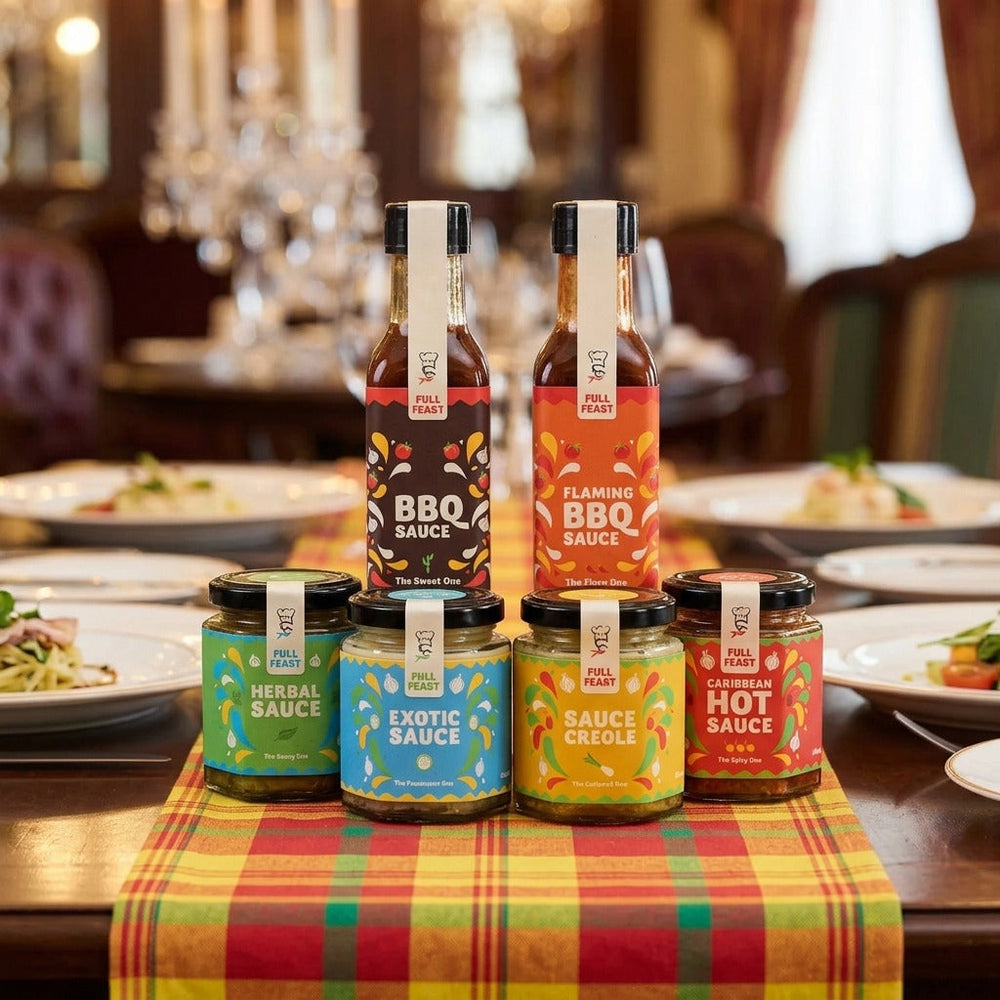
For that I reach for our Caribbean Sauce Creole. It is mostly onion, with green chilli for a clean, fresh heat, a little vinegar and white pepper. No tomato, nothing heavy. A spoonful over a slice of breadfruit soaked in coconut sauce wakes the whole plate without hiding the nutmeg and turmeric. It is good with fish cakes too.
FAQ
What is the national dish of Grenada? Oil down. It is a one-pot stew of breadfruit, salted meat or fish, chicken, dumplings, callaloo and vegetables cooked in coconut milk with turmeric, herbs and spices until all the liquid is absorbed.
Why is it called oil down? Because the coconut milk is cooked down until no liquid is left. Its oil is soaked up by the food or settles at the bottom of the pot.
What type of food is in Grenada? Creole cooking with African, French and Indian roots: oil down, callaloo, breadfruit and dasheen, salt fish, curries with dal puri, aloo pie, doubles, bakes and fish cakes, and plenty of nutmeg and mace.
Why is Grenada called the Spice Isle? Because of its nutmeg and mace. Grenada is the second largest nutmeg producer in the world after Indonesia, and a nutmeg appears on its national flag.
Can I make oil down without breadfruit? Yes. Yam or potato works well in its place, spinach can replace callaloo, and dasheen can be left out. Soak the salted meat or fish first.
One small thing to try this week
Buy a whole nutmeg. Not the powder in a jar, a whole one, and a small grater. This weekend, grate a little over something you already cook: a pot of rice, a creamy sauce, a bowl of porridge, a pumpkin soup.
Smell it as it falls. That warm, sweet, slightly sharp smell is the smell of a kitchen in Grenada. Once you have that, you are halfway to your first oil down.
JP