Doubles, Pelau and Callaloo Through the Eyes of a Guadeloupe Cook
Trinidad is only a short flight south of Guadeloupe, but the first time I ate Trinidad food properly was in London. A friend from Port of Spain handed me a small parcel wrapped in paper, warm and already a little soaked through. Two soft fried breads, curried chickpeas, tamarind, a sharp hit of pepper. Doubles.
I ate it standing on the pavement, and I understood something straight away. This was the food of the island’s Indian families, the same story as my own colombo back home, but it had taken a completely different road.
That is what I love about the food of Trinidad and Tobago. Every plate carries a piece of somebody’s journey. So here is my guide: the dishes I think everybody should know, where they come from, how they compare with what we cook in Guadeloupe, and how to bring them into your own kitchen.
What is Trinidad food?
Trinidad food is the cooking of Trinidad and Tobago: Indian, West African, Creole, Chinese, European, Amerindian and Latin American cooking mixed in the same pots. Its best-known dishes are doubles, pelau, callaloo, bake and shark, roti with curry, and, in Tobago, curried crab and dumplings.
Where Trinidad food comes from
Every dish on the islands tells you who arrived and what they carried. The Amerindian peoples left farine, still eaten at breakfast. Enslaved Africans brought their leafy stews and one-pot rice, and made them work with what grew around them. The Portuguese left garlic ham, the carne vinha-d’alhos that still comes out at Christmas. Chinese families brought fried rice, chow mein, pows and wontons.
Then came the biggest change. Between 1845 and 1917, about 147,592 people came from India to Trinidad as indentured labourers. They brought curry, roti, chickpeas and a whole vegetarian kitchen. Today Divali, Eid and Indian Arrival Day are public holidays, and you can taste that history on almost every street corner.
It is the same story as Guadeloupe, told in a different accent. Our first Indian workers landed at Pointe-à-Pitre on 24 December 1854, on a ship called the Aurélie. From them came our colombo. In Trinidad, the same kind of journey gave the world doubles and buss up shut.

Doubles, the national snack
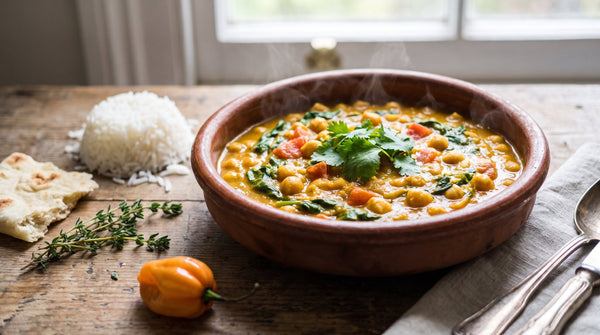
If you only taste one Trinidad food, make it doubles. Two baras, soft fried flatbreads, are filled with curried channa, which is what Trinidad calls chickpeas. Then come the toppings: pepper sauce, tamarind chutney, cucumber, or kuchela, a pickle of green mango.
The story most people tell starts in Princes Town, in the south of Trinidad, in the 1930s. Emamool Deen and his wife sold curried channa on a single bara, and called it channa and bara. Customers started asking for a second piece of bread to close it like a sandwich. Two baras, so: doubles. Sources give slightly different years, but they agree on the family and the town.
Doubles are eaten for breakfast, at lunch, or any time a craving comes. Across the island you buy them from stalls, and Curepe, Debe, St. James and Aranguez are famous for them. You can also find doubles stalls in cities with big Caribbean communities, London among them.
The heat is your choice. You ask the vendor for as much pepper sauce as you can handle, and the channa underneath stays gentle and earthy.
Pelau, the pot of burnt sugar
Pelau is the pot that feeds a whole family, and for many people in Trinidad it is the dish that means home. The cook starts by melting sugar in hot oil until it turns a deep caramel. Meat goes into that sugar and comes out dark and glossy. Then rice, pigeon peas and coconut milk go in, and everything cooks together in one pot.
The Trinidad Guardian traces pelau back to the one-pot rice dishes of West Africa, such as jollof rice and benachin. The burnt sugar start is the Caribbean’s own touch, and so are the coconut milk and the peas. That is why the paper calls it widely regarded as a national dish.
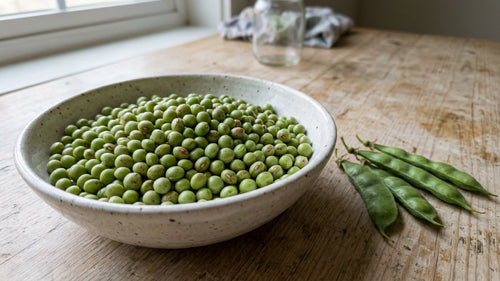
Those peas are the same ones we cook at Christmas in Guadeloupe: pois d’Angole, or pwadibwa in our Creole. I wrote about them in my guide to pigeon peas and how the islands cook them. Same little pea, a very different pot.
In Trinidad every plate carries a piece of somebody's journey. You only have to eat slowly enough to taste it.
JP
Callaloo, crab and dumpling, and Sunday lunch
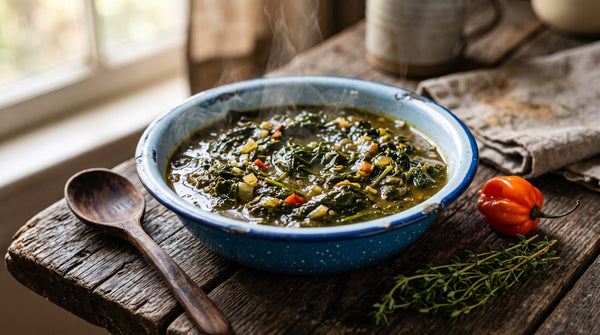
Callaloo is the other dish people name when you ask for the national plate. In Trinidad it is made with dasheen bush, the young leaves of the dasheen plant, cooked with okra, pumpkin, coconut milk and green seasoning. A whole Scotch bonnet goes in unbroken, for perfume, and crab or salted pigtail is added if you like. At the end the cook breaks it all up with a swizzle stick until it is smooth and green.
Enslaved Africans brought the idea of a leafy green stew. On the island, dasheen bush became the leaf, okra gave the body, and coconut milk took the place of palm oil.
Callaloo is a Sunday lunch dish, spooned over white rice beside stewed chicken, macaroni pie and ground provisions. It often comes with coo coo, a cornmeal dish. Macaroni pie, by the way, is pasta baked with eggs and cheese, and nobody in Trinidad would call Sunday lunch complete without it.
In Guadeloupe our calalou is a cousin, not a twin: we cook it with madère leaves and crab at Easter. I explain all the versions in my guide to callaloo across the islands.
Cross over to Tobago and the food turns to the sea. The island’s signature is curried crab and dumplings, the kind of plate you eat slowly, with your fingers, and with a lot of napkins.

Bake and shark at Maracas Bay
Bake and shark is the beach sandwich of Trinidad. A bake, which is fried dough, is split open and filled with seasoned fried fish, then you load it at the counter: lettuce, coleslaw, tomato, pineapple, garlic sauce, a green sauce made with culantro, and pepper sauce.
It belongs to Maracas Bay, on the north coast, probably the most popular beach in Trinidad. The official tourism board says no visit there is complete without a trip to a bake and shark vendor. In Tobago, Store Bay plays the same role, especially at the weekend.
One honest note: many shark species are now endangered through overfishing, and stalls often use catfish or ray instead. If I make it at home, I use a sustainable white fish, and nobody has ever complained.
When I first tasted it I laughed, because it is so close to our bokit, Guadeloupe’s fried bread sandwich. Fried dough, split hot, stuffed and drowned in sauce. Two islands, one very good idea.
Roti, curry and the sauces on every table
Roti is the everyday bread of Indian Trinidad. Sada roti is the simple one, flour, baking powder and water cooked on a flat tawa. Buss up shut is the flaky paratha, beaten until it tears like a burst shirt, for scooping up a curry. Curry duck is one of the best-loved dishes on the island, served with roti or rice. I tell the whole story of the wrap in my guide to Caribbean roti and how Trinidad gave it to the islands.
And then there are the sauces, which tell you a lot about a kitchen:
- Pepper sauce: Scotch bonnet or other hot peppers, minced or chopped. Every house has a bottle.
- Green seasoning: a cold blend of culantro, which Trinidad calls chadon beni, with spring onion, garlic and vinegar, used as a marinade for almost everything.
- Chow: green mango or pommerac tossed with culantro, pepper and salt, a sour and fiery snack.
For something sweet, there are tamarind balls, toolum and sugar cake, and an ice-cold coconut from a roadside vendor.
How to cook Trinidad food at home
You do not need to fly to Port of Spain to start. Begin with the dishes that forgive you.
For doubles, the channa is the heart. My Caribbean chickpea curry is a good place to begin: cook it a little looser, add plenty of cumin and serve it between two warm flatbreads with tamarind and cucumber. It is vegan, and it is ready on a weeknight.
For Sunday, make a pot of my Guadeloupe callaloo. It is our Guadeloupe version, but the method is the same family, and in the UK frozen spinach works when dasheen leaves are hard to find. Put it next to a dish of my Caribbean mac and cheese, the baked macaroni pie, and you have a Trinidad Sunday plate.
For pelau, take your time on the sugar. Let it go dark amber but not black, add the chicken, and only then the rice, peas and coconut milk.
The sauce I put beside it
Trinidad is a pepper sauce island. It goes on doubles, on bake and shark, on roti and curry, and almost always it means Scotch bonnet.
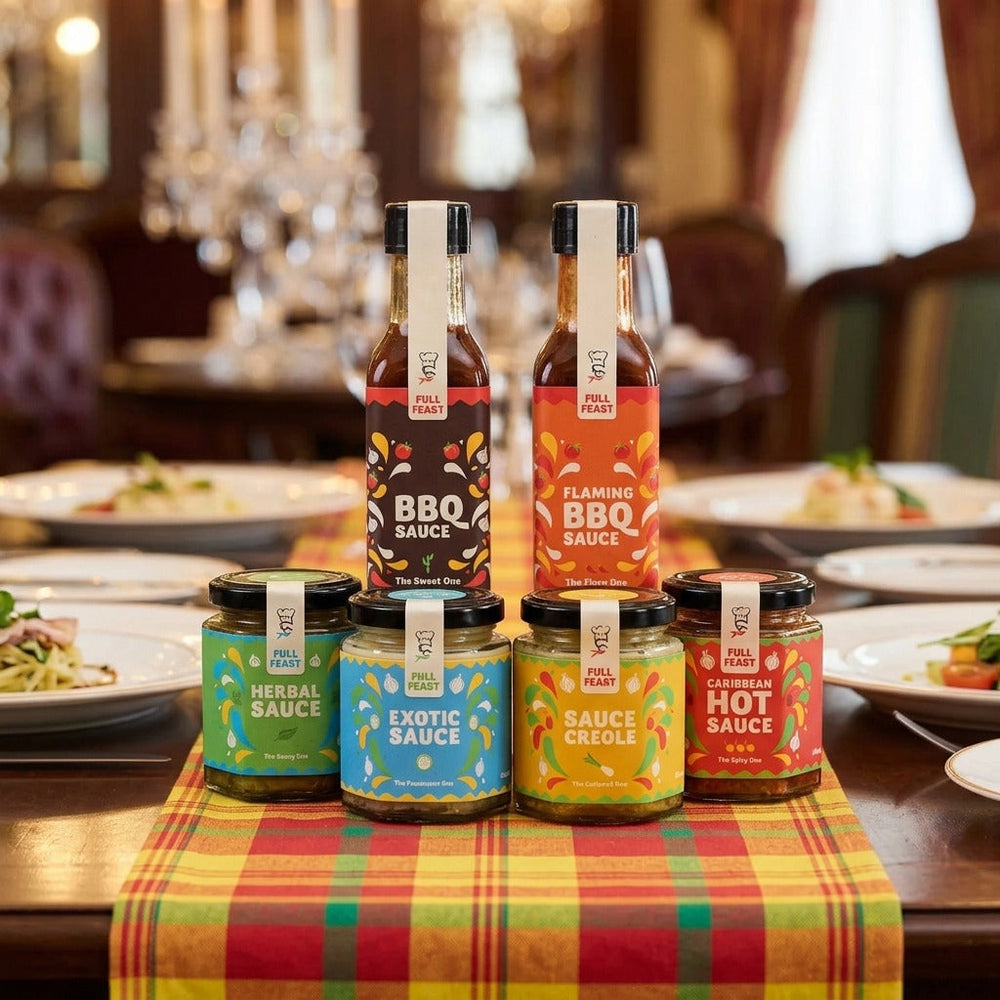
So when I cook Trinidad food at home, the jar on my table is Full Feast Caribbean Hot Sauce. It is mostly Scotch bonnet, 40.6 per cent, with white onion and garlic, and nothing else fighting for attention: no allspice, no thyme, no fruit. That makes it a natural partner for doubles. A few drops on the channa, a spoon inside the bake, a little in the pelau if you like it hotter. It adds the heat and the fruity chilli taste without changing the seasoning you worked on.
FAQ
What are some traditional dishes from Trinidad and Tobago? Doubles, pelau, callaloo with coo coo, bake and shark, roti with curry duck or curry chicken, macaroni pie, and in Tobago curried crab and dumplings.
What is the national dish of Trinidad and Tobago? There is no official one. Callaloo is the dish most often named, and pelau is widely regarded as a national dish too. Doubles is usually called the national snack.
Why is Trinidad food similar to Indian food? Between 1845 and 1917 about 147,592 people came from India as indentured labourers. They brought curry, roti and chickpeas, and those dishes became everyday Trinidad food.
What snacks is Trinidad known for? Doubles first of all, then bake and shark, aloo pie, pholourie, chow, tamarind balls and sugar cake.
What is in doubles? Two soft fried breads called bara, filled with curried channa (chickpeas), topped with pepper sauce, tamarind chutney, cucumber or green mango pickle.
Coo-coo travels between the islands too: in Barbados it becomes cou-cou, the national dish, and I explain it in my piece on Barbados food and the Bajan kitchen.
The sour note behind tambran balls and tambran sauce comes from one tree, and I tell its story in my piece on what tamarind is and how the islands eat it.
One small thing to try this week
Open a tin of chickpeas and cook them with onion, garlic, curry powder and a good pinch of cumin until they are soft enough to crush with a spoon. Warm two small flatbreads, spoon the channa between them, and add cucumber and a little tamarind if you have it.
Then add pepper sauce, as much as you dare. Eat it standing up in your kitchen, the way it is meant to be eaten. You will understand in one bite why a whole island fell in love with it.
JP