Cou-Cou, Flying Fish and the Weekly Rhythm of a Bajan Kitchen
The first thing a Bajan friend ever cooked for me was not a feast. It was a Friday supper in a small London kitchen: a yellow mound of cornmeal, smooth and firm, with okra hidden inside, and a piece of fish in a spicy gravy poured all around it. She stirred the pot with a flat wooden stick and would not let me help.
That was my real introduction to Barbados food. I grew up in Guadeloupe, in my mother’s kitchen, where cornmeal and okra and salt cod were familiar faces. Yet this plate tasted like a cousin I had never met. Same family, different accent.
This month Barbados celebrates 60 years of independence, on 30 November 2026. It feels like the right moment to sit down at the Bajan table and explain what is on it, dish by dish, day by day, from the point of view of a cook from a neighbouring island.
What is Barbados food?
Barbados food, often called Bajan food, is the everyday cooking of Barbados: a mix of African, British, Portuguese, Indian, Irish and Indigenous influences. Its national dish is cou-cou, a cornmeal and okra mash, with flying fish. Meals are usually seasoned meat or fish, hot sides, salad and a pepper sauce.
Where Bajan food comes from
Every Caribbean kitchen tells the story of who arrived and what they carried. The Barbados story has African roots at its centre, with British, Portuguese, Indian and Irish layers on top, and Indigenous traces underneath.
You can taste the African root most clearly in cou-cou. Cornmeal and okra were cheap and easy to find, so the dish became common in the early colonial years. Similar dishes still exist on the other side of the Atlantic: funge in Angola, and banku in Ghana, eaten with okra stew and fish.
The British layer shows up in a surprising place: the calendar. Conkies, the sweet parcels every Bajan waits for in November, were once made for Guy Fawkes Day on 5 November, long before they became an Independence Day treat.
Cou-cou and flying fish, the national dish
If you only learn one Bajan dish, learn this one. Cou-cou is cornmeal cooked slowly with okra and its cooking water until it turns smooth and firm enough to hold a shape. On the other islands it has cousins: fungee in the Leeward Islands and Dominica, coo-coo in the Windward Islands, and in Trinidad it is served with callaloo and fish.
The secret is the stirring. Bajan cooks use a cou-cou stick, a long, flat, rectangular piece of wood, and many will tell you that you cannot get the right firm texture without one. Breadfruit can replace the cornmeal for a different version.
Beside it comes the flying fish, fried or steamed, with a spicy gravy. The fish matters so much here that its picture is on the money. It is traditionally a Friday dish, at home and in small cafés across the island, though you will meet it on Saturday too.

For a Guadeloupe cook the okra part feels like home. We call it gombo, and I wrote a whole piece on okra and how I cook it, including how to keep it from turning slimy. In cou-cou, though, that silky texture is exactly the point. It is what makes the cornmeal smooth.
Fridays are fish, Saturdays are for souse
What I love most about Bajan food is that it keeps a calendar. The official Barbados tourism site puts it simply: fish on Friday, souse on Saturday, and a big spread after church on Sunday.
Friday belongs to the sea. The fishing village of Oistins hosts the most famous fish fry, busiest on Friday night, with flying fish as the star. Fried fish and a cold Banks beer from a rum shop, and there is a rum shop on every corner.
Saturday is for pudding and souse, and it surprises everyone the first time. Souse is pickled pork, and it can use many parts of the pig. The pudding is steamed sweet potato seasoned with onion, salt and pepper. Despite its name it is savoury, not a dessert. You find it sold at the roadside and in rum shops on Saturday mornings.
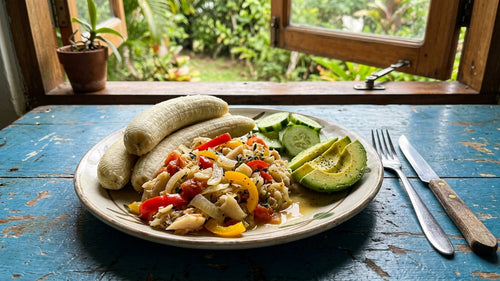
Sunday is the family plate: rice and peas, macaroni pie, chicken, vegetables or salad.
A kitchen that keeps a calendar is a kitchen that keeps its people together. Barbados knows that.
JP
Macaroni pie and the Sunday table
In Barbados, pie usually means macaroni pie. It is baked macaroni bound with grated cheddar, evaporated milk, egg and onion, and many cooks add a little ketchup and yellow mustard. It is firm enough to cut into squares, and it is a fixture of Sunday lunch.
I grew up with a gratin of macaroni at family gatherings in Guadeloupe too, so this one I understood at the first bite. My own version, the Caribbean mac and cheese baked as a macaroni pie, is the closest thing on Full Feast to a Bajan Sunday side.
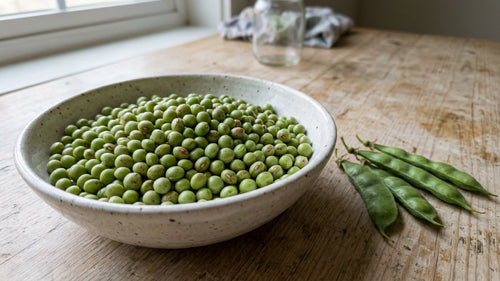
The rest of the hot sides are the ones you will know from the whole region: rice and peas, fried plantain, breadfruit, sweet potato, buttered cassava or yam.

Fish cakes, cutters and bakes: Bajan street food
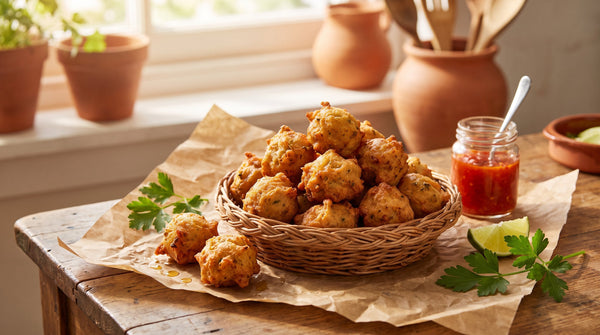
Bajan fish cakes are the breakfast and party snack of the island. Salt cod is boiled to take out the salt, flaked, then mixed with flour, baking powder, onion, herbs and often a little hot pepper. Spoonfuls go into hot oil until they puff and turn golden. They come hot, with pepper sauce, sometimes tucked into a soft salt bread from the market in Bridgetown.
Here Guadeloupe and Barbados really shake hands. Our accras de morue, the saltfish fritters my mother fried every holiday, are close relatives. Both islands learned to love salted cod for the same reasons, and I tell that story in my piece on saltfish and how it crossed the ocean.
Then there are cutters, which are sandwiches. The classic is fried flying fish in a soft roll, but you can find others with fillings such as liver. And bakes, small fried dough breads, were once seen as survival food because they need so little. Today they are simply breakfast.
Conkies and Independence Day
Every November Barbados makes conkies. They are a sweet, steamed mixture of cornmeal, grated pumpkin, sweet potato, coconut and raisins, wrapped in banana leaves. For years neighbours have shared their banana leaves so that everyone can make a batch.
Conkies were once tied to Guy Fawkes Day on 5 November. After Barbados became independent on 30 November 1966, they moved to the new national day, and today they are eaten and sold through the whole month. This year is a big one: the 60th anniversary, with the Independence Parade at the Garrison Savannah.
Something I find touching: in Saint Lucia and Trinidad the same kind of parcel is called paime, and in Saint Lucia it belongs to Creole Day at the end of October. The same food, carried from island to island, finds a different celebration each time.
Bajan pepper sauce, the yellow one
You cannot talk about Barbados food without its pepper sauce. Bajan pepper sauce is built on Scotch bonnet peppers, mustard and vinegar, with smaller amounts of onion, oil, black pepper and turmeric. The mustard and turmeric give it that bright yellow colour. Every family has its own recipe, and they argue happily about whether to cook it or leave it raw.
It goes on fish, on chicken, on meat, on fish cakes, on almost everything. If you want to know why the Scotch bonnet suits it so well, I explain in my Scotch bonnet guide: that fruity taste before the heat arrives.
How to cook Barbados food at home
You do not need a ticket to Bridgetown. Start with the dishes that forgive you.
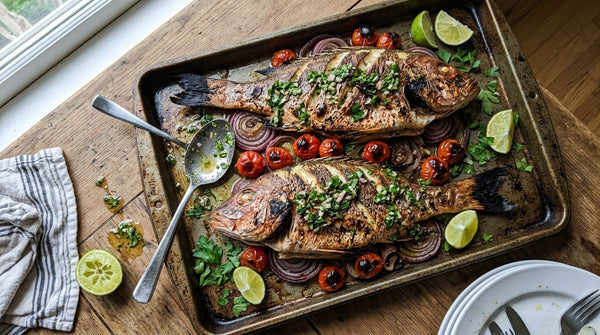
- A Friday fish supper. Fry or steam a small white fish fillet and make a gravy of onion, tomato, garlic, thyme and pepper. If you cannot find flying fish, I use any small, thin white fillet. My whole roasted Caribbean red snapper is the grand version for a weekend.
- Cou-cou. Slice okra and simmer it in salted water. Take out the okra, then whisk fine cornmeal into the hot okra water, return the okra and stir with a flat wooden spoon over low heat until the mash comes away from the sides. Shape it in a buttered bowl and turn it out.
- Fish cakes. Use the same soaked salt cod as my accras de morue, add a little more flour and baking powder, and fry spoonfuls until golden.
- Sunday. Bake a macaroni pie and put it next to rice and peas and chicken. That is the plate.
Read more about how the neighbouring islands eat in my guide to Trinidad food, from doubles to pelau. The two kitchens share more than you would think, coo-coo included.
The sauce I put beside it
Bajan cooking is pepper sauce cooking. I would never pretend a jar from Guadeloupe is a Bajan sauce: the real one has mustard and turmeric, and mine has neither.
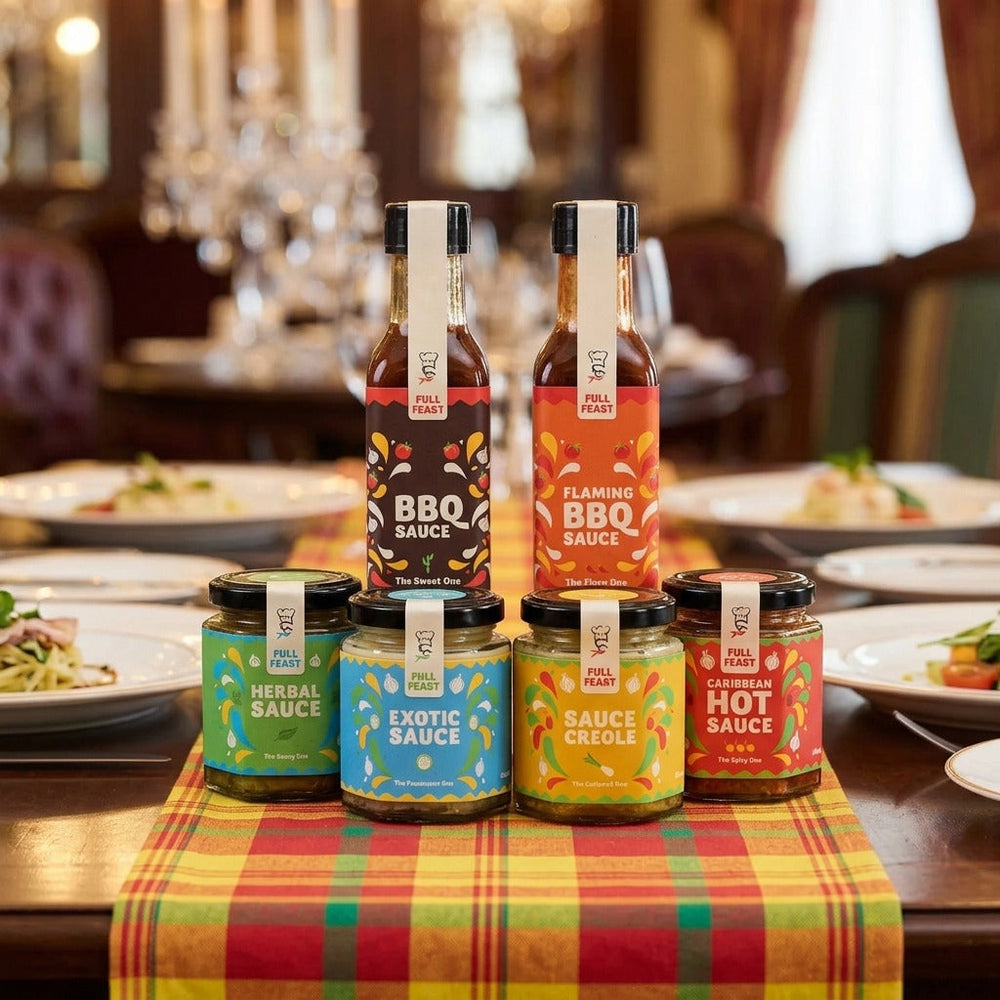
But when I cook flying fish, fish cakes or a Sunday plate at home, the jar on my table is Full Feast Caribbean Hot Sauce. It is mostly Scotch bonnet, 40.6 per cent, with white onion, garlic and white pepper. A few drops in the fish gravy, a spoon beside the fish cakes, a little on the cou-cou. It brings the heat and the fruity chilli taste that Bajan food loves, and it lets the dish speak for itself.
FAQ
What are some common foods in Barbados? Cou-cou and flying fish, pudding and souse, macaroni pie, fish cakes, cutters, bakes, rice and peas, pepperpot and conkies, with Bajan pepper sauce on the side.
What is the national dish of Barbados? Cou-cou and flying fish. Cou-cou is cornmeal and okra cooked into a firm mash, served with fried or steamed flying fish in a spicy gravy.
What is cou-cou made of? Mainly cornmeal and okra, cooked together with the okra water and stirred with a flat wooden cou-cou stick. Some cooks make it with breadfruit instead of cornmeal.
What is pudding and souse? A Saturday dish: souse is pickled pork, and pudding is steamed sweet potato seasoned with onion, salt and pepper. It is savoury, not sweet.
What food is eaten on Barbados Independence Day? Conkies: cornmeal, pumpkin, sweet potato, coconut and raisins, steamed in banana leaves. They are made and sold all through November, up to 30 November.
Conkies have cousins all over the islands, and I walk through them, island by island, in my guide to Caribbean desserts.
One small thing to try this week
Make a small pot of cou-cou. Slice six or seven okra, simmer them for ten minutes, lift them out, then whisk a cup of fine cornmeal into the hot water. Stir, stir, stir, put the okra back, and keep going until it is smooth and thick.
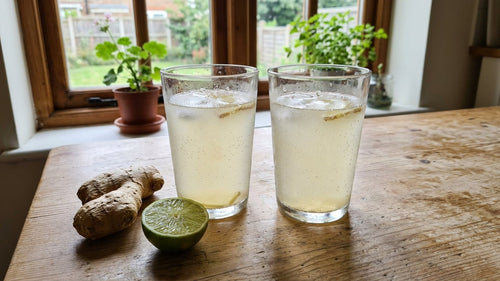
Turn it out into a buttered bowl, then onto a plate. Pour over a quick gravy of onion and tomato, add a piece of fried fish, and a few drops of hot sauce. On 30 November, raise a glass of sorrel or ginger beer to Barbados at 60.
JP