The Warm, the Hot and the Green, From a Guadeloupe Kitchen
The covered market in Pointe-à-Pitre smells of spice before you are through the door. The stalls sell it in little paper cones and plastic bags tied with a knot: cinnamon sticks, nutmegs still in their shells, colombo powder in yellow heaps, allspice berries, vanilla, and bundles of fresh thyme and cive next to the hot peppers.
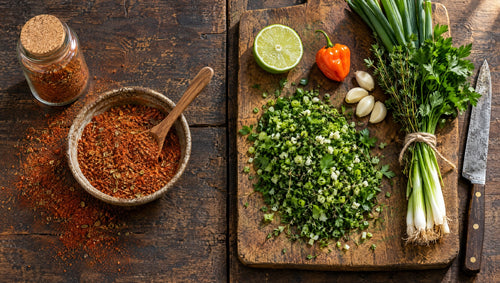
When people in Britain hear “Caribbean food”, most of them think of heat. Heat is part of it. But stand at one of those stalls and you understand that Caribbean cooking is really built on three things: warm spices, hot peppers, and fresh green seasoning. Get those three into the same pot and you are cooking Caribbean, whatever the recipe says.
Here is how I sort them, the way my mother’s kitchen sorted them.
What are Caribbean spices?
The main Caribbean spices are allspice, nutmeg and mace, cinnamon, cloves, ginger, black pepper and Scotch bonnet chilli, with turmeric, coriander and cumin in the curry blends. Alongside them, almost every dish uses a fresh seasoning of thyme, spring onion, garlic and parsley.
Most of these came from somewhere else. Allspice and the hot peppers are native to the Americas. Nutmeg, cinnamon, cloves and ginger arrived from Asia with European trade. The curry spices came with Indian indentured workers in the nineteenth century. The Caribbean took all of them and made something its own.
The warm spices
These are the backbone. They are the flavours British cooks know from Christmas cake and mulled wine, and the biggest surprise for them is that in the Caribbean they go into savoury food.
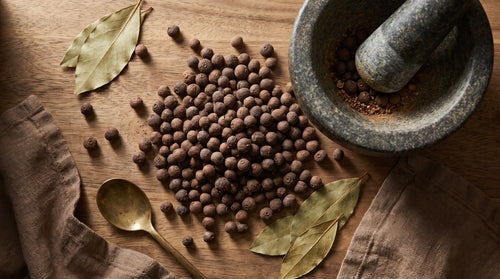
Allspice. If I could keep only one, it would be this. A small dried berry that tastes like clove, cinnamon and nutmeg at once, and the spice that makes jerk taste like jerk. In Jamaica it is called pimento. I have written a whole piece on what allspice is, and on the bois d’Inde leaf we use in Guadeloupe.
Nutmeg and mace. Nutmeg is the seed, and mace is the red lace that wraps around it. Grenada calls itself the Spice Isle and has a nutmeg on its flag. We grate nutmeg into punches, into custards, and into meat dishes more than you might expect. Buy it whole and grate it fresh; the powder fades fast.
Cinnamon. Sticks in the pot for stews and in the punch bowl at Christmas, and in the dark, sweet shrubb we drink in December.
Cloves. Strong, so a few at a time. Into a ham glaze, a pot of pigeon peas, a syrup.
Ginger. Fresh, in marinades and in drinks. Ginger and lime is one of the great Caribbean partnerships, and it is the reason a good sorrel drink has a bite.
The heat
Scotch bonnet. The pepper of the Caribbean. Small, lantern-shaped, very hot, and fruity under the heat in a way that most chillies are not. The trick, which every Caribbean cook knows, is that it does not have to be cut: a whole Scotch bonnet floated in a pot gives perfume and only a little warmth. My Scotch bonnet guide covers how to handle it and how hot it really is.
Black and white pepper. Easy to forget, always there. White pepper especially is a quiet part of a lot of French Caribbean cooking.
The green
This is the part people miss, and it matters as much as the dried spices.
In Guadeloupe almost everything starts with a fresh seasoning: thyme, cive (our spring onion), garlic, parsley, a piece of hot pepper, and lime. It is chopped by hand and used the same day. Trinidad has its own version, blended and kept in a jar, called green seasoning. I wrote about ours, and how it differs from the Louisiana powder sold in shops, in my piece on Creole seasoning.
Thyme deserves its own line. Fresh thyme, whole sprigs, goes into nearly every pot in the French Caribbean. If you only buy one fresh herb for Caribbean cooking, buy thyme.
Bay and bois d’Inde leaves go into the pot whole, the way bay goes into a British stew, and come out at the end.
The curry spices
In Guadeloupe and Martinique, curry means colombo. It is a ground blend that usually includes turmeric, coriander, cumin, fenugreek, mustard seed and black pepper, and many families add toasted rice to thicken the sauce. It came with workers from southern India from 1854, and it is now as Guadeloupean as anything on the island. The full story is in my piece on the history of colombo, and my favourite way to use it is poulet colombo.
The English-speaking islands have their own curry powders, heavy on turmeric, and the curry goat and curry chicken that came to Britain with them.
How they come together
Each of the great Caribbean dishes is really a particular mix of these three groups.
Jerk is allspice, Scotch bonnet and thyme, with spring onion, garlic and lime. My jerk seasoning shows both the dry rub and the wet paste.
Colombo is the curry spices, with the fresh green seasoning and a whole hot pepper.
A Creole stew is the green seasoning, a little allspice or a bois d’Inde leaf, and pepper.
A Christmas punch is nutmeg, cinnamon and lime, and of course rum.
A starter shelf for a British kitchen
If you want to cook Caribbean food at home, you do not need a new cupboard. Six things will take you a long way:
- Whole allspice berries
- Whole nutmegs and a small grater
- Cinnamon sticks
- A good colombo or Caribbean curry powder
- Fresh thyme, every time you shop
- Scotch bonnets, or a hot sauce made with them
You will find most of these in any Caribbean grocer, in the world food aisle of larger supermarkets, and online.
Where our sauces fit
I want to be honest about this, because people ask. My sauces are not spice blends. They are simple: mostly onion and chilli, with garlic, vinegar, salt and pepper in different measures, and in the Herbal sauce shallots, basil, coriander and a little mustard. You will not find allspice or nutmeg in any of them.
That is on purpose. The spices belong in your pot, where they have time to cook. The sauce is what you add for heat and freshness: a spoon of Caribbean Hot Sauce for Scotch bonnet fire, or Caribbean Sauce Creole for a sweet onion base with a gentle green chilli warmth. They sit on top of the spices instead of fighting them.
FAQ
What spices are used in Caribbean food?
The main ones are allspice, nutmeg, cinnamon, cloves, ginger, black pepper and Scotch bonnet, plus turmeric, coriander and cumin in curry blends such as colombo. Most dishes also use a fresh seasoning of thyme, spring onion, garlic and parsley.
What is the most important spice in Caribbean cooking?
If I had to choose one, allspice. It is native to the region, it gives jerk its flavour, and it turns up in stews, marinades and drinks across the islands. Fresh thyme comes a very close second.
Is Caribbean food always spicy?
No. Most Caribbean food is well seasoned rather than hot. The heat usually comes from a whole Scotch bonnet in the pot or a hot sauce on the table, so each person can decide how much they want.
What is the difference between Caribbean and Indian spices?
Many are the same, because Indian workers brought their spices to the Caribbean in the nineteenth century. The difference is in the use: Caribbean cooking leans on allspice, thyme and Scotch bonnet, which are not part of Indian cooking, and Caribbean curries such as colombo are usually simpler blends.
Where can I buy Caribbean spices in the UK?
Caribbean grocers have everything, often fresher and cheaper. Larger supermarkets carry allspice, nutmeg, Scotch bonnets and Caribbean curry powder in their world food aisles, and colombo powder is easy to find online.
One small thing to try this week
Next time you make a stew, put in a sprig of thyme, four allspice berries and a whole Scotch bonnet, uncut. Take the pepper out before you serve.
You will not have made a Caribbean dish. But your kitchen will smell like one, and that is how it starts.
JP