Braised Creole Style Until They Fall Off the Bone
When I was a boy in Guadeloupe, my mother cooked cabri, goat, for the days that mattered. A baptism, a communion, a cousin home from France. She bought the meat with the bone still in, because she said the bone is where the taste lives, and she cooked it slowly in one big pot until the whole street knew what we were eating. Seven children around that pot, all of us pretending we were not hungry.
When I came to London, cabri was hard to find. So I went to the butcher and asked him what cut of lamb behaves like goat. He held up a lamb shank. Tough, he said, full of sinew, needs three hours. I laughed, because that is exactly what my mother would have said about a good piece of cabri.
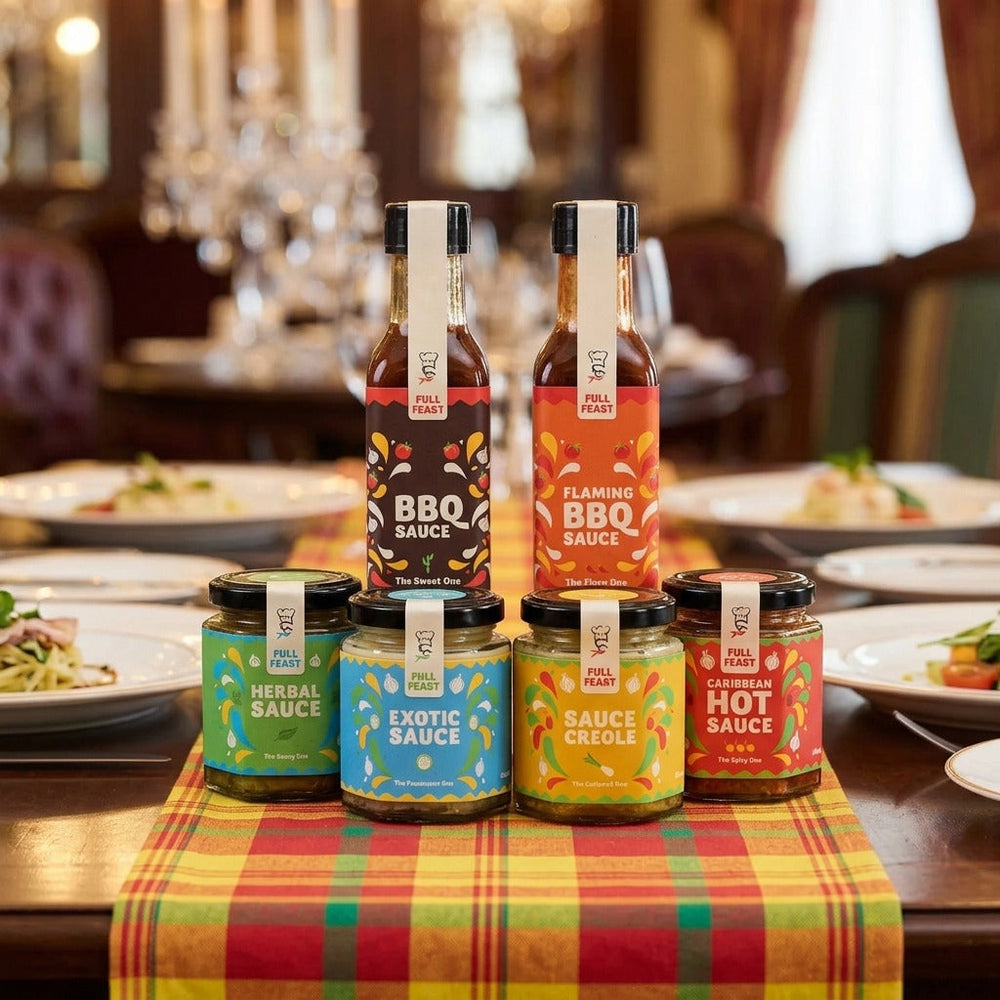
That is how this lamb shank recipe was born. It is not a traditional Guadeloupe dish. Lamb shanks are a British butcher’s cut, and red wine braises are the way most people here cook them. This is my version: the shank cooked the way my mother cooked her Sunday meat. A marinade of lime, garlic, thyme and allspice. A hard browning in the pot. Then onions and sweet peppers, and a good spoonful of Caribbean Sauce Creole, and a long, slow afternoon in the oven.
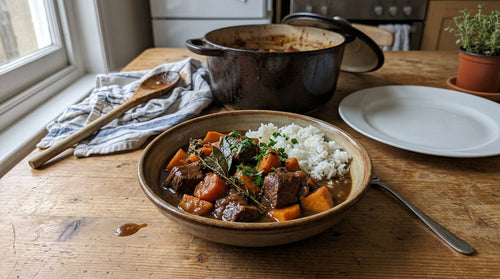
When the lid comes off, the meat has pulled back from the bone and the sauce has turned dark and glossy and sweet. You do not need a knife. You need a spoon, a pile of mash or rice, and somebody to share it with. I cook this on the coldest Sundays of the year, and I promise you the kitchen will smell like home.
Recipe at a glance
- Cuisine: Caribbean fusion (French Caribbean flavours, British cut)
- Prep: 20 minutes (plus marinating, 1 hour or overnight) • Cook: 3 hours • Total: 3 hours 20 minutes
- Serves: 4
- Featured sauce: Caribbean Sauce Creole
- Heat level: 5/10, a gentle green chilli warmth in a sweet onion sauce
- Diet: Gluten free and dairy free as written (use gluten free stock)
What you’ll need
Four shanks, one heavy pot with a lid, and patience. That is the whole secret. Ask your butcher for shanks of about 400 g each; the hind shanks are meatier if you can get them. The jar of Caribbean Sauce Creole does a lot of the work here: it is mostly sweet cooked onion with green chilli, so it melts into the braise and gives it body.
For the marinade:
- 4 lamb shanks (about 1.6 kg in total)
- Juice of 1 lime
- 4 garlic cloves, grated
- 2 spring onions, finely chopped
- 1 tbsp fresh thyme leaves
- 6 allspice berries, crushed (or 1/2 tsp ground allspice)
- 1 tsp freshly ground black pepper
- 1/2 tsp salt
- 2 tbsp Full Feast Caribbean Sauce Creole
For the braise:
- 2 tbsp vegetable oil
- 2 onions, sliced
- 1 red pepper and 1 green pepper, sliced
- 2 carrots, cut into thick rounds
- 2 garlic cloves, sliced
- 1 tbsp tomato purée
- 6 tbsp Full Feast Caribbean Sauce Creole, plus 1 tbsp to finish
- 500 ml hot lamb or chicken stock (gluten free if you need it)
- 4 sprigs of thyme and 2 bay leaves
- 1 whole Scotch bonnet (optional, left whole, for perfume rather than fire)
- 1 tsp cornflour mixed with 1 tbsp cold water (only if you want a thicker sauce)
- To finish: juice of half a lime and 2 spring onions, sliced
How I make it
- Marinate the shanks. Rub the shanks all over with the lime juice, then the garlic, spring onion, thyme, crushed allspice, pepper, salt and 2 tbsp of Sauce Creole. Massage it in like you mean it. Cover and leave for at least 1 hour, or overnight in the fridge if you can. Take them out of the fridge 30 minutes before cooking.
- Heat the oven. Set it to 160°C (140°C fan, gas 3).
- Brown the meat. Scrape most of the marinade off the shanks and keep it. Heat the oil in a large casserole over a medium high heat and brown the shanks two at a time, turning them, for 8 to 10 minutes per batch until they are deep golden all over. Do not rush this part. The colour you build now is the colour of your sauce later. Lift them onto a plate.
- Soften the onions. Turn the heat down to medium. Add the onions to the same pot with a pinch of salt and cook for 8 minutes, scraping up the brown bits, until soft and golden. Add the peppers, carrots and sliced garlic and cook for 3 minutes more.
- Build the sauce. Stir in the tomato purée and cook for a minute until it darkens. Add the 6 tbsp of Sauce Creole, the saved marinade, the hot stock, the thyme sprigs and bay leaves. Stir and bring it to a simmer.
- Into the oven. Put the shanks back in, nestled down so the liquid comes at least halfway up the meat. Drop in the whole Scotch bonnet if you are using it. Put the lid on and slide the pot into the oven.
- Leave it alone. Cook for 1 hour 30 minutes, then turn the shanks over and spoon the sauce over them. Put the lid back on and cook for another 1 hour to 1 hour 30 minutes. They are ready when the meat has shrunk back from the bone and a fork goes in with no resistance at all.
- Reduce the sauce. Lift the shanks out carefully onto a warm dish and cover them with foil. Fish out the Scotch bonnet (in one piece, please), the bay and the thyme stalks. Skim the fat from the top of the sauce with a spoon. Put the pot on the hob and bubble it for 8 to 10 minutes until it is glossy and coats the back of a spoon. If you like it thicker, stir in the cornflour mix and simmer for 1 minute more.
- Finish and serve. Take the pot off the heat and stir in the last tablespoon of Sauce Creole and the lime juice. Taste, and only then add salt if it needs it. Put the shanks back in the sauce, scatter over the spring onions and bring the pot to the table.

How to cook lamb shanks in the oven, the slow cooker or on the hob
The oven is my favourite, because the heat comes from every side and the pot looks after itself. But you have choices.
- Oven: 160°C (140°C fan), lid on, 2 hours 30 minutes to 3 hours, as above. Small shanks of 300 g can be ready in 2 hours 15 minutes, so start checking early.
- Slow cooker: do steps 1 to 5 in a pan, then put everything in the slow cooker and cook on low for 7 to 8 hours. Use only 350 ml of stock, because nothing evaporates in a slow cooker. Reduce the sauce in a pan at the end.
- Hob: keep the lid on and the heat on the lowest flame you have, turning the shanks every 45 minutes, for about 2 hours 30 minutes. Check the liquid does not catch on the bottom.
The role of Caribbean Sauce Creole in this dish
Most lamb shank recipes lean on red wine for depth. This one leans on onions. The Sauce Creole is about two thirds onion, cooked down with green chilli, oil and vinegar, so when you stir it into the pot it is like adding an hour of slow onion cooking in one spoonful.
Over three hours in the oven it does something beautiful. The onion melts into the lamb juices and turns the sauce sweet and round and silky. The green chilli gives a gentle warmth at the back of your throat, never a burn. And the little acidity of the vinegar cuts through the richness of the lamb fat, the job wine would usually do.
The spoonful I stir in at the very end is my mother’s trick. A slow-cooked sauce gets deep but a little sleepy. One fresh spoon of sauce and a squeeze of lime at the last minute wakes it all up again.
Tips from my kitchen
- Choose a pot that fits. The shanks should sit snugly in one layer. In a pot that is too big the liquid spreads thin and the tops of the shanks dry out.
- Make it the day before. Like every good stew, this is even better tomorrow. Cool it, chill it overnight, and you can lift the fat straight off the top as one hard layer. Reheat gently on the hob, covered, for 25 to 30 minutes until piping hot.
- Watch the salt. Between the marinade, the stock and the Sauce Creole there is already salt in the pot. Always taste at the very end before you add more.
- The Scotch bonnet stays whole. Whole, it gives the sauce its fruity perfume with only a little heat. If it splits, the pot gets very hot very fast. Lift it out gently with a spoon.
- Like it hotter? Put Caribbean Hot Sauce on the table and let everyone add their own.
What to serve it with
Lamb shank with mash is the British way, and I will not argue with it: a soft, buttery pile of potato (or olive oil mash if you want to keep it dairy free) catches every drop of sauce. Back home we would put it with rice, and my rice and peas is perfect here, creamy with coconut milk and thyme.
For something sweet on the side, slices of fried plantain go beautifully with the dark onion sauce. On a cold winter Sunday I also make my Caribbean red cabbage, because its sharpness against the rich lamb is a very good marriage. Some green beans or buttered greens and you have a feast.
And if you love slow-cooked lamb, try my Caribbean BBQ lamb shoulder next time you have a crowd, or the beef short ribs that cook in the same patient way.

FAQ
Why are my lamb shanks tough?
Nearly always because they are not cooked long enough. A shank is full of connective tissue, and it gets tougher before it gets tender. Only after a long, slow braise does that tissue melt and turn the meat soft. If yours are still firm after 2 hours 30 minutes, put the lid back on and give them another 30 minutes. Keep the heat low and the lid tight: fast boiling makes the meat stringy.
Can you overcook lamb shanks?
Yes, but it takes some doing. After 4 hours or more the meat starts to fall into threads and can taste dry, even sitting in sauce. You want it to come away from the bone easily but still hold its shape on the plate. Check at 2 hours 30 minutes and every 20 minutes after that.
How long do you cook lamb shanks in the oven?
At 160°C (140°C fan), covered, 2 hours 30 minutes to 3 hours for shanks of about 400 g. Smaller shanks need less, bigger hind shanks a little more. Turn them once halfway so both sides spend time in the sauce.
Can you freeze lamb shanks?
Yes. Cool them in their sauce, then freeze in a sealed container for up to 3 months. Defrost overnight in the fridge and reheat gently in a covered pan until piping hot all the way through to the bone. The sauce protects the meat, so they freeze better than almost anything else I cook.
Is this lamb shank recipe gluten free, and what allergens are in it?
As written, yes, it is gluten free and dairy free. The thickener is cornflour, and Caribbean Sauce Creole is lab tested gluten free. Just check your stock is gluten free too, and remember that some stocks contain celery. The sauce’s vinegar is made from barley, which is declared on the label, so read it if you are cooking for someone with a cereal allergy. If you serve it with butter mash, the plate is no longer dairy free.
Final word from me
This is not a fast recipe, and that is the point. You do the work in twenty minutes, then the oven does the rest, and you spend the afternoon with the people you love while the kitchen fills with that smell. When you lift the lid, call everybody to the table. My mother would want it that way.
Bon appétit, and cook it with love.
JP