The Root Guadeloupe Turns Into Flour, Flatbread and a Fierce Avocado Mash
The first time I saw cassava sold in London, it was lying in a box outside a grocer in Brixton, long and brown and dusty, with a label that said yuca. The woman next to me picked one up, frowned, and put it back. I understood. It looks like a piece of firewood.
Back home in Guadeloupe we call it manioc, and it was never a mystery. My grandmother kept a tin of farine de manioc, the coarse flour made from the root, next to the salt and the oil, and shook a spoon of it into the juices of a stew so the plate was never left wet. On Sundays there was féroce, the avocado and salt cod mash the flour holds together, and on market days there was kassav, the flat round cassava bread, still warm, folded around grated coconut.
So let me explain cassava the way I would at my own table: what it is, why it must be cooked properly, what Guadeloupe does with it, and how to cook it in a British kitchen.
What is cassava?
Cassava is the starchy root of a woody shrub called Manihot esculenta, native to South America and now grown across the tropics. The roots are long, with rough brown bark and firm white flesh. It is the same plant that gives us tapioca, and it is sold in the UK as cassava, yuca or manioc. It must always be peeled and cooked. Never eat it raw.
Where cassava comes from
Cassava is an American plant, domesticated in what is now west-central Brazil perhaps as long as 10,000 years ago, and it reached the islands long before any European ship. The word itself is Taíno, the language of the first people of the Greater Antilles: their caçabi became the French and Portuguese cassave, then the English cassava. Manioc comes from the Tupi mandioca, and yuca is Taíno too.
In Guadeloupe it came with the first inhabitants, the Arawaks and the Caribs, and for a very long time it was a staple of the island. A 1989 study from the University of the Antilles put it simply: manioc, as flour or as cassave, is a traditional Guadeloupean food, still made by hand and sold on the markets.
Today cassava feeds hundreds of millions of people across the tropics. It is the third biggest source of carbohydrate in tropical food after rice and maize, and it copes with poor soil and uncertain rain, which is why so many kitchens rely on it.
Sweet cassava and bitter cassava: why it must be cooked
Here is the part every cook needs to know. Cassava roots, peel and leaves contain natural compounds that release hydrogen cyanide when the raw root is cut or chewed. There are two main types. Sweet cassava has a little of these compounds and is what you buy as a vegetable. Bitter cassava has a great deal more and goes to the flour makers, who squeeze and dry the poison out.
For the home cook the rule is simple and old:
- Peel it completely. Cut off the brown bark and the pinkish layer just underneath it, where the compounds concentrate.
- Cook it until tender. Boiling sweet cassava properly makes it safe. Soaking alone is not enough.
- Never eat it raw. Not a sliver, not grated into a salad. The leaves are not eaten raw either.
- Flour and tapioca are already processed. Farine de manioc, cassava flour and tapioca pearls need no special precaution.
In Guadeloupe nobody thinks twice about this, because the knowledge is built into the kitchen. The bitter roots go to the maniocrie. The sweet roots go in the pot.

How Guadeloupe turns cassava into flour and kassav
Drive south from Pointe-à-Pitre along the Basse-Terre coast and you reach Capesterre-Belle-Eau, the heart of manioc in Guadeloupe. The old growing areas run from Petit-Bourg down to Capesterre, with more in the north of Grande-Terre around Anse-Bertrand and on the island of Marie-Galante.
The work happens in a maniocrie, sometimes called a kassaverie. The roots are peeled, washed and grated. The wet pulp is pressed hard to squeeze out the toxic juice, then dried and sifted into flour. It takes a lot of root to make a little flour: the usual figure is about 20 kg of farine from 100 kg of manioc. The flour that comes out is very dry, which is why a tin of it kept for months in my grandmother’s cupboard.
Part of that flour goes to the market as farine de manioc. The rest becomes kassav. The flour is spread on a hot steel plate called a platine and cooked dry, with nothing added, until it sets into a soft round flatbread. Sweet versions are filled with grated coconut or spread with guava jam. The plain one is eaten with coffee. Savoury kassav with cheese, salt cod or vegetables is a newer idea.
At îlet Pérou in Capesterre-Belle-Eau, one family has made cassaves since 1972, three generations now, on plates that are a century old, and visitors can watch the whole process. The markets at Pointe-à-Pitre, Basse-Terre and Sainte-Anne sell kassav too. Eat it warm the same day if you can. It keeps a few days wrapped, and a minute in a dry pan brings it back.
A kassav is only flour and fire. There is nothing to hide behind, so the flour has to be good.
JP
In December 2024, the making of Caribbean cassava bread was added to UNESCO’s list of the Intangible Cultural Heritage of Humanity, on a nomination from Cuba, the Dominican Republic, Haiti, Honduras and Venezuela. Guadeloupe was not among them, since we are a French department, but the bread on their plates and the kassav on ours are the same idea from the same first people: peel, grate, press, dry, sift, then cook the flour on a hot plate.
Féroce: the avocado mash with cassava flour
If you want to taste farine de manioc the way Guadeloupe loves it, make féroce. The name means fierce, and it earns it.
Mash ripe avocado. Add salt cod that has been soaked, poached and flaked, then lime juice, chopped onion, chilli and a little parsley. Stir in two or three spoons of cassava flour. The flour drinks up the juices and gives the mash a slightly grainy body, so it sits firm on the plate instead of sliding. Season it, as the Routard guide says, “férocement”, with real chilli heat. Serve it cold, as a starter or beside grilled fish.
The flour is used the same way across the island table: dusted over sauces, beans and the Sunday peas to soak up the gravy. There is also farine coco and pain de manioc. But féroce is the one I would start with, because it shows you what the flour does.

Cassava, yuca, yam, sweet potato: what is what
In a British shop cassava sits beside everything else that is brown and knobbly, so let me sort them out.
- Cassava and yuca are the same thing. Yuca is the Spanish-speaking Caribbean name, spelt with one c. Yucca, with two, is a different plant altogether.
- Cassava is not a yam. Yams are a completely different plant family altogether. I wrote about them in my piece on what a yam actually is.
- Cassava is not a sweet potato. The sweet potato belongs to the morning glory family and tastes sweet. Cassava is mild and starchy, and its skin is bark, not skin.
- Cassava is not dasheen. Dasheen, the taro we call madère, is a round, ringed corm. If you are curious, read my guide to dasheen and how I cook it.
- Tapioca is cassava starch. The pearls in bubble tea and the school dinner pudding both come from this root. Tapioca is the pure starch; cassava flour is the whole dried root, ground.
How to buy and cook cassava in the UK
Fresh cassava is sold at Afro-Caribbean and Asian grocers, and some big supermarkets now stock single roots, usually grown in Costa Rica. In the world foods freezer you will find bags of peeled frozen cassava chips, honestly the easiest way to start. Cassava flour and garri, the West African roasted version, sit on the dry shelf.
A fresh root should be hard all along, with no soft spots and no grey or black streaks at the cut end. Cassava starts to spoil as soon as it is cut and turns black within a few days, so buy it when you mean to cook it.
Here is how I cook it:
- Boiled cassava. Peel, cut into 7 cm lengths, split each one and pull out the woody core. Simmer in salted water for 20 to 30 minutes until a knife slides through. Serve it like potato, beside a stew, with a spoon of hot sauce.
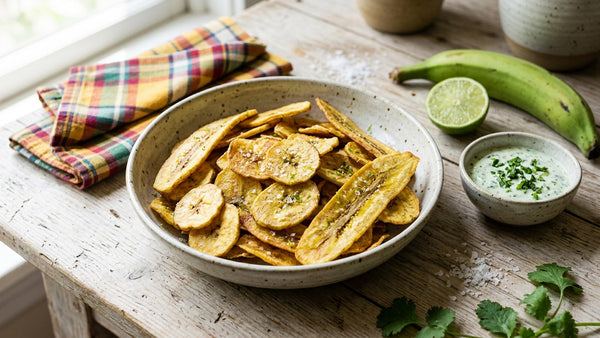
- Cassava chips. Boil as above, drain and let the pieces steam dry. Fry in hot oil until golden at the edges, or toss in oil and roast at 220C for 25 minutes. Fluffier inside than any potato chip. My plantain chips with a green herb dip and these belong on the same table.
- Cassava in a stew. Add peeled chunks to a beef or fish stew for the last 30 minutes, the way we add yam or green banana.
- Farine de manioc. Keep a bag in the cupboard for stews, beans and féroce.
How I eat it: three recipes already on the blog
Cassava and salt cod are old friends, so start with the recipes that have morue in them.
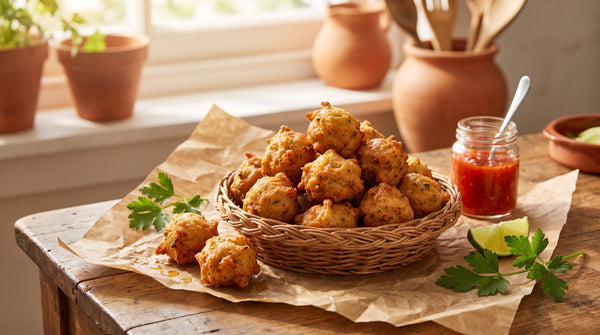
- My accras de morue, the salt cod fritters my mother fried teach you how to soak and flake salt cod, which is the first step of féroce.
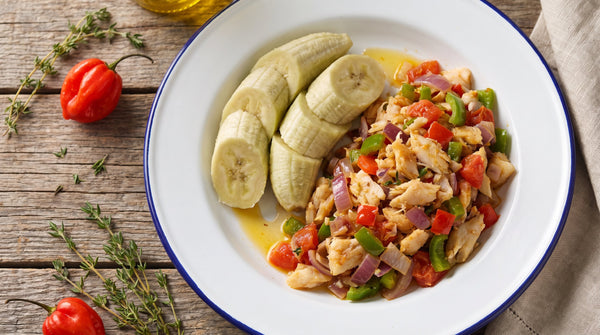
- Green banana and saltfish, the Guadeloupe breakfast I grew up on is the plate where a spoon of farine de manioc belongs, dusted over the top.
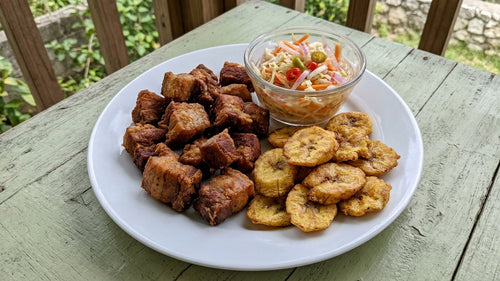
- Fried plantain, bananes pesées, the way my mother made them are cooked exactly like cassava chips: boil, flatten, fry.
Cassava runs through our neighbours’ kitchens too. Haiti was one of the countries behind the UNESCO listing, and I touch on its table in my piece on Haitian food seen from a Guadeloupe kitchen.
The sauce that goes with it
A plate of boiled cassava is a calm, mild thing. It needs salt, a little fat and some heat.
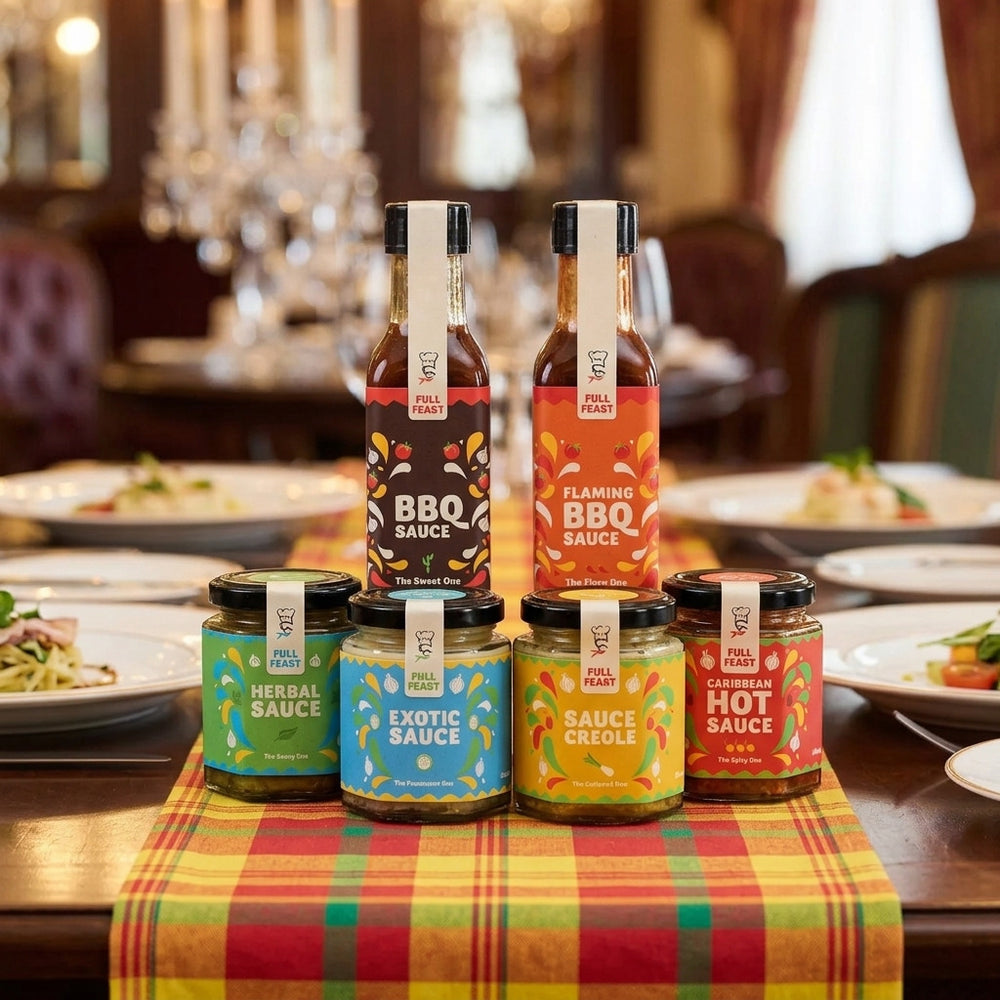
For cassava I reach for Full Feast Caribbean Hot Sauce. It is Scotch bonnet, white onion, garlic and vinegar, with salt and white pepper, and nothing else in the way. A teaspoon stirred into melted butter and spooned over hot boiled cassava is a Sunday lunch from my childhood. The same spoon goes into the féroce in place of fresh chilli, and a dab beside cassava chips makes them disappear faster than any ketchup.
FAQ
Is cassava a sweet potato? No. They are different plants from different families. Sweet potato is sweet and soft inside. Cassava has brown bark, firm white flesh, a woody core and a mild starchy taste, and it must never be eaten raw.
Is cassava the same as tapioca? Tapioca is the starch extracted from cassava, so it comes from the same root but is not the same thing. Cassava flour is the whole dried root; tapioca is only the starch, made into pearls or flour.
What are the two main types of cassava? Sweet and bitter. Sweet cassava has low levels of the compounds that release cyanide and is safe once peeled and cooked. Bitter cassava has far more and is turned into flour by grating, pressing, drying and heating.
Can you eat cassava raw? No. Raw cassava releases hydrogen cyanide and can make you seriously ill. Peel it, remove the pink layer under the bark, and cook it until tender.
What is cassava called in the Caribbean? In Guadeloupe it is manioc, and the flatbread is kassav or cassave. In the Spanish-speaking islands it is yuca and the bread is casabe. In Jamaica the flatbread is bammy.
One small thing to try this week
Buy a bag of frozen cassava chips, the peeled ones. Boil them for twenty minutes in salted water, drain them, and let them steam dry in the colander.
Then fry them in a finger of hot oil until the edges go golden and blistered. Salt them while they are hot and put a small dish of hot sauce beside them.
That is cassava. Nothing to be afraid of, and better than chips.
JP