The Yellow Carambole Guadeloupe Pours Into Juice, and How I Eat It Here
There was a carambolier two gardens down from my mother’s house in Guadeloupe, and for a few weeks each year its branches hung over the fence like a tree somebody had decorated. Waxy yellow fruit, ribbed like little lanterns, dropping onto the path when they were ripe. We called them caramboles. Nobody in Britain calls them that. Here the fruit is star fruit, and most people have only ever met it as a slice on the rim of a cocktail glass.
That is a waste of a good fruit. Back home a star fruit was a glass of juice pressed at the roadside, a wedge sucked on the walk to school, the sour note in a jug of fruit punch. So let me show you what it really tastes like, how to tell a ripe one from a sour one, how to cut it without wasting half of it, and the one serious thing to know before you pass the bowl around.
What is star fruit?
Star fruit is the fruit of Averrhoa carambola, a small tree from Southeast Asia. It is oval, 5 to 15 centimetres long, with five deep ridges running down its length, so every slice cut across the fruit is a five-pointed star. The thin waxy skin turns yellow when it is ripe, the flesh is crisp and juicy, and the whole thing is edible, skin included. In French we call it carambole.
Where does star fruit come from?
Not from the Caribbean, whatever the cocktail menus suggest. The tree is thought to have started in Sri Lanka and the Moluccas, and it has been farmed across Southeast Asia and Malaysia for many centuries. Sea traders carried it to India long before any European saw it. In Malaysia it is belimbing, in the Philippines balimbing, in India kamaranga.
The name we use in the French islands is older than the English one. Carambole comes from the Portuguese carambola, which the Portuguese took from the Marathi word karambal when they reached India. Star fruit is simply the plainest description anyone ever gave it.
It came to our islands late, and in many places it was planted for the look of the tree before anyone cared about the fruit. Then every island gave it a name of its own. Guyana calls it five fingers. Haiti says zibline. In some of the French islands it is cornichon, the word for a small pickled gherkin.
Today Malaysia grows more of it than anyone, and almost all the American crop comes from Florida.

What does star fruit taste like?
There are two kinds, and this is where most British disappointment starts. The small, very sour type is the one with real character, sharp and fragrant, with more of the oxalic acid that gives the fruit its tang. The larger so-called sweet type is milder and, if I am honest, a little bland on its own. Even the sweet ones rarely carry more than 4 per cent sugar, so nobody should expect a mango.
What you get instead is texture and freshness. The flesh is crisp and very juicy, with a flavour people compare to apple, pear, grape and citrus all at once. The Routard guide to Guadeloupe puts it well: a good citrus taste, a little tart when it is properly ripe. Underripe it is as sour as a green apple.
Ripeness changes everything. On the tree the fruit is pale green. As it ripens the body turns yellow while the tips of the ridges go brown, and a fully ripe one is golden yellow with brown edges. Those brown edges are not rot. They are the sign to eat it.
How to choose, store and eat star fruit
At the shop, pick a firm fruit that is bright yellow or yellow-green with just a little browning along the ridge edges. Mostly green means unripe: leave it on the counter out of the sun for a few days. Dark yellow with brown spots all over means it is past its best. Once the ridges have browned, put it in the fridge, where it keeps for about four days.
Cutting it is quick once you know the trick:
- Wash it. You are going to eat the skin.
- Run a knife along each of the five ridges and trim off the thin brown edge. It is slightly bitter and it bruises in transit.
- Slice straight across the fruit, about a centimetre thick, and every slice is a star.
- Flick out the flat brown seeds with the tip of the knife.
- Eat it as it is, skin and all. Two or three fruit make about 450 grams.
Now the serious thing. People with kidney disease must not eat star fruit at all, in any form. The fruit contains a natural toxin that healthy kidneys clear but failing kidneys cannot, and the consequences can be severe. The regional health authority in Martinique has told kidney patients to avoid it in every form: juice, fruit salad, jam, sorbet and the slice on the side of the plate. If that is you, or anyone at your table, leave it out and nobody will mind.

How Guadeloupe eats carambole
At home the carambole is a drink before it is anything else. The travel guides say it plainly: in Guadeloupe it is eaten mostly as juice, pressed by the street vendors who sell fresh fruit juice cheap. A jug of jus de carambole on a hot afternoon, sweetened just enough to round off the sourness, is one of the tastes of my childhood.
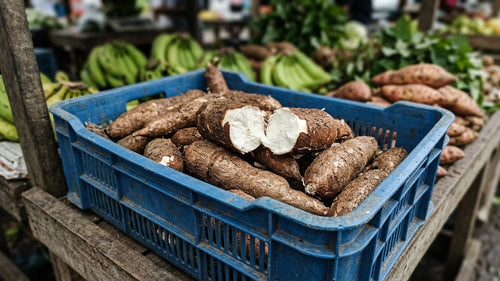
It goes into the fruit punches too, sliced and left to macerate with sapodilla and whatever else is ripe. If you want to see how we build a punch, my guide to rum punch the way Guadeloupe pours it is the place to start. And because the tree is in so many yards, the fruit turns up in the kitchen as an everyday ingredient alongside giraumon pumpkin and malanga root.
The sour types do a job no sweet fruit can. Their juice sharpens stews and curries the way a squeeze of lime would, and the slightly underripe fruit is salted, pickled or cooked down into a confiture. On a plate of grilled fish, a star slice on the edge is the cook saying the tree is in fruit.
A star fruit is not a decoration. Back home it is a drink first, a pickle second and a garnish last.
JP
What the rest of the world does with it
Because the tree grows wherever it is warm, every kitchen has found a use for it:
- In Malaysia the fruit is stewed with sugar and cloves, sometimes with apples.
- Chinese cooks put it in the pan with fish, and Thai cooks boil the green fruit with prawns.
- In Jamaica the ripe fruit is sometimes dried.
- A star fruit jelly needs pectin from another fruit, often green papaya, with lemon or lime. I wrote about green papaya and how we cook it earlier this week.
And one use that has nothing to do with eating: the juice of the sour types dissolves tarnish and rust, so it has been used to polish brass and to bleach rust stains out of white cloth.
Buying star fruit in the UK
Most of the star fruit on British shelves has long come from Malaysia, which still grows more than anyone, so the fruit you buy here has travelled a long way and was picked pale green to survive it. Give it a few days at home before you judge it.
The reliable places are the online exotic-fruit grocers, who sell it singly. When I checked this week, one Asian grocer in the UK had it at £1.79 a fruit, and a specialist exotic-fruit shop listed it at £2.95 each and was sold out. The big supermarkets stock it from time to time, so you will see it one month and not the next. Buy it the way I buy passion fruit and guava in this country: when you see it, take it, and ripen it on the windowsill.
Star fruit and star apple are not the same thing
The names get mixed up, so let me be clear. The star fruit is the yellow, ridged, Asian fruit in this post. The star apple is something else entirely: a round fruit native to Central America and the Caribbean islands, with skin that goes from green to purple, a milky white pulp, and seeds arranged in a star pattern you only see once you cut it in half.
In the French islands we call the star apple caïmite or pomme de lait, milk apple, and you never eat its skin, which carries a latex with an unpleasant taste. You eat the pulp from the half shell. Different tree, different fruit. If a trader hands you something purple and round when you asked for star fruit, you now know why.
How I cook with star fruit at home
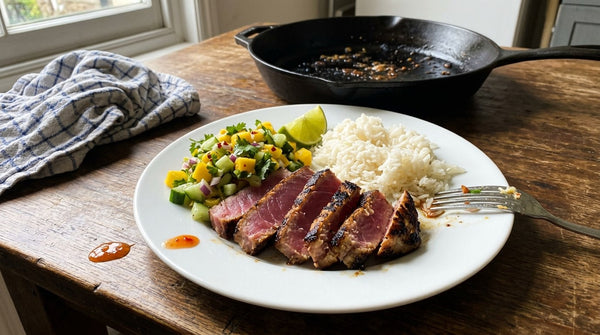
The sweet-sour snap of star fruit is made for the grill. My favourite thing to do with it is a quick salsa: dice two trimmed fruit small, add half a red onion chopped fine, a handful of coriander, the juice of a lime, a pinch of salt and a teaspoon of my Caribbean Hot Sauce. Leave it ten minutes. It is the salsa I spoon over my seared Caribbean tuna steak when the mangoes in the shop are hard, and it is just as good folded through the slaw on crisp Caribbean fish tacos.
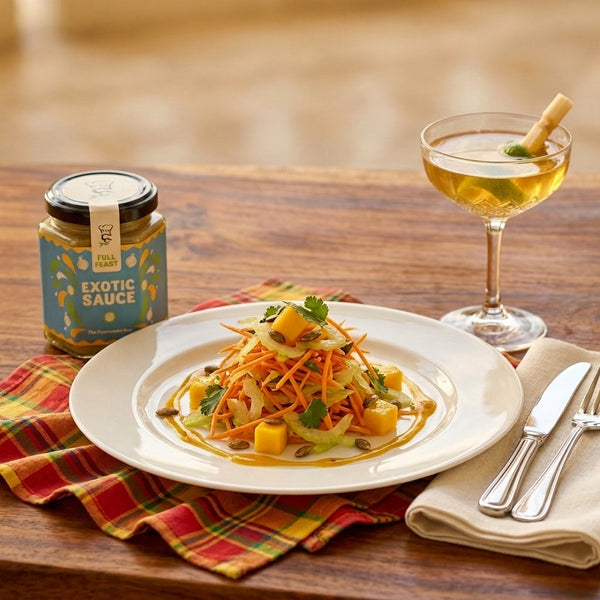
The other place it belongs is a crunchy salad. Slice it thin and toss it through my Exotic mango crunch salad, where its sourness plays against the sweet mango and the carrot. A few slices on a plate of avocado or prawns is the old island habit, and it works.
The sauce I put next to it
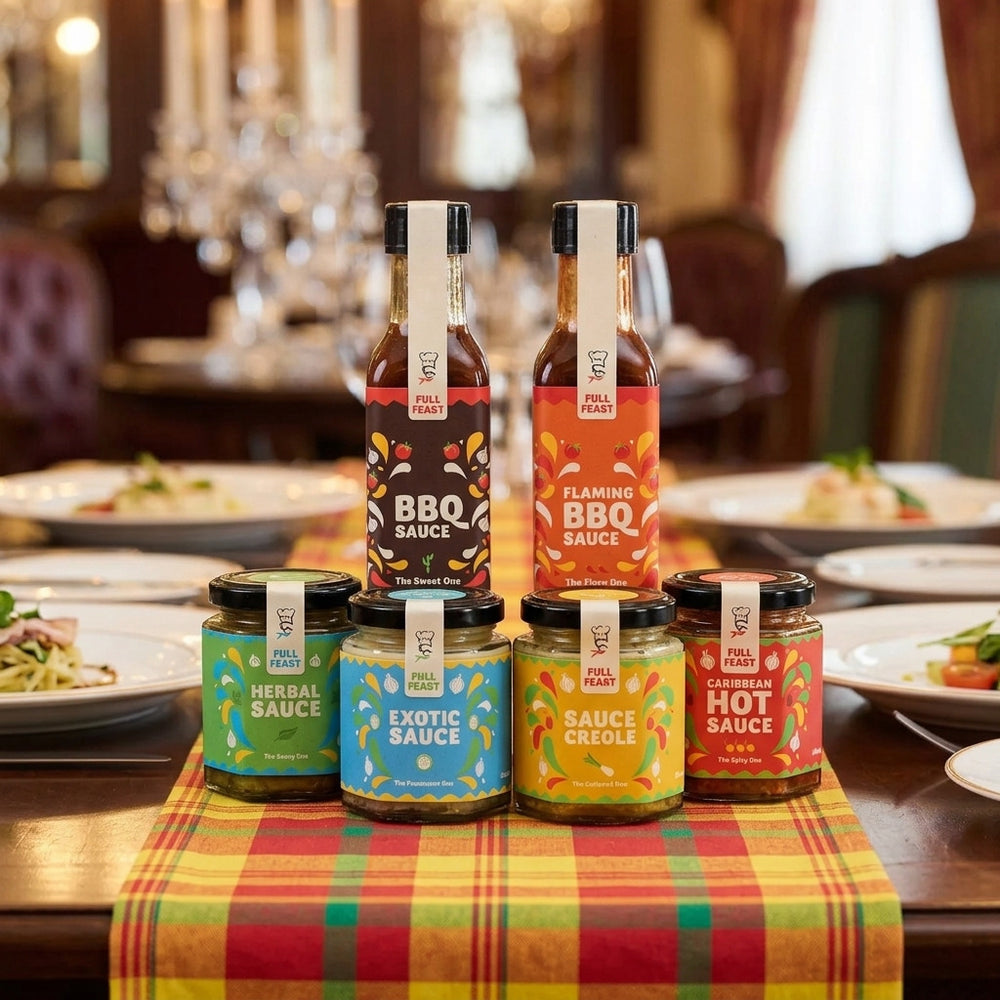
A sour fruit wants clean heat, not sugar. That is why I reach for the Caribbean Hot Sauce rather than one of the sweet ones. It is 40 per cent Scotch bonnet with white onion, oil, vinegar, a little garlic, salt and white pepper, and nothing else. No fruit, no sugar, no spice blend to muddy things. A teaspoon in the salsa, or a few drops on a star slice before it goes onto grilled fish, and the fruit’s sharpness and the chilli’s warmth meet in the middle. It is vegan, and like all six of our sauces it is gluten free by lab test.
FAQ
What does star fruit taste like? Crisp, juicy and fresh, somewhere between apple, pear, grape and citrus. Sour types are sharp and fragrant, sweet types mild. Underripe fruit tastes like a green apple.
Can you eat the skin of a star fruit? Yes. The whole fruit is edible, including the thin waxy skin. Trim the brown edge off the five ridges, which is slightly bitter, slice across, and flick out the flat seeds.
Is star fruit dangerous to eat? For most people, no. For anyone with kidney disease, yes: the fruit contains a toxin that failing kidneys cannot clear, and it must be avoided in every form, including juice, jam and sorbet. Kidney charities and the health authority in Martinique both say so.
Can you get star fruit in the UK? Yes. Online exotic-fruit grocers sell it singly for about £1.80 to £3 a fruit, and the large supermarkets stock it from time to time. Most of it is imported from Malaysia.
Where does star fruit come from? Southeast Asia. The tree is believed to have originated in Sri Lanka and the Moluccas and has been farmed in Malaysia for centuries. Traders carried it to India, the Portuguese named it carambola, and it reached the Caribbean much later.
One small thing to try this week
Buy one star fruit. Just one. Leave it on the windowsill until the body is golden and the edges of the ridges have gone brown, then trim it, slice it and eat a star standing at the counter, the way I did as a boy with the ones that fell over the fence.
If it is a sour one, do not give up on it. Dice the rest with red onion, lime and a teaspoon of hot sauce and put it next to a piece of grilled fish tonight. That is the fruit doing its job.
JP