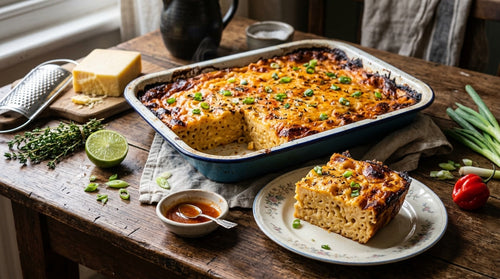
The Creamy Christmas Side From My French Caribbean Table
I will tell you a secret about dauphinoise potatoes. Most people get it wrong. They rinse the potatoes, they use thin cream, they bake them too hot and too fast, and they end up with a dish of hard slices swimming in something that looks like it split. Then they decide dauphinoise is difficult. It is not. It just asks for patience, and a little respect.
People are sometimes surprised that a cook from Guadeloupe loves a dish from the French Alps. But my island is France too. We grew up with the baguette next to the bokit, French cheese next to the boudin créole, and the word “gratin” was in my mother’s mouth every week. Her favourite was gratin de christophine, the pale green chayote we call christophine, scooped out, mashed with garlic and herbs and baked until the top went golden. On Sundays and at Christmas, there was always a gratin on the table, next to the ham and the pigeon peas.
The first time I made a true dauphinoise for a crowd was years ago, for a Christmas party when Full Feast was still a catering company. Forty people, four big trays, and an oven I did not trust. I stood there watching those trays like a fisherman watching the sky. When they came out, bubbling and brown at the edges, the whole room went quiet. That is the power of potato, cream and garlic.
My version keeps the soul of the classic, with one thing from my own kitchen: a few spoons of Fresh Herbal Sauce stirred through the cream. Shallot, basil, coriander, a touch of French mustard and a good amount of salt. It seasons the whole dish from the inside, and it makes the cream taste of something. Let me show you how I make it.
Recipe at a glance
- Cuisine: French, with a French Caribbean touch
- Prep: 20 minutes • Cook: 85 minutes • Total: 1 hour 45 minutes (plus 10 minutes resting)
- Serves: 6 as a side
- Featured sauce: Fresh Herbal Sauce
- Heat level: 0/10, no chilli at all, just herbs, shallot and garlic
- Diet: Vegetarian, gluten free
What you’ll need
This is a short list, so every ingredient matters. Use Maris Piper or King Edward potatoes: they are floury enough to drink up the cream but they hold their shape in thin slices. Use double cream, not single. Single cream splits in a long bake, double cream stays silky. And a mandoline helps a lot, but a sharp knife and a calm hand will do the job. This is my dauphinoise potatoes recipe for the UK kitchen, so everything is in grams, millilitres and °C.
For the dauphinoise
- 1.2 kg Maris Piper or King Edward potatoes
- 400 ml double cream
- 200 ml whole milk
- 3 garlic cloves: 2 thinly sliced, 1 cut in half
- 4 sprigs fresh thyme
- 1 bay leaf
- 4 tbsp Fresh Herbal Sauce
- A good grating of nutmeg (about ¼ tsp)
- Freshly ground black pepper
- 15 g soft butter, for the dish
- Salt, only if needed after tasting (the sauce is already well salted)
To finish
- A few thyme leaves
- A small handful of chopped chives (optional)
You will need an ovenproof dish of about 30 x 20 cm, or a round one about 25 cm across, and around 6 cm deep.
How I make it
-
Heat the oven and ready the dish. Heat your oven to 180°C, 160°C fan, gas 4. Take the halved garlic clove and rub the cut side all over the inside of the dish. Really rub it, so the dish smells of garlic. Then butter it generously.
-
Infuse the cream. Pour the cream and milk into a wide saucepan. Add the sliced garlic, thyme sprigs and bay leaf and bring it slowly to a gentle simmer. As soon as you see little bubbles at the edge, take it off the heat and leave it for 10 minutes. The kitchen will start to smell like a French Sunday.
-
Slice the potatoes. While the cream rests, peel the potatoes and slice them about 3 mm thick. Thin, but not paper. Here is the important part: do not rinse them. That starch on the slices is what thickens the cream and holds the whole dish together. Rinse it away and you get soup.
-
Season the cream. Fish out the thyme sprigs and bay leaf. Stir in the Fresh Herbal Sauce, the nutmeg and a good few turns of black pepper. Now taste it. It should taste slightly too seasoned, because the potatoes will take that seasoning. The sauce carries a lot of salt, so most of the time you will not need any more. Only add a pinch if it tastes flat.
-
Give the potatoes a head start. Put the cream back on a low heat, add the potato slices and stir gently with a wooden spoon so every slice is coated. Let it barely simmer for 5 minutes, turning the slices carefully so they do not catch on the bottom. This little step is my insurance: the potatoes start cooking, the cream starts to thicken, and you will never pull out a dish of hard potatoes.
-
Layer it up. Tip the potatoes into the dish and use your hands or a spoon to lay them flat in overlapping layers, like roof tiles. Pour over every last drop of the cream. The top layer should be just under the cream, not drowning. Press it down gently.
-
Bake covered, then uncovered. Cover the dish with foil and bake for 40 minutes. Then take the foil off and bake for another 35 to 40 minutes, until the top is deep golden, the edges are bubbling and a knife slides through the middle with no resistance at all. You don’t rush this part.
-
Rest it. Take it out and leave it for 10 minutes before you cut it. The cream settles and sets, and the slices hold together when you serve. Scatter over a few thyme leaves and the chives, and take it to the table.

The role of Fresh Herbal Sauce in this dish
A classic dauphinoise is seasoned with salt, pepper, garlic and nutmeg, and that is beautiful. But cream is greedy. It swallows flavour, and a lot of home versions taste rich and nothing else.
Fresh Herbal Sauce is mostly shallot, with basil, coriander, black pepper, a little white wine vinegar and French mustard. When you stir it into warm cream, the shallot melts into the background like a slow-cooked onion, the herbs give the cream a fresh green note, and the mustard and vinegar wake it up so it never feels heavy. It does the job of the salt too, which is why I tell you to taste before you add any.
There is no chilli in this sauce, so the dish stays gentle. The children eat it, the grandparents eat it, the guest who says “I don’t like spicy food” goes back for a second spoon. On a Christmas table full of strong flavours, that is exactly what a side dish should do.
Tips from my kitchen
- Slice evenly. If some slices are thick and some are thin, the thin ones go to mush while the thick ones stay hard. A mandoline is worth it. Use the guard, please. I have seen too many cooks lose a fingertip in December.
- Don’t let the cream boil hard. A gentle simmer, always. Fierce boiling is what makes cream split and look grainy.
- Make it the day before. Bake it fully, cool it, cover it and keep it in the fridge. On the day, cut it into neat squares and reheat at 180°C, 160°C fan for 25 to 30 minutes. It cuts even cleaner cold, which is why many restaurants do it this way.
- Want it lighter? You can make dauphinoise potatoes with milk and less cream: use 300 ml double cream and 300 ml whole milk. Go lower than that and the sauce becomes thin and more likely to split.
- Leave out the cheese. In the Dauphiné, the proper version has no cheese at all. If you add Gruyère on top, you have made something closer to a gratin savoyard. Still delicious, but a different dish, and check the label if you cook for vegetarians, because many hard cheeses are made with animal rennet.
What to serve it with
Dauphinoise belongs next to a big roast. At Christmas, I serve it with my Caribbean turkey crown glazed with passion fruit. The sweet, sticky glaze and the soft, garlicky potatoes are made for each other. For a Sunday, it is perfect with my Caribbean roast beef and its Creole onion gravy, the richest plate of the week.
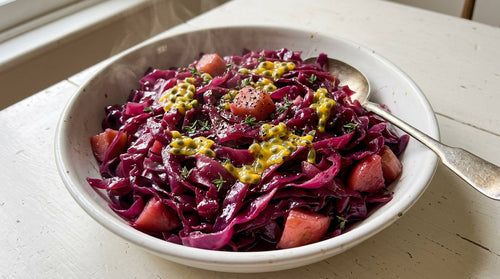
Because the potatoes are so creamy, you want something sharp and bright alongside. My Caribbean red cabbage, braised slowly with passion fruit, cuts right through the cream. Simple green beans or buttered sprouts with lemon work well too.
And for the guests who want a little fire on their plate, put a bottle of Caribbean Hot Sauce on the table next to the meat. Not on the dauphinoise, that one stays gentle.
If you want to know what else goes on a Christmas table back home, I wrote about Christmas in the Caribbean and what December actually tastes like on the islands.

FAQ
Can you make dauphinoise potatoes in advance?
Yes, and at Christmas I always do. Bake it completely the day before, let it cool, cover it and keep it in the fridge for up to 2 days. Reheat it covered with foil at 180°C, 160°C fan for 25 to 30 minutes, taking the foil off for the last 10 so the top crisps again. Make sure it is piping hot all the way through before you serve it.
Why did my dauphinoise potatoes curdle?
Usually one of three things. You used single cream or too much milk, the oven was too hot, or the cream boiled hard on the hob. Double cream has enough fat to survive a long bake without splitting. Keep the simmer gentle, bake at 160°C fan, and keep the potato starch on the slices, because it binds the sauce.
Why are my dauphinoise potatoes hard?
The slices were too thick, or the dish did not cook long enough. Slice at 3 mm, give the potatoes 5 minutes in the simmering cream before they go in the dish, and test the middle with a knife before you take it out. If the top is browning before the centre is soft, put the foil back on and give it another 15 minutes.
Can you freeze dauphinoise potatoes?
You can, though the texture is never quite as silky as fresh. Freeze it already baked and cooled, in portions, for up to 1 month. Defrost it in the fridge overnight and reheat it covered at 180°C, 160°C fan until piping hot. Double cream freezes much better than single cream or milk here.
What is the difference between potato gratin and dauphinoise?
Dauphinoise is a type of gratin. In the classic version from the Dauphiné, raw potato slices are baked in cream and milk with garlic, and there is no cheese. Many other potato gratins add cheese, eggs or stock, or use potatoes that are boiled first. This one is gluten free and vegetarian, but it contains milk (cream, milk and butter). Fresh Herbal Sauce contains mustard and sulphites from the white wine vinegar, so keep that in mind if you cook for anyone with allergies.
Final word from me
Dauphinoise taught me something I tell every young cook: the simplest dishes are the ones that show if you care. Potatoes, cream, garlic, time. Make it the day before, keep your simmer gentle, and stir a few spoons of Fresh Herbal Sauce through the cream. Then put it in the middle of your Christmas table and watch it disappear.
JP