The Taro Root Guadeloupe Calls Madère, and How I Cook It
Saturday morning at the market in Pointe-à-Pitre, my mother would walk straight past the pretty fruit and stop at the roots. Yam, sweet potato, green bananas, and a heap of hairy brown bulbs with rings around them like an old tree. That was dasheen. We called it madère, or dachine, and it went into the basket every week without discussion.
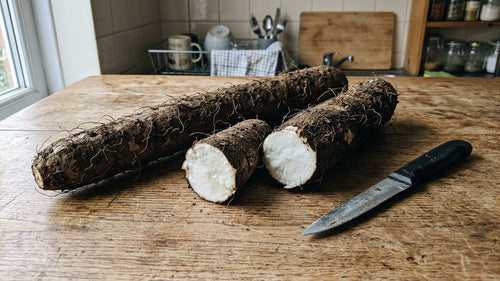
At home she peeled it at the sink, cut it into chunks and boiled it in salted water. Cut open, the white flesh is flecked with little purple threads. Cooked, it turns soft and smooth, a little sweet, a little nutty, and it drinks up whatever sauce is on the plate.
In the UK people ask me about dasheen all the time. Is it a potato? Is it the same as taro? Can you eat the leaves? Let me answer all of it, the way I would in my own kitchen.
What is dasheen?
Dasheen is taro, Colocasia esculenta, a tropical plant grown for its starchy root (the corm), its big heart-shaped leaves and its young shoots. The root has hairy brown skin and white, purple-flecked flesh with a sweet, nutty taste. Every part must be cooked before you eat it.
Root, leaves and shoots: one plant, three foods
Dasheen is a generous plant. It stands tall, around 1 to 2 metres, with broad, velvety, heart-shaped leaves. People who grow it use three parts:
- The corm. The central root, which growers call the “mammy”, usually weighs about 0.5 to 1 kg and can reach around 3.6 kg. Smaller side tubers of about 55 to 115 g grow around it. You cook them much like potatoes.
- The leaves. Cooked as greens. In Trinidad and Tobago and in Grenada the leaves are called dasheen bush, and they go into callaloo.
- The young shoots. Blanched, they have a flavour people compare to mushrooms.
That purple you see in the flesh is natural. It comes from pigments in the root, and it is part of the character of this vegetable.

Why dasheen must always be cooked
This is the one rule I insist on. Raw dasheen, root and leaf, contains calcium oxalate, fine needle-shaped crystals that make it unpleasant and not safe to eat raw. Heat breaks them down. Cooking makes it palatable, and some cooks also soak the cut root in cold water overnight before cooking.
For the leaves, the University of Florida gives a simple method: boil them for 15 minutes, drain, then rinse with boiling water. After that they are ready for a soup or a stew. Never put raw dasheen leaves in a salad, however beautiful they look.
Many cooks, me included, wear thin gloves to peel the root. It is a habit from home, and a good one.
Dasheen asks for one thing only: heat. Give it a pot of salted water and it gives you everything back.
JP
Madère in Guadeloupe
At home, a plate of meat or fish comes with salad, rice and red beans, and with what we call légumes-pays, the country vegetables, which are usually roots. Dasheen is one of them, beside yam, sweet potato and green banana. Across the English-speaking islands the same basket has its own name: ground provisions, the yams, sweet potatoes, dasheen, eddoes and cassava that sit on the side of the plate. In Trinidad they are served with stewed meat, fish or chicken.
If you want to meet the rest of that basket, read my guide to the real yam and my piece on breadfruit, our fruit à pain. For the whole Guadeloupe table, start with my guide to Guadeloupean food.
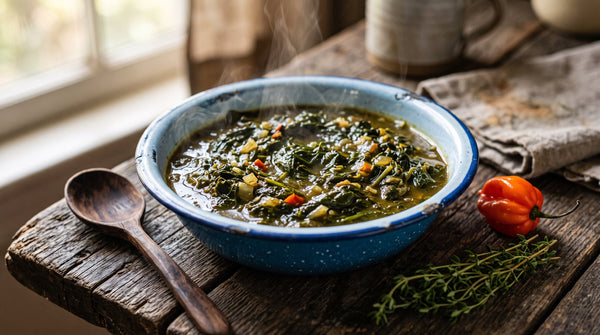
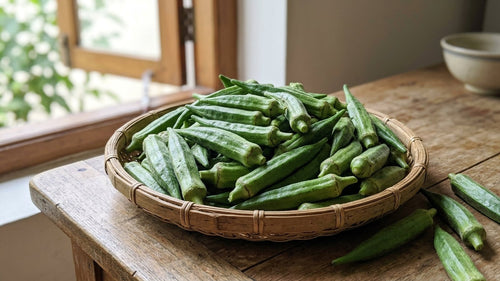
The leaves have their own feast day. In Guadeloupe, calalou au crabe, crab with greens, is a traditional Easter dish. In Trinidad and Tobago, callaloo made with dasheen bush and okra is a national dish, and Dominica claims callaloo as its national dish too.

Where the name dasheen comes from
I love this part, because the name tells the story of our islands. In French Creole we say dachine, and dachine is a shortening of chou de Chine, “Chinese cabbage”. The English word dasheen most probably comes from that same Creole word. So when someone in Trinidad or London says dasheen, they are speaking a little bit of French Caribbean without knowing it.
The plant itself comes from much further away. Taro is thought to be native to southern India and South East Asia, and from there it spread across the world, all the way to the Caribbean. In Guadeloupe, Martinique and French Guiana you will hear three names for it: madère, chou chine and dachine. In my family it was mostly madère.
Dasheen vs eddo: what is the difference?
You will often see dasheen sold next to eddoes, and the labels move around. Eddo is a close relative of dasheen, sometimes treated as its own species, Colocasia antiquorum. It grows in poorer soil and cooler conditions, and in the West Indies people call them “Chinese eddoes”.
Then there is malanga. Some shops use it for dasheen too, but the word more often means a different plant, Xanthosoma. If you want to be sure, look at the shape:
- Dasheen is the bigger, barrel-shaped central corm, ringed and hairy, with purple flecks inside.
- Eddoes are the smaller, rounder tubers, the size of an egg or a small fist.
- Taro is simply the general name for the plant. Dasheen is taro.
In the kitchen I treat them the same way: peel, cut, boil, serve with sauce.
Where to buy dasheen in the UK
Dasheen travels well. Jamaica exports dasheen with its other ground provisions, especially to the UK and Canada, which is why you can find it here at all. Where to look:
- Caribbean grocers. Ask for dasheen or taro. It usually sits beside the yams, eddoes and green bananas.
- Market stalls in cities with Caribbean communities.
Pick roots that feel heavy and hard, with no soft patches and no mould at the ends. Dasheen leaves are harder to find in Britain. If you see them, buy them, and cook them the same day.
How to cook dasheen
My mother’s method, the one I still use:
- Wear gloves and peel thickly with a sharp knife, taking off all the hairy skin.
- Cut into large chunks, about the size of an egg.
- Boil in well-salted water until a knife slides in with no resistance. Do not hurry it, and do not leave it hard in the middle.
- Drain and serve hot, with butter, or next to anything with a good sauce.
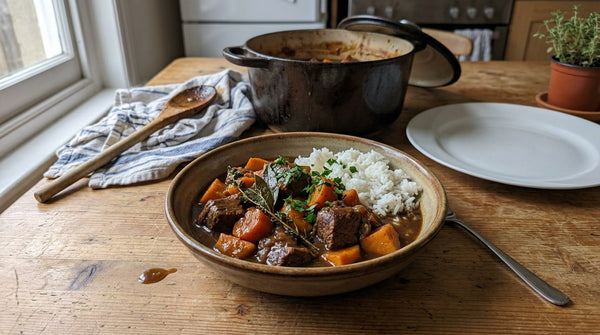
Boiled dasheen goes beautifully with a slow stew. Put it on the plate beside my Caribbean beef stew and let it soak up the gravy. On a Friday, serve it with my mother’s court-bouillon de poisson, the way ground provisions go with fish across the islands. And for the leaves, my Guadeloupe callaloo recipe is the place to start. In London I make it with spinach and spring greens because taro leaves are hard to find, but if you get dasheen leaves, boil them first as above and use them in place of the greens.
The sauce I put on boiled dasheen
A plate of hot boiled dasheen is soft, sweet and calm. It needs something with a bit of life on top. Back home that is always a spoonful of something onion-sharp with a little chilli.
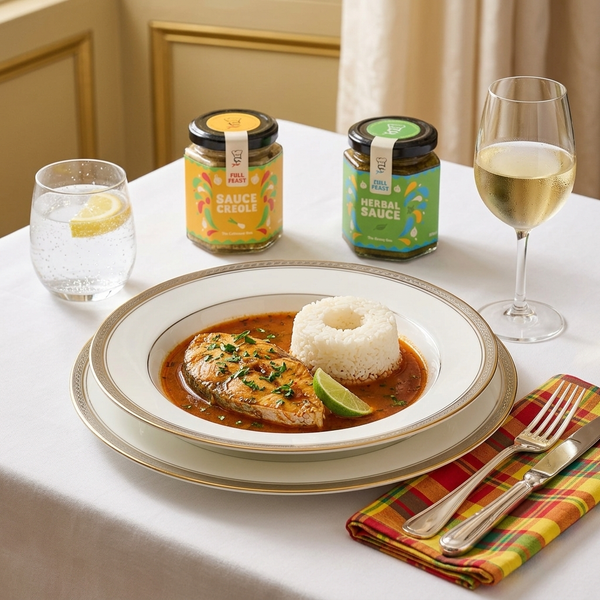
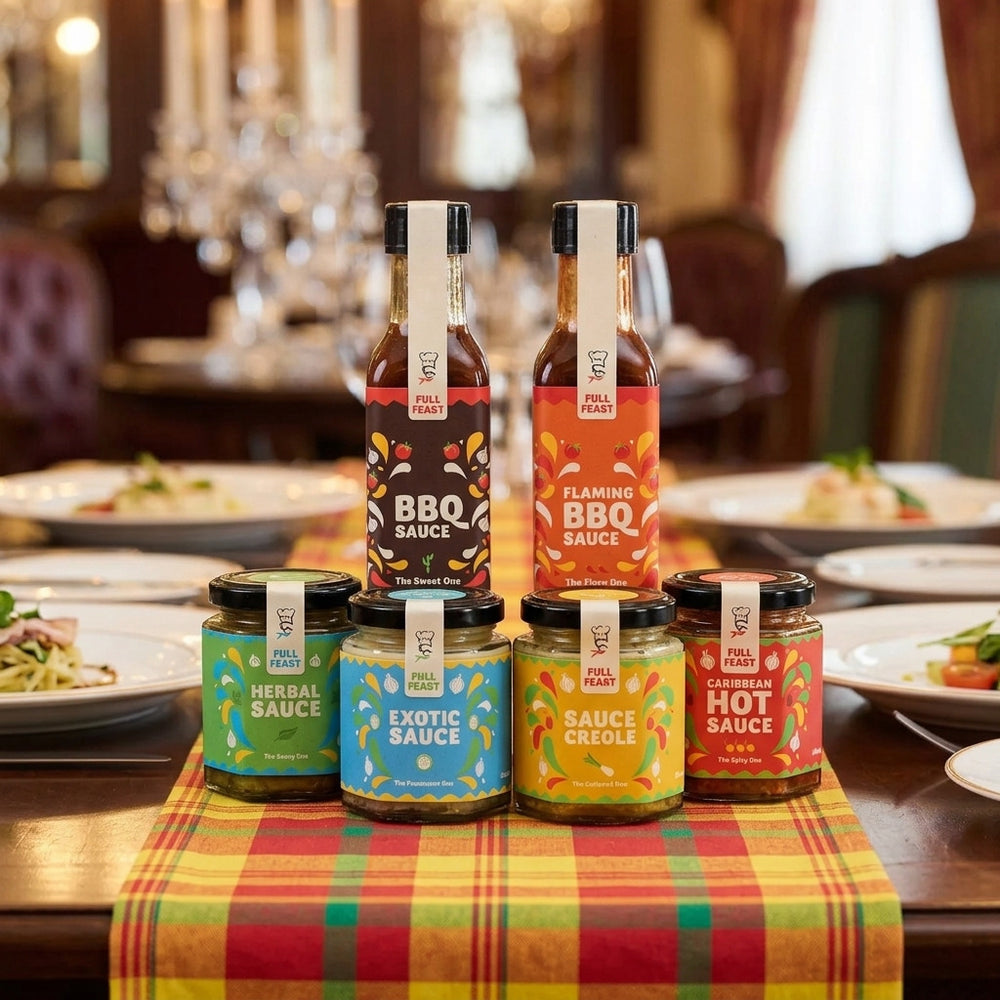
In my kitchen today that is our Caribbean Sauce Creole. It is mostly onion, with green chilli, a little vinegar, salt and white pepper. No tomato, no garlic: just sweet onion and a gentle green heat. Spoon it over the dasheen while it is still steaming, add a piece of grilled fish or chicken, and you have a Guadeloupe lunch in ten minutes once the pot is boiled.
FAQ
What is dasheen? Dasheen is taro, Colocasia esculenta. It is a starchy tropical root with hairy brown skin and white, purple-flecked flesh. The leaves and young shoots are eaten too. Every part must be cooked.
Is dasheen the same as taro? Yes. Dasheen is the Caribbean name for taro. The word most probably comes from the French Creole dachine, from chou de Chine. In Guadeloupe we also call it madère.
Can you eat dasheen leaves? Yes, but only cooked. The leaves contain calcium oxalate crystals that heat breaks down. Boil them for 15 minutes, drain and rinse with boiling water, then use them in callaloo or a stew. Never eat them raw.
What is dasheen bush? Dasheen bush is the name in Trinidad and Tobago and Grenada for the leaves of the dasheen plant, used to make callaloo.
What is the difference between dasheen and eddo? They are close relatives. Dasheen is the large central corm. Eddoes are smaller, rounder tubers from a related plant that grows in poorer soil and cooler conditions. You cook both the same way.
Dasheen is one of three roots a British shopper mixes up; the other is cassava, and I explain what cassava is and why it must always be cooked in its own piece.
The leaves deserve their own story, so I wrote one: callaloo, the green three islands cook three ways, including the Easter crab pot we make with madère at home.
One small thing to try this week
Find a Caribbean grocer and buy one dasheen root. Cut it open at home and look at those purple threads in the white flesh.
Peel it with gloves, boil it in salted water until soft, and eat it hot with a little butter and a spoonful of Sauce Creole. Nothing else. That is my mother’s Saturday lunch, and now it is yours.
JP