Smoked Haddock, Prawns and Herbs Under a Golden Mash
I will tell you about my first winter in England. I had come from Guadeloupe with a suitcase and a head full of my mother’s cooking, and nobody had warned me about November. The light went at four in the afternoon. The rain did not fall so much as hang in the air. I was cold in a way I did not know a person could be cold.
One Friday a friend took me to a pub and put a fish pie in front of me. I looked at it and thought, this is a plate of mashed potato. Then I broke the crust with my fork and the steam came up, smoked haddock and cream and something green, and I ate the whole thing without speaking. That was the day I understood that this country had its own way of looking after people. Fish, milk, potato, heat. Simple things, done with care.
Back home, Friday was always fish. My mother made court-bouillon, the fish stew with lime and tomato that every family in Pointe-à-Pitre has its own version of. So a Friday fish pie made sense to me straight away. It was the same idea in a colder coat.
Over the years I have made it my own. I cook the sauce with shallots and herbs the way my mother cooked everything, I put a little sweet potato in the mash for colour and sweetness, and I finish it with lime zest so it tastes alive. There is no chilli in this one. This is the fish pie recipe I make for my children on a grey Friday, and it is the one I am giving you now.
Recipe at a glance
- Cuisine: British Caribbean
- Prep: 20 minutes • Cook: 50 minutes • Total: 70 minutes
- Serves: 4 generously
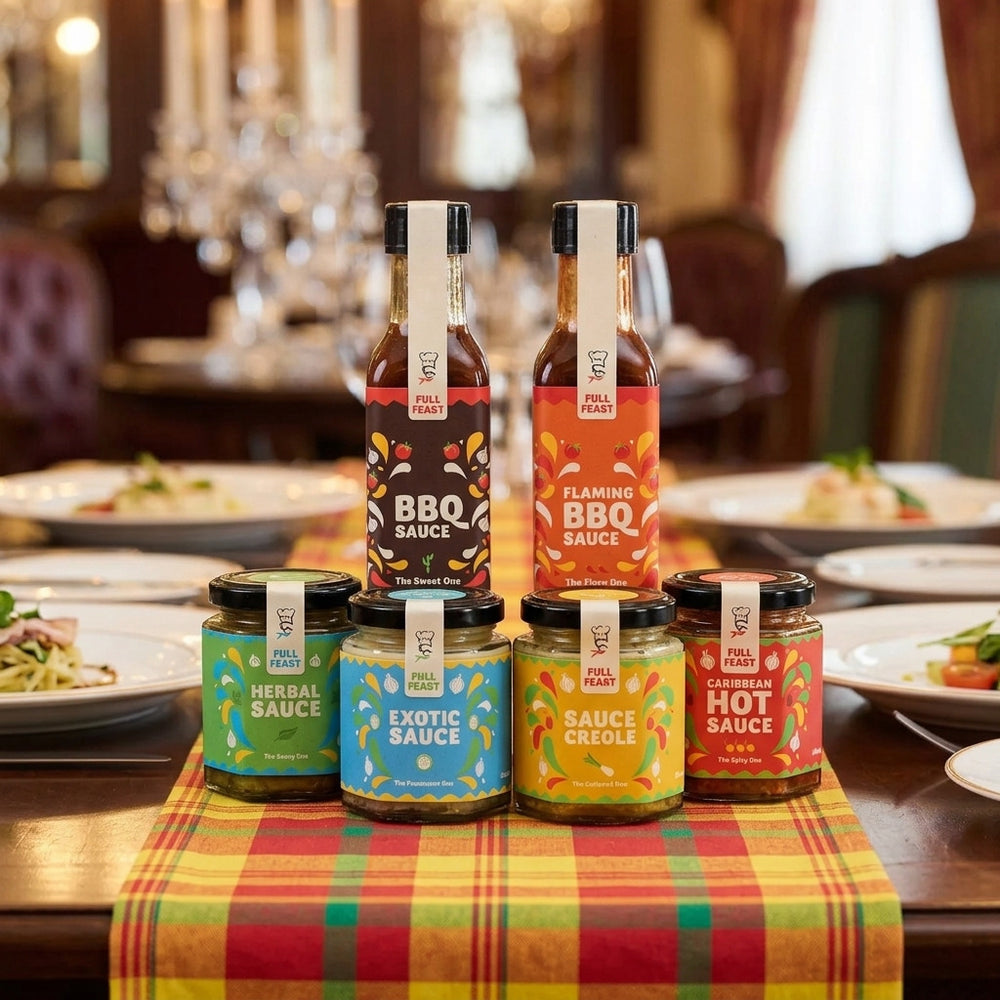
- Featured sauce: Fresh Herbal Sauce
- Heat level: 0/10, no chilli at all, the whole family eats this
- Diet: Pescatarian. Not gluten free as written (the plain flour in the sauce); see the FAQ for the swap
What you’ll need
Buy the fish from a counter if you can and ask for undyed smoked haddock, the pale kind. The bright yellow one has been coloured and it tastes the same but looks wrong under the sauce. If you are using a frozen fish pie mix, read the tip in the FAQ first.
For the mash
- 800g floury potatoes (Maris Piper or King Edward), peeled and cut into chunks
- 300g sweet potato, peeled and cut into chunks
- 60g butter
- 3 tbsp whole milk
- Black pepper
For the filling
- 500ml whole milk
- 1 bay leaf
- 1 small onion, halved
- 3 whole allspice berries (optional, they go in the poaching milk, not the sauce)
- 300g undyed smoked haddock fillet, skin on
- 300g cod or hake fillet, skin on
- 200g raw peeled king prawns
- 2 eggs, hard boiled and quartered (optional)
For the sauce
- 40g butter
- 40g plain flour
- 4 tbsp Fresh Herbal Sauce
- 2 spring onions, finely sliced
- Zest of 1 lime
- A small handful of flat-leaf parsley, chopped
- Black pepper
- 80g mature Cheddar, grated, for the top (optional)
Fresh Herbal Sauce is well salted and smoked haddock is salty too, so there is no salt in this list on purpose. Taste the sauce at the end and add a pinch only if it needs it.
How I make it
-
Start the mash. Put the potatoes and sweet potato in a big pan of cold salted water, bring to the boil and cook for 15 to 18 minutes until a knife slides in with no resistance. Drain them well and leave them in the colander for 2 minutes so the steam goes. Wet potatoes make a wet mash.
-
Mash it properly. Back in the warm pan, mash with the 60g of butter and the 3 tablespoons of milk until smooth. You want it soft enough to spread but firm enough to hold a fork mark. Season with black pepper and set it aside with a lid on. Heat the oven to 200°C (180°C fan, gas 6).
-
Poach the fish. Pour the 500ml of milk into a wide pan with the bay leaf, the onion halves and the allspice berries. Bring it to a gentle simmer, not a boil. Lay in the haddock and cod, skin side down, and let them poach for 4 minutes. They should be just turning opaque, not fully cooked. They finish in the oven.
-
Lift and strain. Take the fish out onto a plate with a slotted spoon. Strain the milk into a jug and keep it; you need about 450ml. When the fish is cool enough to touch, peel off the skin and break the flesh into big pieces. Big pieces. If you flake it fine, it disappears into the sauce and you lose the whole point.
-
Build the dish. Scatter the fish into a baking dish of about 1.5 litres. Tuck the raw prawns in between the fish, and the quartered eggs if you are using them. The prawns cook in the oven and stay sweet. If you add them cooked, they go tough.
-
Make the sauce. Melt the 40g of butter in a pan over a medium heat, stir in the flour and cook it for a full minute, stirring, until it smells biscuity. Now add the warm poaching milk a ladle at a time, whisking each one in before the next. Let it bubble gently for 3 to 4 minutes until it coats the back of a spoon thickly. A thin sauce is the reason fish pies turn watery.
-
Add the green. Take the pan off the heat. Stir in the Fresh Herbal Sauce, the spring onions, the lime zest and the parsley. Grind in black pepper. Taste it now. It should be sharp, herby, a little mustardy, and salty enough without adding anything.
-
Pour and rest. Pour the sauce over the fish and give the dish a gentle shake so it settles in. Leave it for 5 minutes. A warm sauce that has sat a moment holds the mash up; a boiling sauce swallows it.
-
Top it. Spoon the mash over in dollops, then join them up with the back of the spoon, working from the edges in so the filling is sealed. Drag a fork across the top to make ridges. The ridges go crisp and golden; a flat top stays pale. Scatter the Cheddar over if you are using it.
-
Bake. Put the dish on a tray (it will bubble over, they all do) and bake for 25 to 30 minutes until the top is golden and the sauce is bubbling at the edges. Push a knife into the middle and hold it to your lip: it must be hot right through, and the prawns pink. Leave it 5 minutes before you serve. You do not rush this part.

The role of Fresh Herbal Sauce in this dish
A classic fish pie sauce is milk, butter, flour and a bit of parsley. It is comforting and it is also, if I am honest, a little polite. What I always wanted under that mash was the taste of my mother’s kitchen: shallots softened in the pot, herbs torn in at the last moment, a sharp edge of vinegar to wake the fish up.
That is what Fresh Herbal Sauce does here. It is shallots, mostly, with basil and coriander, white wine vinegar, black pepper and a little French mustard. There is no chilli in it, so it brings nothing hot, only bright. Stirred into the white sauce off the heat, it turns it pale green and gives it the sharpness that cream alone never has. The mustard in it is exactly what smoked haddock wants. And because the sauce is already well salted, it seasons the whole pie for you.
If you have made my moules marinières, you know this trick already. Shallot, herb and vinegar is the base of half the fish cooking in Guadeloupe, and it is the base of half the fish cooking in France. A fish pie is just the English way of serving the same thing.
Tips from my kitchen
- Undercook the fish in the milk. Four minutes and out. It goes back in the oven for half an hour. If you cook it through twice, it goes dry and stringy and you will wonder why your fish pie is dry. That is why.
- Keep the sauce thick. It should coat the spoon like custard before it goes anywhere near the fish. The fish releases its own juice as it bakes and that is what loosens it to the right texture.
- Cold mash on a hot sauce slides off. Make the mash first so it is warm and soft when you spread it, or warm it through with a splash of milk if it has gone stiff.
- Make it in the morning. Build the pie, let it cool, cover it and put it in the fridge. Bake it from cold at the same temperature for 40 to 45 minutes instead of 30. The flavour is better for the wait.
- If you like a crunch on top, mix a handful of breadcrumbs with the Cheddar before it goes on, or leave the cheese out entirely and let the fork ridges do the work. Both are good. My children vote for cheese every time.
What to serve it with
A fish pie needs something green and something sharp beside it. At home that is buttered peas with a squeeze of lime, or wilted spinach with black pepper, nothing more. On a Sunday I put my Caribbean coleslaw on the table too, because the crunch and the cold against the hot pie is a very good thing.
For heat, the pie itself has none, and that is deliberate. I put a bottle of Caribbean Hot Sauce on the table instead so each person decides. A teaspoon on the side of the plate, dragged through the sauce, turns a family fish pie into something closer to home for me. The children leave it alone. I do not.
If fish is your Friday too, my pan-fried sea bass with Fresh Herbal Sauce is the fifteen-minute version of the same idea, for the weeks when there is no time for a pie.

Fish pie questions I get asked
Why is my fish pie watery?
Three reasons, usually all at once. The sauce was too thin before it went in, the fish was fully cooked in the milk and then cooked again in the oven so it leaked all its juice, or frozen fish went in still icy and released water as it thawed. Make the sauce thick enough to coat a spoon, poach the fish for 4 minutes only, and thaw frozen fish fully and pat it dry with kitchen paper before it goes in the dish.
Can you make fish pie with frozen fish?
Yes, and a bag of frozen fish pie mix is a good weeknight shortcut. Thaw it completely in the fridge overnight, drain it, and pat the pieces dry. Poach it for 3 minutes rather than 4, because the pieces are smaller. If the mix already has salmon in it, use it; a little salmon is lovely in here. Do not use fish that has already been cooked and frozen, it will fall apart.
Can you freeze fish pie?
You can, as long as the fish was not frozen before. Build the pie, let it cool completely, leave out the eggs (they go rubbery), cover it tightly and freeze it unbaked for up to a month. Thaw it overnight in the fridge and bake from cold for 40 to 45 minutes until it is bubbling and hot right through. I do not freeze a baked pie; the mash goes grainy.
Can you make fish pie in advance and reheat it?
Making it ahead and baking it later is better than reheating, so build it in the morning and bake it in the evening. If you do have leftovers, keep them in the fridge, eat them within two days and reheat only once, in the oven, until the middle is piping hot, 70°C or more if you own a probe. That is the standard UK food safety guidance for reheating, and fish is not something to take chances with.
What is in this fish pie that people might be allergic to?
Fish and crustaceans (the prawns), milk (the butter, milk and Cheddar), wheat (the plain flour), egg if you add them, and from the Fresh Herbal Sauce, mustard and sulphites from the white wine vinegar. The pie is not gluten free as written because of the plain flour: for a gluten free version, swap the 40g of plain flour for 2 tablespoons of cornflour mixed to a paste with a little cold milk and stirred into the hot poaching milk until it thickens. All six Full Feast sauces are lab tested gluten free, so the sauce is fine; it is only the flour.
Final word from me
I came to England cold and homesick and a fish pie was one of the first things that warmed me up. Now I make it with my mother’s shallots and herbs in the sauce and a little sweet potato in the mash, and it tastes like both my homes on one plate. Make it on a Friday. Put the dish in the middle of the table, let everyone break the crust themselves, and keep the hot sauce handy for the brave ones. Then tell me how it went.
JP