Is It a Nut or a Fruit? A Guadeloupe Cook Explains
Back home in Guadeloupe, a coconut was never something you bought in a shop. It came from the side of the road. A man with a cutlass, a pile of green nuts in the shade, three quick strokes and a hole in the top. You drank it standing up, the water cool even in the afternoon heat. Then he split it in two and cut you a little spoon from the husk so you could scrape out the soft white jelly inside.
So when someone in London asked me, “JP, is a coconut a nut or a fruit?”, I laughed. For me it was a drink, then a snack, then, at home, the milk in my mother’s rice and the cream in her Christmas dessert.
But it is a good question, and a lot of people ask it. The answer is a little surprising, and it explains a lot about how we cook with it. So let me open one up for you, slowly, the way we do at home.
Is a coconut a nut or a fruit?
A coconut is a fruit. Botanically it is a drupe, the same family of fruit as a peach or a plum: a fleshy or fibrous outside around one hard stone with a seed inside. It is not a true nut. We call it a nut in the kitchen because of its hard shell and its rich, oily white flesh.
Why a coconut is not a true nut
In botany, a true nut is simply a hard shell around one seed, a shell that does not open by itself. Hazelnuts, chestnuts and acorns are true nuts. There is no flesh and no fibre around them, just the shell and the seed.
A coconut is built differently. It has three layers, like any drupe:
- The exocarp, the smooth outer skin, green on a young coconut.
- The mesocarp, the thick fibre we call the husk. This fibre is coir, the stuff of doormats and plant pots.
- The endocarp, the hard brown shell you see in UK shops, about 4 mm thick.
Skin, flesh or fibre, then a hard stone with the seed inside: that is exactly the plan of a peach or a plum, only much bigger and much drier. The white flesh and the water we love are inside the stone, part of the seed.
At one end of the shell are three small round marks. Two are plugged, and one is a real opening, the soft spot where a new shoot pushes out when the coconut grows into a palm.
So the honest answer is that a coconut is a fruit, a seed inside it, and a “nut” only in the cook’s sense. Botanists say drupe. My mother said dinner.

Why is it called a coconut?
The name has nothing to do with cocoa. It comes from the old Portuguese word coco, meaning head or skull. Look at the end of a brown coconut and you see those three dark marks: two eyes and a mouth. Portuguese and Spanish sailors in the 16th century saw a little face, and some say a grinning bogeyman from their folk tales, el Coco.
English added “nut” on the end, and for a long time it was even spelled “cocoanut”. So the word itself carries the whole confusion: a Portuguese face and an English idea of a nut.
Where the coconut tree comes from
The coconut palm, Cocos nucifera, is the only living species of its genus. It is not from the Caribbean. Its home is the Central Indo-Pacific, and it was the Austronesian peoples of Island Southeast Asia who first domesticated it and carried it across the sea, east into the Pacific and west as far as Madagascar.
It reached us much later. From the 16th century, Portuguese ships took coconuts from India and Sri Lanka to the coast of West Africa, and from there to the Caribbean and Brazil. Coconut milk came into Caribbean kitchens in the colonial era, and today it is hard to imagine our food without it.
A palm can grow up to 30 metres tall. It can give up to 75 coconuts in a year, though fewer than 30 is more usual.
Can a coconut tree grow in the UK?
Not outside. The palm cannot take the cold, and it needs warmth and moisture all year round to grow and give fruit. A British winter would finish it.
Under glass is another story. Kew’s Palm House in London has grown a coconut palm under its central dome, and Birmingham Botanical Gardens lists one in its subtropical house. If you miss the islands in January, a warm glasshouse and a tall palm is not a bad cure.
A coconut is a drink, a snack, a milk and a dessert. Back home, nothing from it went to waste.
JP
Coconut water vs coconut milk: what is the difference?
People mix these up all the time, and it matters, because they are not the same thing at all.
- Coconut water is the clear liquid inside a young green coconut. In the tropics you drink it straight from the nut, as I did as a boy. As the coconut ages, that liquid slowly turns into the white flesh, so an old brown coconut has less water.
- Coconut milk is made. You grate the flesh of a mature coconut, soak it in water, then squeeze and strain it. Thick coconut milk, the first pressing, is coconut cream. Thinner milk has up to about 20% fat.
- Cream of coconut is different again: a sweetened product for drinks and desserts. It is not the same as coconut cream, and you cannot swap one for the other in a curry.
- Copra is dried coconut flesh, the source of oil and milk for industry.
For cooking, use tins of coconut milk or cream. For drinking, buy a green coconut if you can find one. A brown coconut with its husk off will keep for a few weeks; with the husk on, a mature coconut keeps for months.

How Guadeloupe cooks with coconut
In my island, coconut is above all a sweet thing. Three of our best loved treats are built on it.
Sorbet coco. Late in the afternoon, by the roads, at markets and near the beaches, you find the sorbet man. Coconut and condensed milk, perfumed with cinnamon, nutmeg, lime, vanilla and bitter almond, go into a metal drum inside a wooden bucket. Ice and coarse salt are packed around it, and he turns the crank by hand for about half an hour. The texture is soft, almost like a milkshake.
Blanc-manger coco. A set coconut cream, cool and white, that appears on the table at Christmas. With December coming, this is the one I am already thinking about.
Tourment d’amour. A tart from Les Saintes, the little islands south of Guadeloupe: pastry, a layer of coconut jam, and a soft sponge on top. The story says it was made by fishermen’s wives waiting for their men to come home from the sea. In Terre-de-Haut there is even a contest for the biggest one on 15 August.
I wrote more about these sweets, and the other desserts of the islands, in my guide to Caribbean desserts from Guadeloupe to Jamaica.
Coconut in savoury Caribbean food
Across the English-speaking islands, coconut milk does the savoury work. In Jamaica, rice and peas is cooked in it, and run down is salt mackerel simmered in coconut milk until it “runs down”, thick and rich. You can read about both in my tour of traditional Jamaican dishes. In Trinidad, coconut bake comes to the breakfast table with saltfish.
In Trinidad and Grenada, coconut milk goes into the green pot too, with dasheen leaves and okra. My explainer on callaloo, the Caribbean leaf and the dish shows how one name covers a whole family of stews.
How to cook with coconut at home
You do not need a palm tree. A tin of coconut milk is enough to bring the islands to a Tuesday night. These are the recipes I make most often:
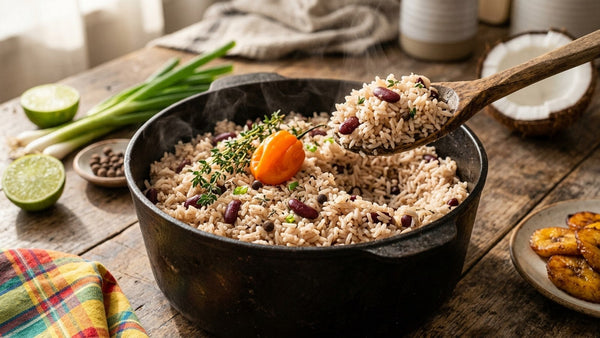
- Rice and peas with coconut milk and kidney beans: the Sunday side, with a whole Scotch bonnet sitting in the pot.
- Caribbean prawn curry with coconut and sweet pepper: twenty minutes, one pan, a creamy golden sauce.
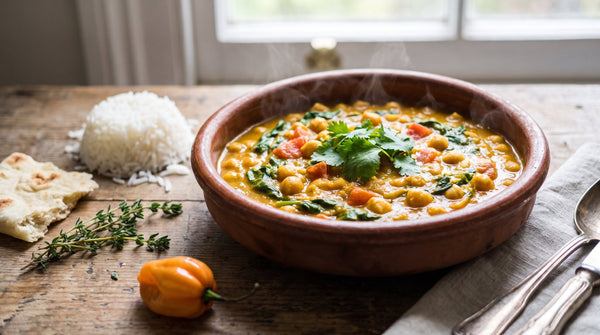
- Caribbean chickpea curry: the weeknight pot for when the fridge is nearly empty.
Two tips from my kitchen. Shake the tin before you open it, or the cream sits on top and the water at the bottom. And add coconut milk towards the end of a curry, then simmer gently: a hard boil can make it split.
To open a fresh brown coconut, find the soft eye of the three and push a skewer through it. Pour the water into a glass. Then hold the coconut in a tea towel and tap firmly around its middle with the back of a heavy knife, turning as you go, until it cracks in two.
Coconut and heat: where the sauce comes in
Coconut is sweet, round and gentle. That is exactly why it loves heat. In a coconut curry the chilli cuts through the richness, and the coconut softens the fire, so you taste the pepper’s fruit and not only its burn.
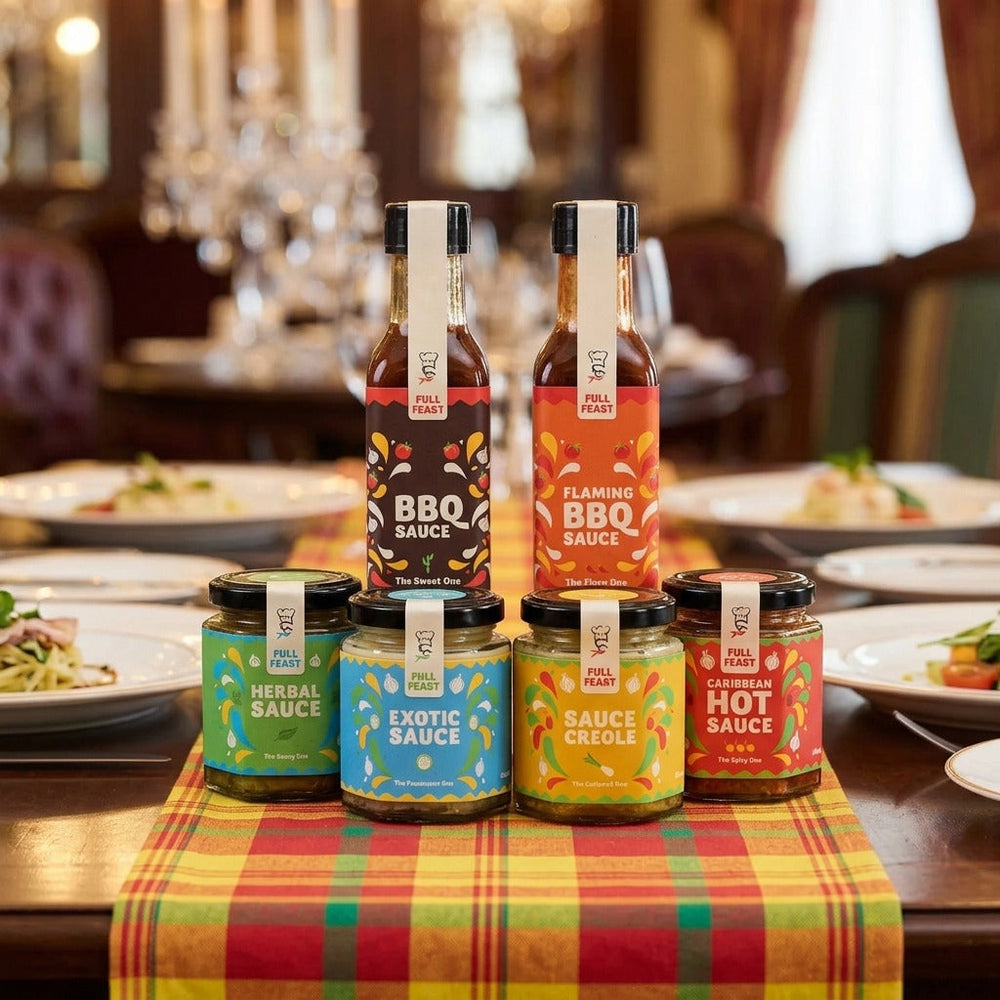
At the table I add a spoon of Full Feast Caribbean Hot Sauce to my plate of rice and peas or prawn curry. It is made with Scotch bonnet, white onion and garlic, nothing sweet and no coconut, so it brings a clean, bright heat against the cream. Start with a little. You can always add more.
FAQ
Is a coconut a nut or a fruit? It is a fruit. Botanically a coconut is a drupe, like a peach or a plum, with a hard stone around one seed. It is only a “nut” in the kitchen sense. If you have a nut allergy, ask your doctor, not a cook.
Why is it called a coconut if it is not a nut? The name comes from the Portuguese coco, head or skull, because the three marks on the shell look like a face. English simply added “nut”.
Is the coconut tree a palm tree? Yes. Cocos nucifera belongs to the palm family, and it is the only living species in its genus.
Can a coconut tree grow in the UK? Not outdoors. It needs year-round warmth and moisture. You can see coconut palms in heated glasshouses such as Kew’s Palm House.
What is the difference between coconut water and coconut milk? Coconut water is the natural liquid inside a young coconut. Coconut milk is made by grating mature coconut flesh, soaking it and squeezing it out.
One small thing to try this week
Buy one green coconut if you can find it, from a Caribbean or Asian grocer. Ask them to open it for you, drink the water cold, then scrape out the soft jelly with a spoon.
If you can only find a brown one, open it the way I showed you, grate a little of the flesh over your morning porridge, and keep the rest in the fridge for a curry at the weekend.
Either way, you will understand in five minutes why my island cannot live without it.
JP