The Wrinkled Purple Egg Guadeloupe Calls Maracudja, and How I Eat It
The first passion fruit I bought in Britain was the wrong one. Smooth, dark and shiny, the size of an egg, and sour enough to make my eyes water. A week later the one I had forgotten at the back of the fruit bowl had gone wrinkled and ugly, and that one was perfect: sweet, sharp, with a smell that filled the kitchen.
Back home in Guadeloupe we call it maracudja. It climbed over my grandmother’s fence, the vine heavy with white and purple flowers, and the fruit dropped to the ground when it was ready. We did not pick it. We collected it, every morning, in a bowl, and by lunchtime it was juice.
So let me explain passion fruit the way I would at my own table: what it is, why the ugly ones are the good ones, how to eat it with a spoon, and what I do with it in a British kitchen.
What is passion fruit?
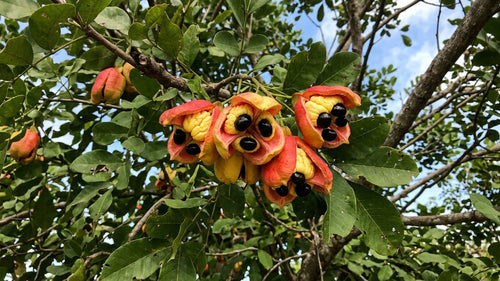
Passion fruit is the egg-shaped fruit of a climbing vine, Passiflora edulis, native to southern Brazil, Paraguay and northern Argentina. Under a thick purple or yellow skin sits a pocket of orange pulp, about 250 small seeds each wrapped in a bead of juice. The pulp is the part you eat, seeds and all. It tastes sharp, sweet and musky, a little like guava.
Where passion fruit comes from, and why it is called that
The vine is South American. It grew wild on the forest edges of southern Brazil long before anyone wrote its name down, and the Tupi people called it something like murukuîá, which became the Portuguese maracujá, the Spanish maracuyá, and in our Creole, maracudja.
The English name has nothing to do with romance. Around 1700, missionaries in Brazil looked at the extraordinary flower, with its ring of purple filaments and its five white petals, and saw in it the story of the crucifixion, the Passion of Christ. They used the flower to teach, and the plant became Passiflora, the passion flower. The fruit took its name from the flower, not the other way round.
From Brazil the vine travelled with ships in the 1800s and 1900s: to Australia, to Hawaii in 1880, to Kenya in 1933, and across the Caribbean, where it was growing wild in Jamaica by 1913. Every island gave it its own name. In Jamaica the purple one is sometimes called mountain sweet cup. In Haiti it is grenadya, in the Dominican Republic chinola, in Puerto Rico parcha. In Guadeloupe and Martinique it is maracudja, and nobody needs a second word.
Purple passion fruit or yellow: which one to buy
There are two forms of the same species, and they are not the same fruit to cook with.
- Purple passion fruit is the one in British supermarkets. It is small, around 35 grams, smaller than a lemon, with a dark purple skin that goes wrinkled as it ripens. The pulp is sweeter, less acid and more perfumed, and the seeds are black. This is the one to eat with a spoon.
- Yellow passion fruit is bigger, around 80 grams and sometimes the size of a grapefruit, with a smooth glossy yellow skin and brown seeds. It is sharper and more acid, which is why the juice factories and the punch makers love it. In Guadeloupe we grow both.
Whichever you find, the fruit should feel heavy. A light passion fruit is a dried-out one.

How to tell if a passion fruit is ripe
This is the question everyone asks me, so here is the whole answer.
A ripe purple passion fruit is wrinkled. Not a little: properly creased, like an old leather purse, and dark all over. It feels heavy and a little soft, and if you hold it to your nose it smells of itself. The smooth, shiny fruit in the shop is not ripe yet. It will taste sour and thin.
If you have bought smooth ones, do what I do. Leave them in the fruit bowl, out of the sun, for a few days until the skin starts to shrivel. Then eat them, or move them to the fridge, where a ripe passion fruit keeps for about a week. The fridge is for ripe fruit, not for ripening it.
In Guadeloupe we never had to think about any of this. The vine does the work. A ripe maracudja drops off by itself, which is why my grandmother collected them off the ground rather than picking them. A fruit still hanging was a fruit not ready.
How to eat passion fruit
Cut it in half around the middle with a small knife. Hold a half in your palm, and scoop the pulp out with a teaspoon, seeds and all. That is it. Eat it straight from the spoon, or over yoghurt, or on top of a bowl of cut mango.
The seeds are edible and we eat them. They are crunchy, slightly bitter, and they are half the pleasure. In Australia they eat it with cream and sugar, seeds included. Only strain them out when you want a smooth juice or a glaze.
To make juice the Guadeloupe way, scoop the pulp of six or eight fruit into a sieve over a bowl and press it through with the back of a spoon. You get a thick, bright orange juice that is far too strong to drink on its own. Sweeten it with a little sugar or cane syrup and let it down with cold water, or with orange or pineapple juice. The pulp also freezes well, so when the fruit is cheap, buy a tray and freeze it in an ice cube tray.
The ugly ones are the good ones. A smooth passion fruit is a promise, a wrinkled one is the fruit.
JP
Maracudja in Guadeloupe: juice, jam and punch
Walk through any market in Guadeloupe in the morning and you will find a woman with a cool box and a stack of plastic cups, selling fresh juice: corossol, guava, mango, sugar cane, coconut, pineapple, prune de Cythère, and maracudja. The juice sellers press it on the spot, and it is cheap. Most of our fruit comes from Basse-Terre, the green, mountainous half of the island, where the orchards sit under the rain.
The jam makers love it too. On a Guadeloupe breakfast table, beside the guava jam and the coconut jam, there is nearly always a jar of confiture de maracudja, sharp enough to wake you up on a slice of bread.
And then there is punch. The planteur, the fruit punch the planters’ wives invented to soften the rum, is pineapple juice, orange juice and maracudja juice with sugar, a scrape of nutmeg and lime, and every family argues about the proportions. The distilleries steep whole passion fruit in white rhum agricole for a few weeks and sell the result as punch maracudja. I wrote about how Guadeloupe pours its rum punch if you want my own planteur for eight. For the children there is always the juice, and honestly I still prefer it.

The passion fruit plant: can you grow it in Britain?
You can, with patience and a greenhouse. The Royal Horticultural Society lists Passiflora edulis as a vigorous evergreen climber that reaches about 5 metres, with glossy three-lobed leaves and bowl-shaped white flowers 7 centimetres across with purple filaments in summer. The fruit follows in summer and autumn, ripening from yellow to purple.
The catch is the cold. It needs more than 15 degrees all year, so in Britain it lives in a conservatory or a frost-free greenhouse, in a big pot of loam-based compost, in full light with a little shade from the hottest sun. The RHS warns that you usually get a few fruits rather than a crop. But the flower alone is worth it: it is one of the strangest, most beautiful things a plant can do, and it explains the name better than any book.
The blue passion flower growing up British garden walls is a different species, grown for the flower rather than the fruit.
How I cook with passion fruit
Passion fruit is a sharp fruit, and sharp fruit belongs with rich food. In my kitchen it goes with pork, duck, chicken skin and anything from the grill, the way lemon does in a French kitchen. Three recipes already on the blog show you what I mean:
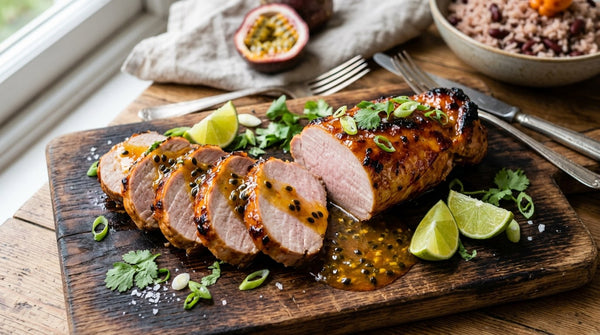
- My passion fruit pork tenderloin, seared gold and glazed sticky is the simplest: the pulp goes into the pan at the end and turns into a glaze in two minutes.
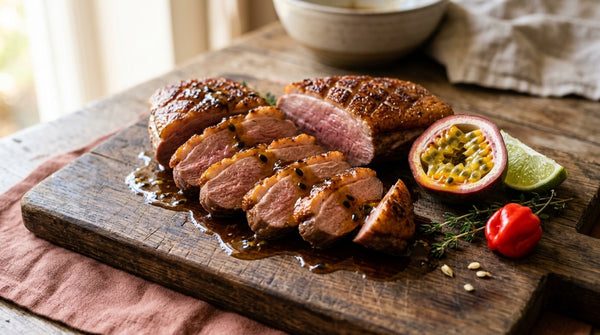
- Caribbean duck breast with a maracudja glaze is the one I make when I want to impress someone in half an hour.
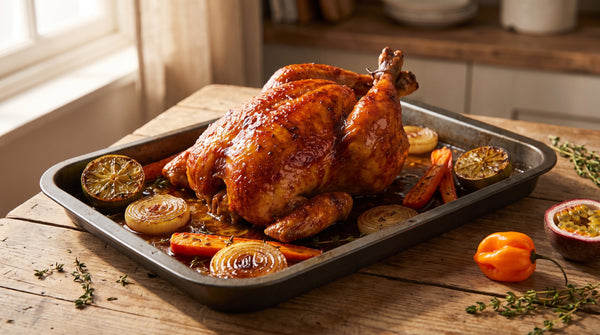
- My Caribbean Sunday roast chicken with a sticky passion fruit glaze is what the family gets.
For a sauce, press the pulp through a sieve, warm the juice with a spoon of sugar or honey until it thickens a little, and brush it on at the end of cooking. Too early and the sugar burns. A spoon of the whole pulp, seeds and all, over grilled fish or a plate of prawns needs no cooking at all.
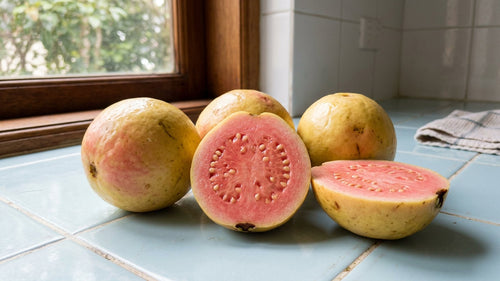
It is a fruit that likes company. It goes with mango, with coconut, with guava, with lime. If you want to know the fruit it is most often compared to, read my piece on guava, the pink fruit Guadeloupe named a town after, and for its sharper, greener cousin on the juice stall, soursop, the fruit we call corossol.
The sauce with maracudja inside
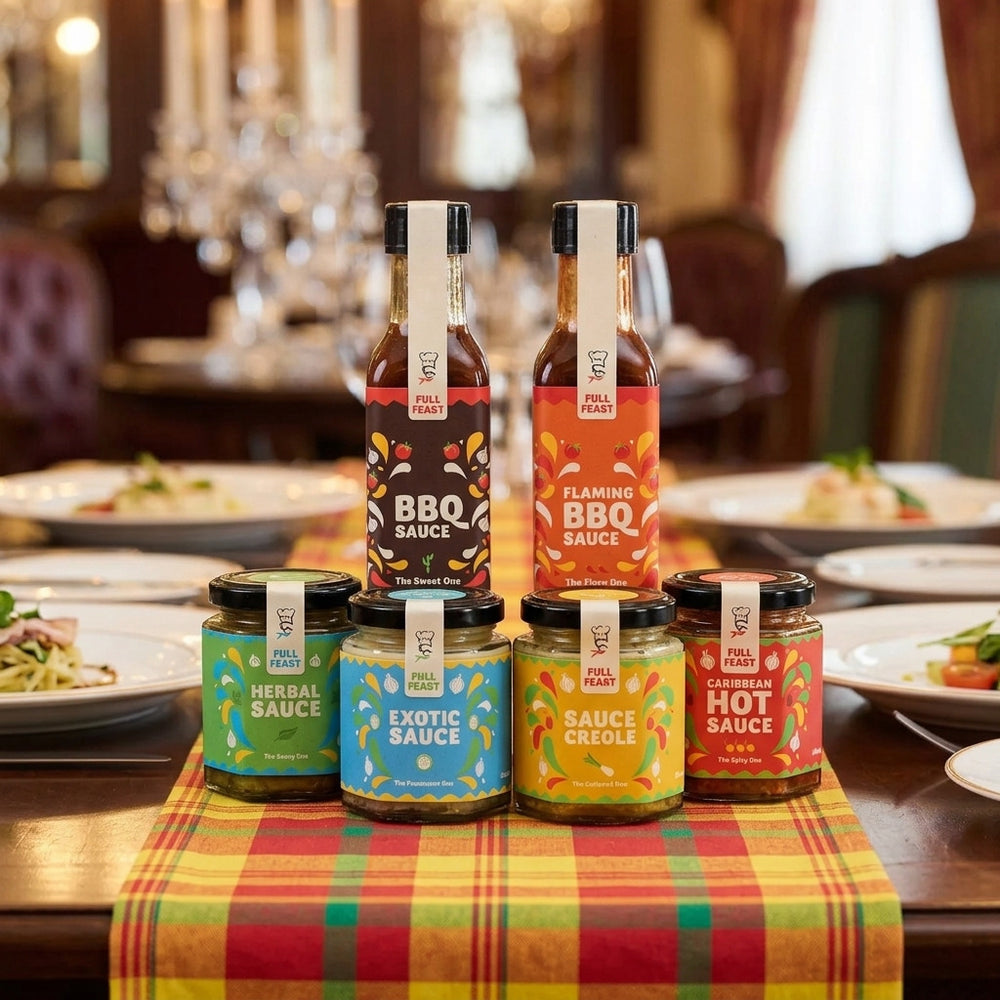
When I developed the Full Feast sauces I wanted one bottle that tasted of the Guadeloupe juice stall, and that is the Exotic Caribbean Sauce. It is mostly slow-cooked onion, then passion fruit juice, a little over fifteen percent of the bottle, with chillies, oil, vinegar, salt and white pepper. There is no mango and no pineapple in it, whatever the colour suggests. The sharpness and the perfume come from the maracudja.
I use it the way I use the fresh pulp: on pork, on chicken, on prawns, stirred into a mayonnaise, or spooned over roast sweet potato. If you have a wrinkled passion fruit in the bowl, scoop it over whatever you have just glazed with the sauce. Fresh and cooked fruit together is the whole island in one mouthful.
FAQ
How do you know when a passion fruit is ripe? The skin is wrinkled and dark, the fruit feels heavy for its size and it smells sweet. Smooth, shiny skin means it needs a few more days in the fruit bowl.
Can you eat passion fruit seeds? Yes. The seeds are edible and crunchy, and in Guadeloupe and Australia people eat the pulp seeds and all. Strain them out only for a smooth juice or glaze.
Is passion fruit the flower or the fruit? The passion flower is the plant, named by missionaries who saw the Passion of Christ in its flower. The passion fruit is the fruit that follows the flower on the edible species, Passiflora edulis.
What is the difference between purple and yellow passion fruit? Purple is smaller, sweeter and more perfumed, with black seeds, and it wrinkles as it ripens. Yellow is bigger, smooth-skinned, more acid and has brown seeds, so it is used for juice and punch.
What is passion fruit called in the Caribbean? In Guadeloupe and Martinique it is maracudja. In Haiti it is grenadya, in the Dominican Republic chinola, in Puerto Rico parcha, and in Jamaica the purple one is sometimes called mountain sweet cup.
Maracudja has a partner in our confiture pots: I wrote about papaya, the fruit Guadeloupe eats green as a vegetable and ripe with lime, and how the two cook down together.
One small thing to try this week
Buy four passion fruit and leave them on the side until they look old and wrinkled. Do not lose your nerve and eat them early.
Then cut two of them around the middle and spoon the pulp over a bowl of thick yoghurt for breakfast. Press the other two through a sieve into a small pan with a teaspoon of honey, warm it for a minute, and brush it over a pork chop or a chicken thigh in the last two minutes of cooking.
That is maracudja. The sour, sweet, perfumed taste of a Guadeloupe morning, in a British kitchen.
JP