Jamaica’s National Fruit, Why It Must Open on the Tree, and How I Cook It
Some fruits you eat with your hands, straight from the tree. Ackee is not one of them. Ackee asks for patience, and for respect.
The first thing you notice is the colour. A red and yellow pod, about the size of a fist, hanging in bunches. Then, when it is ready, the pod splits open by itself, like a mouth that has decided to talk. Inside sit three soft cream lobes, each one wearing a shiny black seed on top like a little hat.
I grew up in Guadeloupe, where our salt cod goes into accras and our breakfasts are green banana and morue. Ackee belongs to our Jamaican cousins, and in London I learned what it means to them. On a Saturday morning in a Jamaican kitchen, a pan of ackee and saltfish is not just breakfast. It is home.
So let me explain ackee the way I would to a friend standing in my kitchen: what it is, how it tastes, why you must never rush it, and how to cook it well.
What is ackee?
Ackee is the fruit of a tree called Blighia sapida, from the soapberry family, native to tropical West Africa. It is the national fruit of Jamaica. You eat only the soft, creamy flesh inside the ripe pod, always cooked, and only once the pod has opened on its own. It is the heart of ackee and saltfish.
Where ackee comes from
Ackee is not native to the Caribbean. It came to Jamaica from West Africa, probably on a slave ship, and it was growing there before 1773. The English name comes from the Akan words akye fufo. So, like so much of our Caribbean food, the fruit carries the story of the people who were brought across the ocean.
The scientific name has a stranger story. In 1793 Captain William Bligh, the same Bligh of the mutiny on the Bounty, took ackee plants from Jamaica to England, to the gardens at Kew. Before that, the fruit was unknown to European science, so the genus was named Blighia in his honour.
Here is the part I love. In West Africa, where the tree began, the fruit is little eaten. People there value the tree for its shade. It was in Jamaica that ackee became a treasure, and later it was planted in Trinidad, Haiti, other Caribbean islands and along the coast of Central America.
What does ackee look like?
If you have only seen ackee in a tin, the tree is a surprise.
- The pod. Pear shaped, with three lobes, about 7.5 to 10 cm long. Yellow, flushed bright red as it ripens.
- The opening. When it is ripe, the pod splits along its seams and gapes open on the branch.
- The flesh. Three cream coloured, glossy lobes called arils. This is the part you eat.
- The seeds. One large, round, hard black seed sits on top of each aril. It is never eaten.
- The membrane. A thin pinkish thread joins the seed to the flesh. It must be removed.

What does ackee taste like?
People always ask me this, and I always say: less than you expect, and more than you expect.
On its own, ackee is mild. Creamy, soft, a little nutty. It is a quiet fruit that soaks up whatever you cook it with: the salt of the fish, the sweetness of onion, the fire of the pepper.
Cooked, it looks like scrambled egg. Yellow, soft, in loose curds. Many people take one look at ackee and saltfish and think it is eggs. It tastes nothing like egg. It is richer, almost buttery, and it melts on the tongue.
Ackee does not like to be hurried. Not on the tree, and not in the pan.
JP
Is ackee safe to eat?
Yes, when it is ripe and prepared properly. No, when it is not. This is the one part of the post I want you to read twice.
Ackee contains a toxin called hypoglycin. The unripe fruit, and the rind and seeds of even ripe fruit, are never safe to eat. Eating unripe ackee can cause vomiting and dangerously low blood sugar, which in Jamaica is known as Jamaican vomiting sickness. Cooking unripe ackee does not make it safe.
The rules for fresh ackee are simple and strict:
- Wait for the tree. Only use pods that have split wide open on their own. Never force a closed pod.
- Take out every seed. The black seeds are always poisonous.
- Remove the pink membrane from each aril.
- Boil, then throw the water away. The traditional way is to parboil the clean arils in salted water and discard that water before you cook on.
- If in doubt, use tinned. In the UK, tinned ackee is what most of us cook with, and it has already been prepared for you.
Ackee in the UK: how to buy it and use it
Fresh ackee pods are hard to find here. What you will usually find is ackee tinned in salted water, usually in 540 g tins, at Caribbean grocers, market stalls in areas with a big Jamaican community, and the world food aisle of large supermarkets. Jamaica, Haiti and Belize all export it.
A few things I have learned with tinned ackee:
- Drain it gently. Tip it into a sieve and let the brine run off. Do not shake it.
- Treat it like a soft cheese. The lobes break easily. Overcook them and you have mush.
- Add it last. Cook everything else first, then fold the ackee in and just warm it through.
- Stir with a spoon, not a spatula. Lift and turn, do not scrape.
A tin is no match for a fresh pod straight from the tree, my Jamaican friends will tell you that. But cooked with care, it is still a beautiful thing.

Ackee and saltfish: the national dish
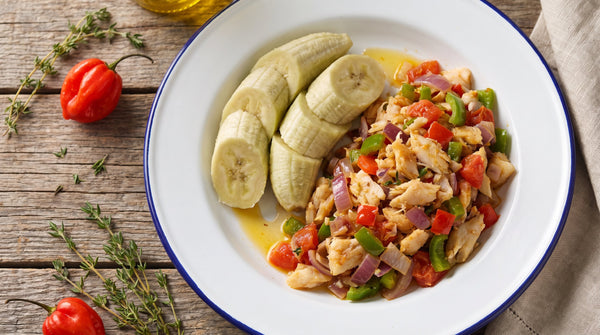
Ackee and saltfish is the national dish of Jamaica, and it is usually eaten for breakfast. Salt cod is soaked to draw out the salt, then sautéed with boiled ackee, onion, Scotch bonnet, tomato and black pepper.
The salt cod has its own history. It came to the Caribbean as a cheap protein that kept for months without a fridge, food for enslaved people in the colonial era. Today it is loved on every island. In Guadeloupe we call it morue.
What goes on the side is just as important:
- Breadfruit, roasted or fried. I wrote a whole piece on breadfruit, the fruit Guadeloupe calls fruit à pain.
- Fried dumplings or hard dough bread.
- Boiled green banana.
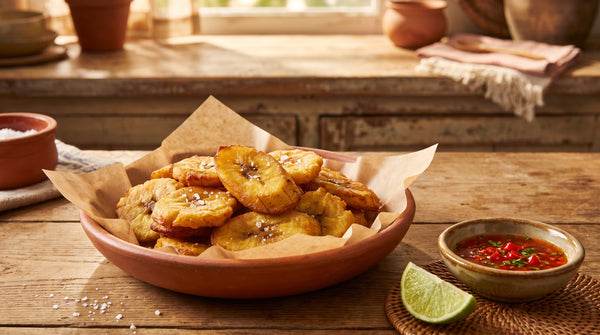
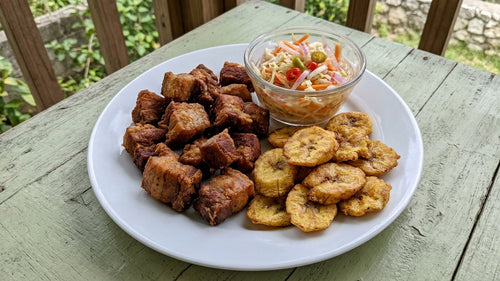
- Fried plantain, sweet and caramelised.
- Rice and peas, for a bigger meal later in the day.
Ackee also goes into stews with salt pork, spring onion and thyme, and it can be curried and served with rice. But ackee and saltfish is the one to start with.
How to cook ackee at home
You do not need a Jamaican grandmother to cook ackee well. You need soaked saltfish, a gentle hand and good sides. Here is how I build the plate, with recipes from my own kitchen:
- Start with the saltfish. Soak it overnight, change the water, then flake it. If you have never done this before, my green banana and saltfish, the Guadeloupe breakfast I grew up on walks you through the soaking step by step, and the green banana is the perfect side.
- Make the sides. Fry some ripe plantain while the fish cooks. My fried plantain, bananes pesées the way my mother made them works with green plantain too, if you like it crisp.
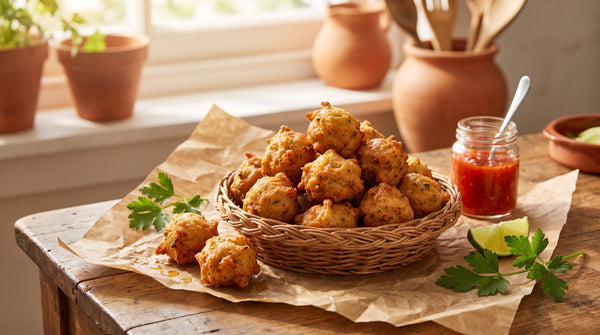
- Use the leftovers. Any saltfish you do not use goes into fritters the next day. My accras de morue, the saltfish fritters my mother fried every Sunday are the Guadeloupe cousin of this breakfast.
For the ackee itself: soften onion and sweet pepper in a little oil, add the flaked saltfish and some tomato, season with black pepper and a little fresh Scotch bonnet, then fold in the drained ackee for the last few minutes. Warm it through. Serve.
The sauce I put on the table
Ackee and saltfish wants heat, but the right kind. The ackee is soft and gentle, so you want a pepper that brings fruit and fire without drowning it.
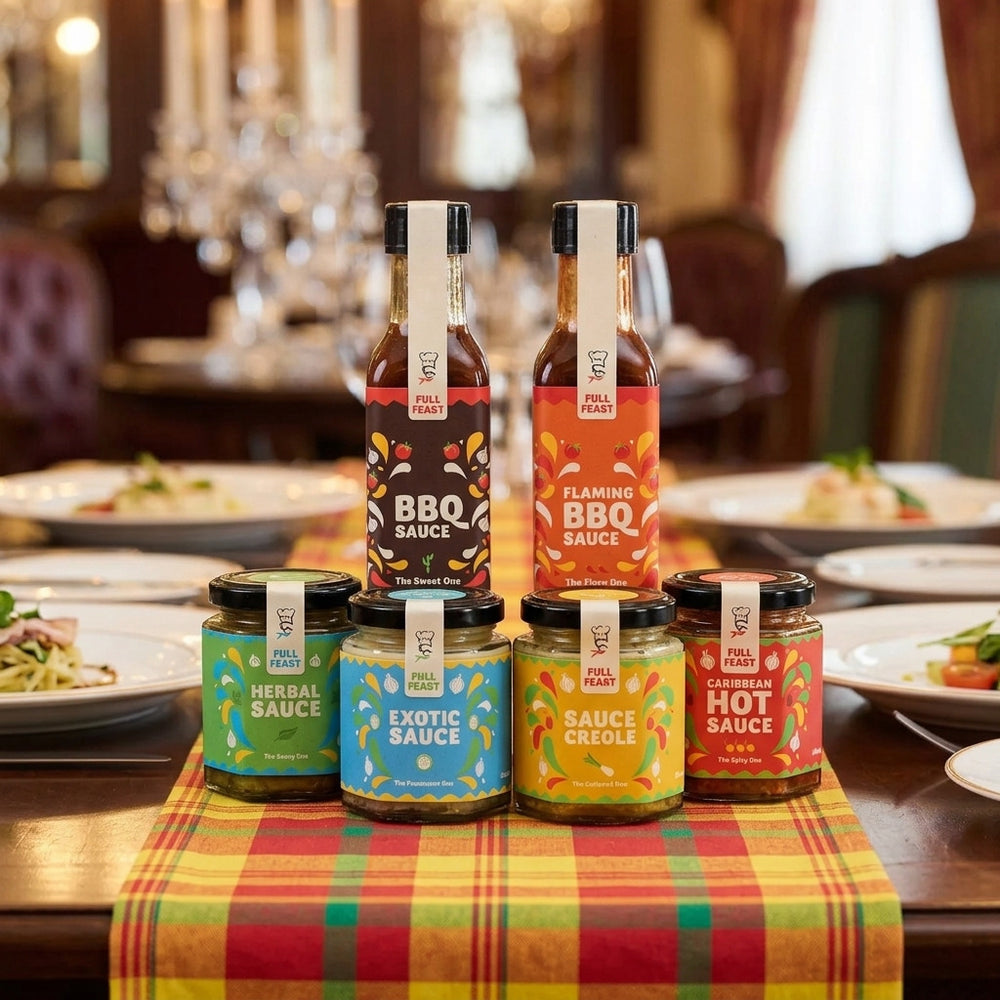
That is why I put our Caribbean Hot Sauce on the table. It is built on Scotch bonnet, with white onion, garlic, a little barley vinegar, oil, salt and white pepper. The same pepper and onion you would cook into the pan, ready in a spoon. Add a few drops at the table, so everyone chooses their own heat. If you want to know why the Scotch bonnet is the pepper of the Caribbean breakfast, read what a Scotch bonnet is and why our cooking is built on it.
And if this has made you curious about the other islands, Haiti grows and tins ackee too. I wrote about our cousins in Haitian food, seen from a Guadeloupe kitchen.
FAQ
What does ackee taste like? Mild, creamy and a little nutty, with a soft, buttery texture. It absorbs the flavours it is cooked with. Cooked, it looks like scrambled egg but tastes nothing like it.
Is it safe to eat ackee fruit? Yes, if the fruit is fully ripe, the pod has opened naturally on the tree, the seeds and pink membrane are removed and the flesh is boiled and the water thrown away. Unripe ackee, the seeds and the rind are never safe. In the UK, tinned ackee is the easy and reliable choice.
Why do Jamaicans eat ackee? Ackee came to Jamaica from West Africa and became part of the island’s food over centuries. It is Jamaica’s national fruit, and ackee and saltfish is the national dish, usually eaten for breakfast.
Is ackee a fruit or a vegetable? Botanically it is a fruit, the fruit of the Blighia sapida tree. In the kitchen it is cooked and eaten savoury, like a vegetable.
Where can I buy ackee in the UK? Tinned ackee in salted water is sold in Caribbean grocers and in the world food aisle of large supermarkets. Fresh pods are hard to find.
One small thing to try this week
Buy one tin of ackee and one piece of saltfish. Put the fish in water tonight, change the water in the morning, and on Saturday make a small pan of ackee and saltfish for breakfast.
Go slowly. Soften the onion, warm the fish, fold in the ackee at the very end with a spoon and leave it alone. Put a fried plantain on the side and a few drops of pepper sauce on top.
Then taste it and tell me it is scrambled egg.
JP