The Fiery Homemade Brew of a Caribbean Christmas
Ginger beer vs ginger ale? For me there was never a contest. Ginger beer is the one that bites you back. The first sip is sweet, then the ginger arrives at the back of your throat like a warm hand on your neck. I have always loved that feeling.
In my mother’s kitchen in Guadeloupe, fresh ginger was never far away. A knob of it went into marinades, into syrups, into the pot with the chicken. So when I came to Britain and found two bottles side by side on every shop shelf, one called ginger beer and one called ginger ale, I wanted to know what really separated them.
The answer is a lovely story. It goes from Yorkshire to Belfast, through a famous Scottish court case, and ends at a Caribbean Christmas table, where some families still blend fresh ginger into big jugs every December. Let me take you through it.
Ginger beer vs ginger ale: what is the difference?
Ginger beer is the older, stronger drink: traditionally brewed by fermenting ginger, sugar and water, so it tastes fiery, cloudy and less sweet. Ginger ale is a lighter soft drink made by adding ginger flavour to carbonated water, so it is paler, sweeter and much milder on the ginger.
Where ginger beer comes from
Ginger beer was born in Yorkshire, in England, in the middle of the 18th century. By around 1790 it had crossed to Canada and the United States. It was a proper brewed drink, and for a long time it was a strong one: until the middle of the 19th century, many ginger beers held about 11% alcohol.
That changed in 1855, when England limited ginger beer to 2% alcohol. From then on, the drink moved slowly towards the soft, family bottle we know today.
The basic recipe has always been simple. Ginger, sugar, water and yeast, and in the old recipes a little lemon juice and cream of tartar.
The ginger beer plant that is not a plant
The old brewers had a secret starter they called the “ginger beer plant”. It is not a plant at all. It is a living partnership between a yeast and a bacterium that work together, a jelly-like mass that families kept going by saving a little from each batch and passing it on.
The botanist Harry Marshall Ward described it in 1892. Today, home brewers more often use a “ginger bug”: grated ginger, sugar and water left to bubble with a little yeast.
Where ginger ale comes from
Ginger ale is younger, and despite its name it is not an ale. It is a carbonated soft drink flavoured with ginger.
The first style, called golden ginger ale, is credited to an Irish doctor, Thomas Joseph Cantrell, in Belfast in the 1850s. It was darker and sweeter, with a strong ginger taste.
Then came the style most of us drink now. A Canadian chemist and pharmacist, John J. McLaughlin, introduced a “pale dry” ginger ale in 1904 and patented it in 1907. It was paler, lighter, with a much softer ginger flavour. During Prohibition in the United States, it became the favourite mixer.

Is ginger beer more ginger than ginger ale?
Yes, and you can taste it with your eyes closed. Ginger beer is more strongly flavoured with ginger and less sweet than ginger ale. A science team at McGill University put it nicely: ginger beer is ginger on steroids, while ginger ale has only a faint ginger flavour.
Here is how the two compare today:
- How it is made: traditional ginger beer is brewed and fermented; ginger ale is carbonated water with ginger flavouring and sugar.
- Taste: ginger beer is spicy and punchy; ginger ale is mild and sweet.
- Look: homemade ginger beer is cloudy; ginger ale is clear and pale.
- Fizz: ginger ale is always fizzy; homemade Caribbean ginger beer often is not.
To be fair, the line has blurred. Many shop ginger beers are no longer fermented at all. They are carbonated with gas, just like ginger ale, and both are now soft drinks of carbonated water, sugar and ginger. The difference that remains is mostly the strength of the ginger.
Is ginger beer alcoholic?
Most ginger beer you buy in a British shop is a soft drink. When a ginger beer is brewed and then sold as non-alcoholic, it is kept under 0.5% alcohol, the level many countries use for the word “non-alcoholic”. Alcoholic ginger beers exist too, and they are labelled as such.
At home it depends on the method. Fermentation turns sugar into bubbles and a little alcohol, and the longer it ferments, the more alcohol stays in the bottle. The quick Jamaican method I describe below is not fermented at all.
Ginger ale whispers. Ginger beer grabs you by the collar and says good evening.
JP
A snail, a bottle and the law
Here is my favourite piece of ginger beer history. On 26 August 1928, in a café in Paisley, near Glasgow, a woman said she found the remains of a snail in her opaque ginger beer bottle.
Her case, Donoghue v Stevenson, went all the way to the House of Lords, which decided it in 1932. It laid the foundation of modern negligence law: the rule that makers owe a duty of care to the people who eat and drink what they make. As a cook, I think about that more than you would expect.
Jamaican ginger beer, the Caribbean Christmas brew
Across the English-speaking Caribbean, homemade ginger beer is a different animal from the shop bottle. In Jamaica, it was traditionally a Christmas drink, poured alongside sorrel, the deep red hibiscus drink and rum punch. Jamaican cooks say it has faded in recent years, leaving sorrel and rum punch as the main two. I hope it comes back.
And Jamaica knows ginger. Jamaican ginger has long been prized for its quality, its flavour and its oil content, and the Christiana area of Manchester parish was once recognised for growing the best ginger in the world.
Every family has its own way:
- The quick way: wash local ginger well, blend it raw with water, strain it, sweeten with brown sugar, and add lime if you like. No cloves, no spices, no fizz. Serve it cold.
- The overnight way: a Christmas feature in the Gleaner blends the ginger with water, pours boiling water over it, leaves it for 24 hours, then strains it and stirs in brown sugar and lime juice.
- The brewed way: some families steep the ginger overnight with brown sugar and a few cloves, add lime and cream of tartar, then bottle it and let it ferment for about a week.
One thing every version shares is brown sugar. Its molasses gives Caribbean ginger beer a deeper, rounder taste than white sugar ever could. And despite the name, homemade ginger beer contains no wheat or barley at all.

How Guadeloupe uses ginger
Back home, ginger is less about bottles and more about the kitchen. Ginger syrup, sirop de gingembre, often made with fresh turmeric too, is a traditional Guadeloupe preparation. A spoonful flavours a glass of water, a juice, a marinade or a sauce.
That is how I learned to think about ginger: as heat. Not the same heat as chilli, but a cousin of it. Ginger warms the throat, chilli warms the whole mouth, and when you put them side by side they make each other better. If you want to see how many spices we lean on, my guide to Caribbean spices goes through the cupboard.
How I drink it: the food that goes with ginger beer
A cold glass of ginger beer wants food with fire and spice. These are the dishes I cook when there is a jug in the fridge, and every one of them already has fresh ginger inside, so the drink and the plate speak the same language:
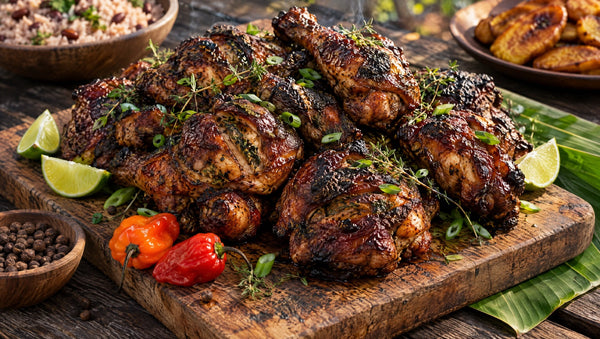
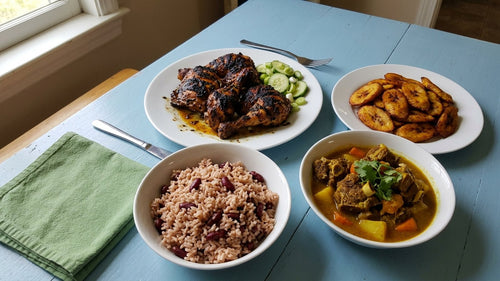
- My jerk chicken, with a thumb of fresh ginger blitzed into the marinade.
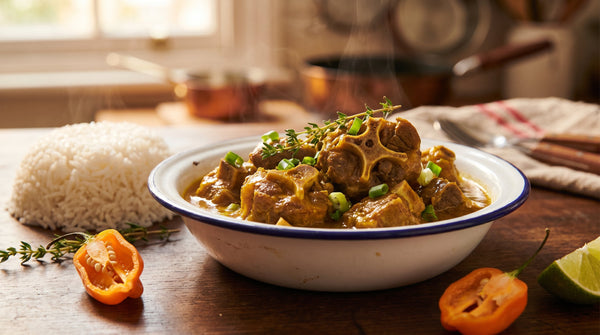
- Curry goat, slow and rich, with grated ginger in the pot.
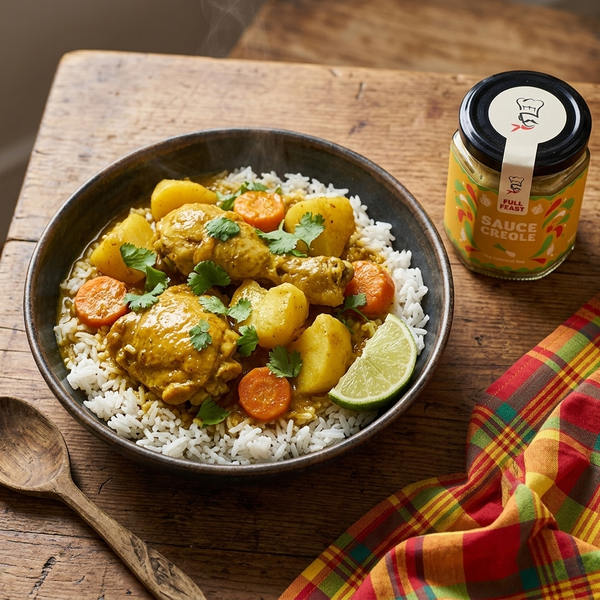
- Poulet colombo, the Guadeloupe curry of my childhood, ginger and garlic first in the pan.
At Christmas, ginger beer sits happily on the table with everything I describe in Christmas in the Caribbean, from the ham to the last slice of cake.
Ginger heat meets Scotch bonnet
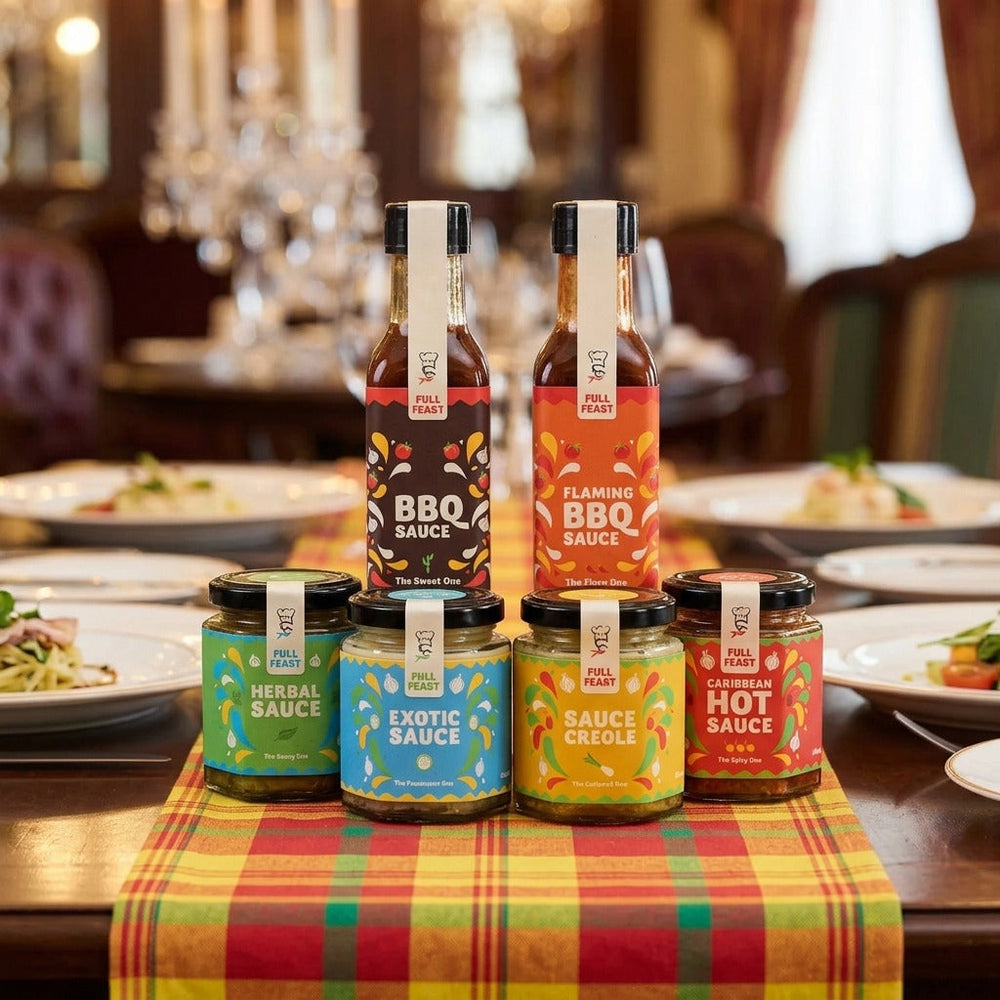
This is where the kitchen comes in. My Caribbean Hot Sauce is built on Scotch bonnet, white onion and garlic, and it is proper heat. A spoonful on jerk chicken, a sip of cold, sharp ginger beer, then back to the chicken. The ginger lifts the fruitiness of the pepper, and the sweetness of the brown sugar calms the fire just long enough for the next bite.
Try it with chicken wings off the grill, or stirred into a marinade with a little fresh grated ginger. Two kinds of warmth, one plate.
FAQ
Is ginger beer alcoholic? Most ginger beer sold in UK shops is a soft drink. Brewed versions sold as non-alcoholic are kept under 0.5% alcohol. Alcoholic ginger beers exist and say so on the label.
Does Jamaican ginger beer have alcohol? The quick homemade Jamaican ginger beer is blended ginger, water, brown sugar and lime, not fermented, so it is a soft drink. Some families bottle and ferment theirs for about a week, and fermentation makes a little alcohol.
What is the difference between ginger beer and Jamaican ginger beer? Jamaican homemade ginger beer is made from lots of fresh ginger and brown sugar, it is cloudy and fiery, and the traditional version is not fizzy. Most shop ginger beer is a carbonated soft drink with a gentler ginger taste.
Is ginger beer more ginger than ginger ale? Yes. Ginger beer is more strongly flavoured with ginger and less sweet. Ginger ale has only a faint ginger flavour.
What is ginger ale? Ginger ale is a carbonated soft drink flavoured with ginger, not an ale. The pale, dry style most people drink was created in Canada in 1904.
One small thing to try this week
Buy a big piece of fresh ginger, the knobbliest one you can find. Wash it well, chop it, and blend it with a litre of cold water. Strain it, stir in brown sugar to taste and a squeeze of lime, and put the jug in the fridge for a couple of hours.
Pour a small glass and taste it next to a can of ginger ale. You will understand the difference in one sip, and I think you will never look at that shop shelf the same way again.
Then make a plate of something hot, and see how the two kinds of heat get along.
JP