A Dry Rub for the Jar, a Wet Paste for the Weekend
Let me be honest with you before we start. Jerk seasoning is not from my island. It is Jamaican, through and through, and it belongs to the people who built it.
I grew up on the far side of the Caribbean Sea, in Guadeloupe. But the first time I tasted proper jerk, I recognised every voice in it. Allspice. Thyme. Hot pepper. Lime. In my mother’s kitchen those were the things that touched almost everything before it went near the heat: lime squeezed over first, then garlic and cive and thyme and piment rubbed in by hand, and the bowl left to sit while the day carried on. Jerk speaks a different dialect of the same language.
So I make my own, two ways.
The first is a dry rub. Allspice at the centre, then thyme, garlic, warm spice, a little sugar and salt, tipped into a jar that lives in my cupboard for months. On a Tuesday I rub a few spoons into chicken thighs and dinner is handled.
The second is a wet paste. Spring onion, fresh thyme, garlic, ginger and lime, blitzed with that same dry rub and my Caribbean Hot Sauce for the fire. This is the weekend one, the one that sits on the meat overnight.
Here is how I make both, what every spice is doing, and how much to use per kilo.
Recipe at a glance
- Cuisine: Caribbean, Jamaican at the root, made my French Caribbean way
- Prep: 15 minutes • Cook: none • Total: 15 minutes, plus marinating time
- Makes: about 260 ml of dry rub (it fits a 300 ml jar) and about 400 ml of wet paste
- Serves: 8, because the paste seasons 2 kg of meat and the jar still has enough left for about 4 kg more
- Featured sauce: Caribbean Hot Sauce
- Heat level: 7/10 in the wet paste, around 3/10 in the dry rub
- Diet: vegan and dairy free. Not gluten free as written, because Caribbean Hot Sauce contains barley
What you’ll need
Almost everything for the dry rub is on a big supermarket’s spice shelf. Buy the ground allspice in the biggest pot, because you use more of it than anything else, or find whole berries in the world food aisle or at a Caribbean grocer and grind your own.
For the paste, everything fresh, with the heat from my Caribbean Hot Sauce.
For the dry rub (one jar)
- 4 tbsp ground allspice
- 2 tbsp dried thyme
- 2 tbsp garlic granules
- 2 tbsp onion granules
- 2 tbsp soft light brown sugar
- 2 tbsp fine sea salt
- 1 tbsp ground black pepper
- 2 tsp ground ginger
- 2 tsp ground cinnamon
- 2 tsp cayenne pepper (1 tsp for a gentler rub)
- 1 tsp ground nutmeg
For the wet paste (about 400 ml)
- 1 bunch spring onions (about 8), trimmed and roughly chopped
- 1 small onion, roughly chopped
- 6 garlic cloves, peeled
- A thumb-sized piece of fresh ginger (about 20g), peeled and sliced
- Leaves from a small bunch of fresh thyme, about 2 tbsp
- 4 tbsp of the dry rub above
- 4 tbsp Caribbean Hot Sauce (2 for mild, 6 for fierce)
- Juice of 2 limes
- 3 tbsp vegetable or rapeseed oil
- 1 tsp fine sea salt
What each spice is doing
A jerk seasoning is a balance. Take one line out of that dry rub and you notice.
Allspice is the backbone. One berry that tastes of clove, cinnamon and nutmeg at once, warm and woody. In Jamaica it is called pimento, and jerk without it is just spicy chicken, so it gets twice the space of anything else in the jar. I have written properly about the berry and its tree, and about the bois d’Inde leaves we cook with back home.
Thyme keeps it savoury. Without it, all that warm spice drifts towards Christmas cake. Dried in the jar because it keeps, fresh in the paste because the paste is made to be used.
Garlic and onion are the floor. Granules in the rub because they stay dry. Fresh in the paste, with the granules adding depth underneath.
Brown sugar is for the crust. It caramelises when the meat meets the heat and rounds off the chilli. Add more and it burns before the meat is cooked.
Salt does the deep work, carrying everything else into the meat. Two tablespoons sounds like a lot until you remember the jar seasons about six kilos.
Black pepper and cayenne are two different heats. Pepper is sharp and quick, cayenne the slower warmth behind it. I keep the cayenne gentle so the jar suits the whole table. The real fire goes into the paste.
Cinnamon, nutmeg and ginger round the edges. If you can taste any one of them on its own, you have used too much.
Lime, in the paste, wakes everything up and starts to open the surface of the meat. That is why fish only gets half an hour in it.
How I make it
Make the dry rub first. The paste uses four spoons of it, so once the jar is done, the paste is ten minutes away.
The dry rub
-
Grind the allspice if you have whole berries. Toast them in a dry frying pan over a medium heat for two minutes, until you can smell them. Cool, then grind in a spice grinder or pestle and mortar until you have 4 level tablespoons. With ground allspice, skip to step 2.
-
Measure everything into a bowl. Every dry rub ingredient, with level spoons, please. You will use this jar for months, so get the balance right once.
-
Mix it properly. Rub out any lumps of sugar between your fingers, then stir with a fork for a full minute. Salt and sugar like to sink, and a lazy stir means one spoonful is all salt and the next is all thyme.
-
Jar it, label it, shake it. Spoon it into a clean, dry 300 ml jar with a tight lid and date the label. Keep it in a cool, dark cupboard, away from the cooker’s heat and steam. Shake it before every use.
The wet paste
-
Chop everything roughly. Spring onions, onion, garlic and ginger, in big pieces, straight into a food processor or blender. The machine does the fine work.
-
Add the rest. Thyme leaves, 4 tablespoons of your dry rub, the Caribbean Hot Sauce, the lime juice, the oil and the teaspoon of salt.
-
Blitz to a rough paste. Pulse in short bursts for about a minute, scraping down the sides. You want a loose, wet pesto with some texture left, not a smooth purée. If the blades spin without catching, add a tablespoon of water.
-
Taste it, carefully. Just a little from the tip of a teaspoon, because raw onion and garlic are loud. It should taste salty and sharp, with the heat arriving late. Too flat, add lime. Not hot enough, another spoon of hot sauce. Blitz again for a few seconds.
-
Set some aside, then use it. Before any raw meat goes near it, spoon three or four tablespoons into a small jar for brushing on at the end of cooking. Rub the rest into your meat, fish or vegetables using the amounts below. Leftover paste keeps in a clean jar in the fridge for up to 4 days, or frozen in an ice cube tray for up to 3 months.
How much jerk seasoning to use per kilo
People always want numbers, so here are mine. The paste batch does 2 kg of chicken or pork, and the jar of dry rub roughly six.
| For 1 kg of | Dry rub | Wet paste | Leave it for |
|---|---|---|---|
| Chicken thighs and drumsticks, bone in | 3 tbsp, plus 1 tbsp oil | 175 ml (just under half the batch) | Overnight is best, never past 24 hours |
| Pork shoulder steaks or chops | 3 tbsp, plus 1 tbsp oil | 175 ml | Overnight is best, never past 24 hours |
| Salmon, firm white fish or prawns | 2 tbsp | 100 ml | 20 to 30 minutes, no longer |
| Cauliflower, sweet potato, squash or firm tofu | 2 tbsp, plus 2 tbsp oil | 100 to 150 ml | 30 minutes to an hour |
The dry rub needs less time: an hour in the fridge is enough for chicken or pork, though overnight is better. The paste wants at least four hours. Score meat with a few shallow cuts first, keep it covered in the fridge, and take it out 30 minutes before cooking.
Bone-in chicken pieces then take 40 to 45 minutes at 200°C (180°C fan), or about the same on the cooler side of a covered barbecue, until the thickest part reads 75°C and the juices run clear. Pork shoulder steaks want 5 to 6 minutes a side on a medium-hot grill, until cooked through. Fish fillets take 10 to 12 minutes at 200°C (180°C fan), prawns 2 to 3 minutes a side in a hot pan, and vegetables 25 to 35 minutes at 200°C (180°C fan), turned once.
The role of Caribbean Hot Sauce in this paste
A traditional jerk paste is built on scotch bonnets. The chilli is the heart of it, fruity before it burns. But chopping a handful raw means gloves, a board that stays hot all day, and guesswork, because no two bonnets carry the same heat.
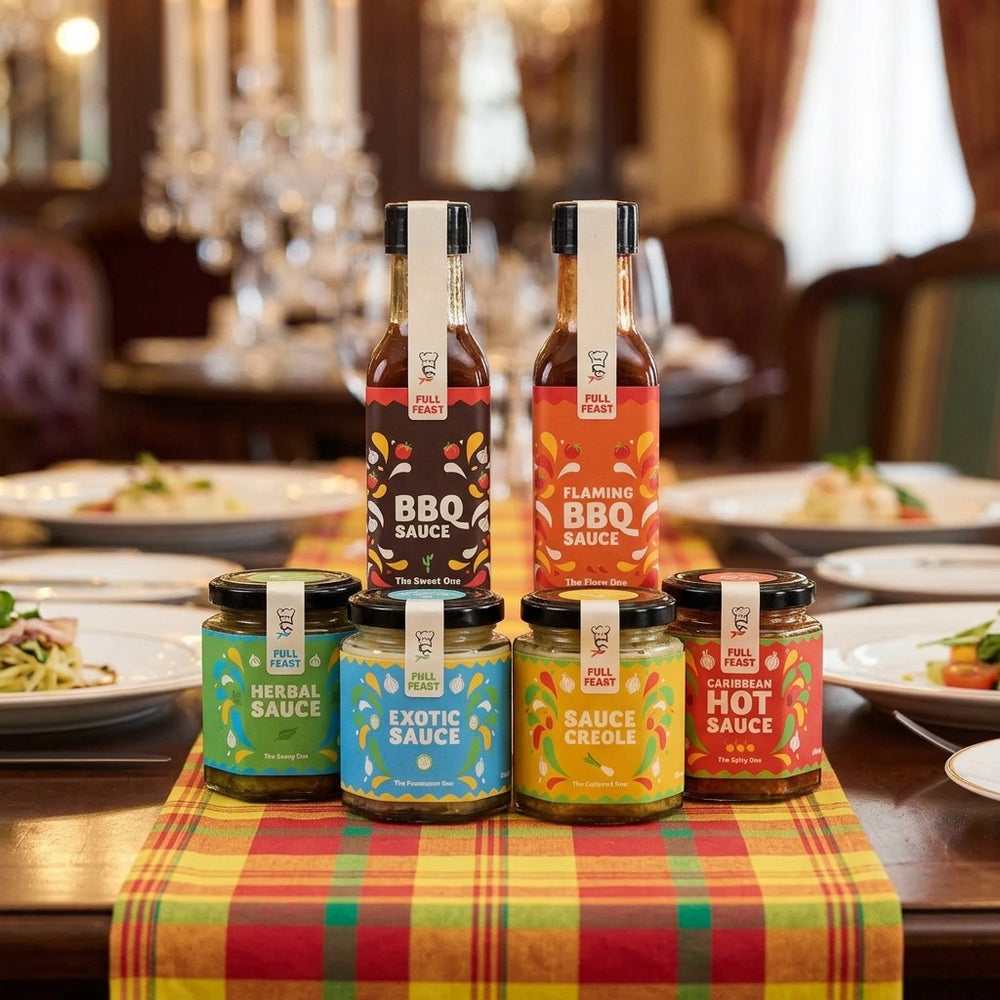
My Caribbean Hot Sauce does that work for you. It is mostly scotch bonnet and onion, with garlic in there too, so it is halfway to a jerk paste before it reaches the blender. You measure it by the spoon, so you can repeat the heat you liked last time, and it is thick enough to cling to the meat instead of pooling in the dish.
In the paste it brings the slow, building heat jerk is known for, arriving after the allspice and thyme rather than in front of them. Its vinegar sharpness works alongside the lime, so the paste tastes bright instead of muddy. And on dry-rubbed chicken, a spoon of it brushed over the skin in the last five minutes gives you the fire without the overnight wait.
Where jerk comes from
Jerk is both a seasoning and a way of cooking. The technique goes back to the Taíno, Jamaica’s indigenous people, who seasoned meat and cooked it slowly over smoke. The Maroons, Africans who escaped slavery and made their lives in Jamaica’s mountainous interior, took it on and made it their own. The word is usually traced to charqui, a Spanish word of Quechua origin for dried meat, the same root that gave English the word jerky.
Two things sit at the centre of it: pimento, which is allspice, and scotch bonnet. Traditionally the meat cooks slowly over pimento wood, so the tree flavours it twice, from the berry in the seasoning and from the smoke. Boston Bay, in the parish of Portland on the north-east coast, is famous for its jerk stands and often called the birthplace of jerk.
Jerk is done both ways, as a dry rub and as a wet marinade. So I am not inventing anything. I am doing it with a Guadeloupe hand: a little more lime, a little more thyme, and the allspice kept at the centre, where Jamaica put it.
Tips from my kitchen
Shake the jar every time. Salt and sugar settle over the weeks. If the sugar sets into lumps on a damp day, run a fork through it. Nothing is wrong with it.
Never reuse the marinade. Once raw meat has sat in it, it goes in the bin. That is why you set some aside in step 9.
Cook on the cooler side first. The sugar in the rub wants to catch. A little char is right; a black crust before the middle is cooked is not. On a barbecue, start the meat away from the coals with the lid down and finish it over the heat. A handful of soaked allspice berries thrown on the coals gives you a breath of pimento smoke.
Freeze the paste in cubes. An ice cube tray, then a freezer bag. Each cube is about two tablespoons, and two cubes will see you through a couple of chicken thighs on a night you did not plan for.
What to make with jerk seasoning
Start with chicken, because that is where jerk is happiest. My jerk chicken recipe is the full method, from the overnight marinade to the char on the skin, in the oven or on the barbecue. Its marinade is a close cousin of this paste, so if you have a batch in the fridge, use it there. For a slower Sunday plate with coconut rice, there is my jerk chicken, rice and peas.
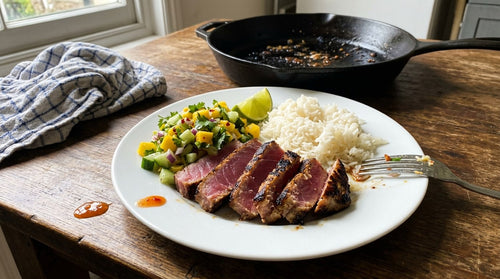
Jerk salmon or pork. A tablespoon of paste over each salmon fillet for twenty minutes, or pork shoulder steaks in the paste overnight, then cooked as above. Lime over both at the table.
Fish tacos. In my Caribbean fish tacos, swap the cumin, paprika, allspice and garlic granules in the cornmeal crust for 1 tablespoon of the dry rub, and leave out the salt.
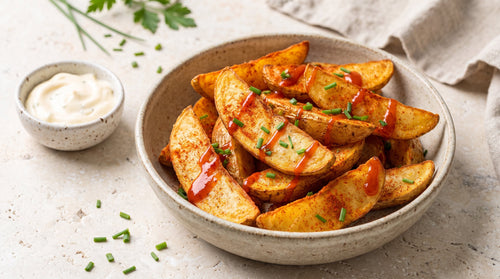
Potato wedges. For my spicy potato wedges, use 1 tablespoon of the dry rub in place of the paprika, garlic granules, thyme and allspice, and halve the salt.
Roast vegetables. Cauliflower florets, sweet potato wedges, squash in thick half-moons. Two tablespoons of dry rub and two of oil per kilo, 30 minutes at 200°C (180°C fan). A vegan dinner with real weight to it.
Jerk mayo. Stir a teaspoon of the dry rub into my spicy mayo for burgers, chips and anything off the grill.
On the side, keep it cool. My Caribbean coleslaw or a plate of fried plantain is all a jerk plate needs.
FAQ
Is jerk seasoning spicy?
It depends which one. My dry rub is warm rather than hot, around 3 out of 10, so the whole table can eat it. The wet paste sits around 7 out of 10, the heat building slowly behind the allspice. You control both: the cayenne in the jar, the Caribbean Hot Sauce in the paste.
What is the difference between jerk seasoning and jerk marinade?
Jerk seasoning usually means the dry spice mix you keep in a jar. A jerk marinade is the wet version, where spring onion, thyme, garlic, lime and hot pepper are blended with those spices into a paste that sits on the meat for hours. The dry rub is quicker and keeps for months. The marinade goes deeper.
How long does homemade jerk seasoning keep?
The dry rub keeps for months in an airtight jar somewhere cool and dark. Spices do not go off, they fade, so it is at its best for the first six months and still good up to a year. The wet paste has raw garlic and oil in it, so keep it covered in the fridge and use it within 4 days, or freeze it for up to 3 months.
Is jerk seasoning gluten free?
Not as a whole recipe, so please read this carefully. The dry rub has no wheat, barley or rye in it, but some ground spices carry a may-contain warning, so check your labels if you need it to be gluten free. The wet paste is not gluten free as written, because Caribbean Hot Sauce contains barley, which comes from the vinegar. If you are cooking for someone with coeliac disease, use the dry rub made with checked spices and bring the heat with fresh scotch bonnet instead of the sauce.
Is jerk the same as Cajun or Creole seasoning?
No. Cajun and Creole seasonings are both dry blends from Louisiana, built on cayenne, garlic and paprika, with Creole carrying more dried herbs. Jerk leans on allspice, scotch bonnet and thyme, so it tastes warmer and rounder. And in the French Caribbean our Creole seasoning is not a powder at all, but lime, garlic, cive, thyme and piment, chopped fresh. I have written about Creole seasoning, Louisiana’s and ours if you want the long answer.
Final word from me
Make the jar this weekend. It takes five minutes and pays you back for months of tired weeknights. Then, on a Saturday with time in it, make the paste, put it on some chicken and leave it overnight.
Jerk is Jamaica’s gift to the rest of us. I am only showing you how I cook it in my kitchen. Tell me what you put it on. I always want to know.
JP