The Salted Cod That Crossed an Ocean to Feed the Islands, and How Guadeloupe Cooks It Now
Every Saturday night of my childhood, back home in Guadeloupe, there was a bowl of water on the kitchen counter with a stiff grey slab of saltfish in it. Nobody touched it. You walked past it on the way to bed, and by morning my mother had changed the water twice and the fish had softened into something you could flake with your fingers. That bowl meant Sunday. It meant accras frying before church, and green bananas boiling for breakfast with the fish folded through onion and chilli.
Saltfish is the most ordinary thing in a Caribbean kitchen, and the one British customers ask me about most. What is it? Is it cod? Why does a tropical island eat a fish from the North Atlantic, and how long do you soak it? Let me answer all of that, because the story behind this plain grey slab is the story of the islands themselves.
What is saltfish?
Saltfish is white fish, traditionally Atlantic cod, that has been preserved by salting and then drying. The salt draws the water out of the flesh, so the fish keeps for months without a fridge. It is sold stiff and crusted with salt, and it has to be soaked in fresh water before you can cook with it. In Guadeloupe we call it morue.
Where saltfish comes from: a cold fish in a hot place
Cod does not swim anywhere near Guadeloupe. It lives only in cold water, and the Norwegians were fishing it in the eleventh century, the French from the thirteenth. In 1497 Giovanni Caboto, sailing for the English Crown, reached Newfoundland and found the sea so thick with cod that he wrote about the quantity. Basque and Breton fishermen were already there, and by 1520 Europeans had fishing camps on the island.
Salting was the only way to get that fish anywhere. In the seventeenth century cheap salt from southern Europe reached the northern fisheries and salting became practical on a huge scale. Norway’s product was first called terranova fisk, Newfoundland fish, and later klippfisk, rock fish, after the rocks it dried on. The Portuguese say bacalhau, the Spanish bacalao, the French morue salée. In Europe it was never a prestige food. It was what you ate on meatless Fridays and through Lent.
How saltfish is made, and why it keeps
The method has not changed much. The fish is split, most of the spine is removed, and it is layered with salt. The salt pulls water out of the muscle and works its way in, and the fish is then dried until it is only about half water. Finished klippfisk carries about 20 per cent salt, which is why nothing grows on it: there is not enough free water left for the microbes that spoil fresh fish.
That is also why you cannot eat it as it comes. The salt has to come down to 2 or 3 per cent, and the only way is water and patience. The reward is flavour. A fish that has matured in salt tastes fuller than the same fish fresh, with a firm flake that holds together in a fritter where fresh cod would fall apart.

How saltfish reached the Caribbean
Here is the part of the story nobody told us at the table, because everyone already knew it. Saltfish came to the islands to feed enslaved people.
The sugar plantations needed a protein that was cheap and would not rot in the heat, and the Newfoundland fishery had exactly that: the lowest grades of salt cod, the fish rejected for sale in Europe, were shipped south. In the French islands the Code Noir of 1685 wrote the ration into law: each enslaved adult was to receive, every week, manioc flour or cassava and two pounds of salt beef or three pounds of fish. Salt beef cost more, so in practice it was the fish, and historians note that evidence of the ration being enforced at all is negligible.
When slavery ended, the fish stayed. It fed the newly freed, and then the Indian and Kongo labourers brought to work the fields. By the 1800s saltfish was part of daily life on every island, and a food that had been imposed became a food that was loved. Most of the morue sold in the French Antilles today still comes from Norway and Newfoundland, dried, salted and sealed in plastic.
Saltfish was never meant to be good. That is exactly why every island made something beautiful out of it.
JP
What Guadeloupe does with morue
In Guadeloupe we say morue in French and lanmori in Creole, which is simply la morue said quickly, the way we say most things. You will see it on menus as ti-nain lanmori, boiled green banana with salt cod, and on every market table from Pointe-à-Pitre to the smallest roadside lolo. These are the dishes we build on it.
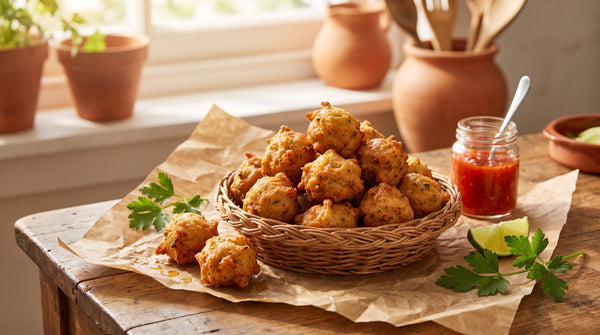
- Accras de morue. Our fritters, and the one thing almost every Guadeloupe menu puts first. Flaked salt cod in a batter with cives, parsley, garlic and chilli, fried until crisp outside and tender inside, served hot with a squeeze of lime or a spicy sauce and, if it is evening, a ti-punch. The word accra comes from the Ewe language of West Africa, where it means a vegetable fritter, and the dish came across with the Africans who were made to eat the fish. In Martinique they call the same fritters marinades. On Good Friday, when nobody eats meat, accras are everywhere.
- Chiquetaille de morue. Salt cod grilled, then flaked and dressed with onion, chilli and oil, eaten cold on bread or next to the accras. The name means shredded, and that is all it is. It is the dish I make most in London.
- Féroce d’avocat. Avocado crushed with a fork, mixed with flaked morue and farine de manioc, our cassava flour, and seasoned so fiercely with chilli that the dish is named for it. If you have read about cassava and the flour Guadeloupe makes from it, this is where that flour ends up on a Sunday.
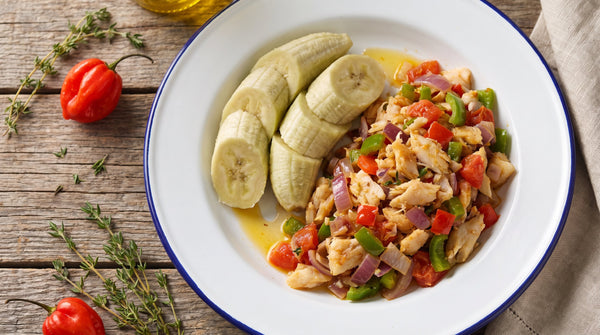
- Ti-nain lanmori. Green cooking bananas boiled like potatoes, with the fish sautéed in onion and seasoning on top. Breakfast, lunch, whatever you need it to be.
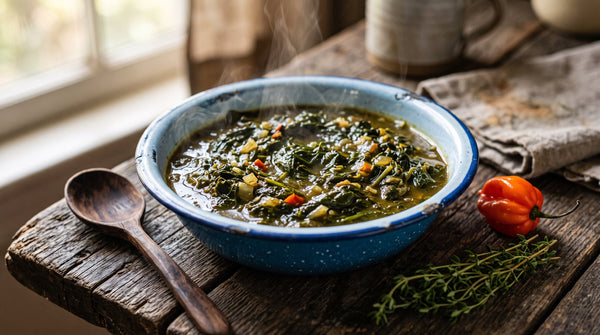
- In the pot. Morue goes into our calalou and into gratins. It is a seasoning as much as a main ingredient: a handful of flaked salt cod makes a pan of vegetables taste of the sea.

Saltfish across the islands: Jamaica, Trinidad, Haiti
Every island took the same imposed fish and made it its own. In Jamaica, saltfish is sautéed with boiled ackee, onion, Scotch bonnet and tomato, and ackee and saltfish is widely regarded as the national dish, eaten at breakfast with breadfruit, fried dumplings or boiled green banana. The ackee was brought from Ghana before 1725, so the national dish of Jamaica is two arrivals meeting in one pan. I have written about ackee, the fruit that must open on the tree before it is safe. Jamaica also fries saltfish into fritters called stamp and go, a name nobody can quite explain.
In Trinidad the breakfast is buljol: boiled, flaked saltfish tossed with onion, sweet pepper, tomato, lime juice and hot pepper, eaten with fried bakes, especially at Easter. In Haiti it is mòri ak bannann bouyi, salt cod with onion, pepper, garlic and thyme beside boiled plantain, our ti-nain lanmori with a different accent. One fish, a dozen kitchens, and in every one of them it is the taste of home.
Buying saltfish in the UK, and how to soak it
Here is something most British shoppers do not know. The neat boneless, skinless packs of saltfish in the big supermarkets are very often not cod at all. Read the label: the ingredients on the common brands say Alaska pollock and salt. Pollock is a fine fish and works in every recipe here, but it is milder and softer than cod. For the real thing, go to a Caribbean grocer and look for salted cod with the skin and bone still in. It costs more and tastes of more. Whatever you buy, it must be soaked. This is how my mother did it and how I do it now:
- Rinse the fish under the cold tap to wash off the loose salt.
- Cover it with plenty of cold water in a bowl and put it in the fridge.
- Change the water two or three times a day. A thick bone-in piece wants 24 to 48 hours. A thin boneless supermarket fillet is usually ready after 12, and some packs are lightly salted and need only a short soak, so read the pack.
- Taste it. Boil a small piece from the thickest part for a few minutes and try it. It should taste seasoned, not salty. If it bites, give it a few more hours and one more change of water.
- Cook it gently in fresh water for ten minutes or so, cool it, then pull it into flakes with your fingers, feeling for bones.
In a hurry, boil the fish in two or three changes of water instead of soaking it. The texture is a little less silky, but on a Tuesday night I will take it.
How I cook saltfish at home
Once the fish is soaked and flaked, the whole island opens up. These are the recipes I reach for most, and the ones I would start with:
- Accras de morue, the saltfish fritters my mother fried every Sunday, with a batter that stays light.
- Green banana and saltfish, the Guadeloupe breakfast I grew up on, which is ti-nain lanmori under its English name.
- Guadeloupe callaloo, the green soup my mother simmered every Sunday, where a handful of flaked morue seasons the whole pot. If you want to know why the same word means three different plants on three islands, read my piece on callaloo and what Guadeloupe does with it at Easter.
The sauce I put next to it
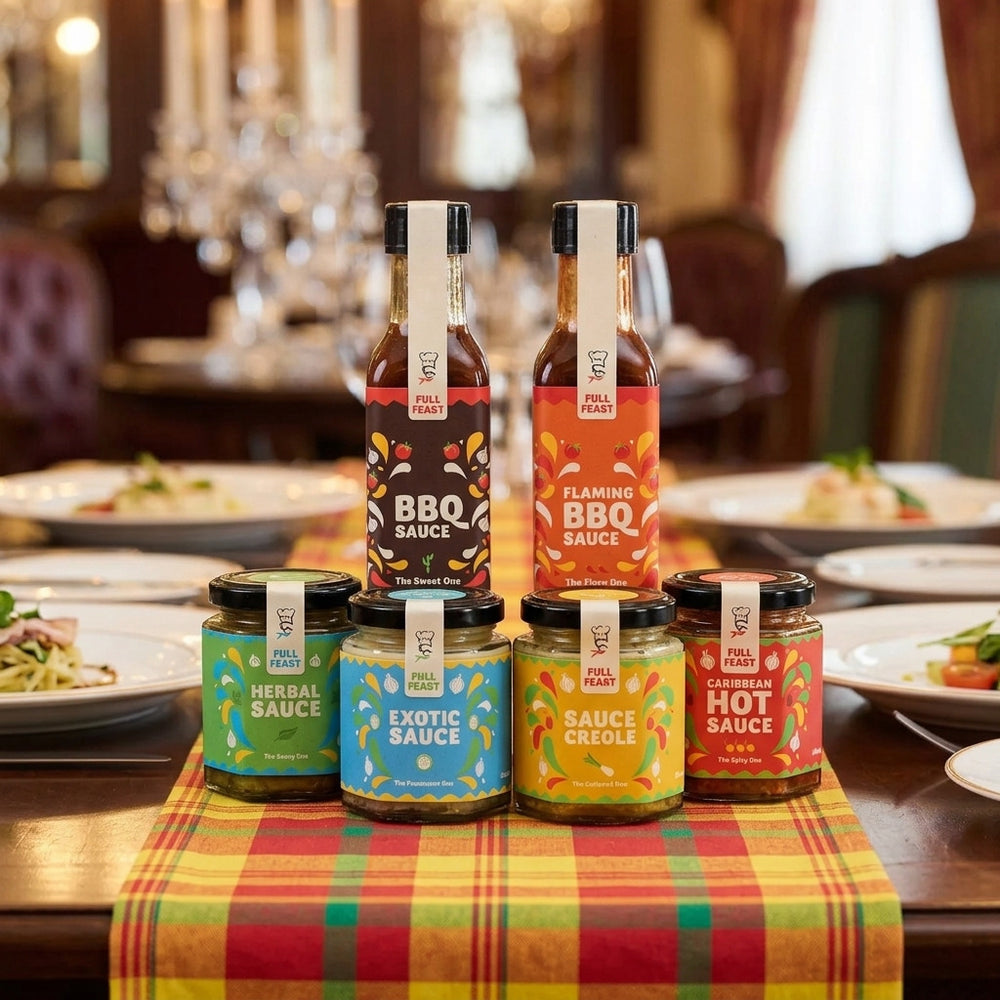
Chiquetaille is only onion, chilli, oil and flaked fish, and in London I make a lazy version in two minutes. I flake the soaked, cooked saltfish into a bowl and stir through a few spoonfuls of Full Feast Caribbean Sauce Creole, which is 68 per cent onion with green chilli, vinegar, salt and white pepper. There is no tomato and no garlic in it, so it does what the onion in my mother’s chiquetaille did: it sweetens the salt and carries the chilli without covering the fish. A squeeze of lime, a slice of bread or a boiled green banana, and that is lunch.
FAQ
What kind of fish is saltfish? Traditionally Atlantic cod, salted and dried. Since cod stocks collapsed, a lot of saltfish is made from pollock, haddock or ling. UK supermarket boneless packs are usually Alaska pollock, so check the label.
Are cod and saltfish the same thing? Saltfish is cod, or another white fish, preserved in salt and dried. Fresh cod is the same animal before the salt. Saltfish is firmer, flakier and more savoury once soaked.
Why do Jamaicans eat saltfish? For the same reason every Caribbean island does. Salt cod was shipped from Newfoundland to feed enslaved people on the plantations because it was cheap and kept in the heat. Jamaica turned it into ackee and saltfish, widely regarded as the national dish.
Can you eat saltfish raw? No. As sold it is about 20 per cent salt. Soak it in cold water, changing the water two or three times a day, then cook it. It needs to come down to 2 or 3 per cent salt before it is pleasant to eat.
How long do you soak saltfish? Thick bone-in cod needs 24 to 48 hours in the fridge with the water changed two or three times a day. Thin boneless fillets are often ready in 12 hours. Taste a small boiled piece to check, and keep soaking if it still bites.
One small thing to try this week
Buy one pack of saltfish, read the label to see which fish is in it, and put it in a bowl of cold water in the fridge tonight. Change the water before bed and again at breakfast.
Tomorrow evening, boil it for ten minutes, let it cool, and flake it with your fingers. Stir half through a spoon of onion and chilli and eat it on toast with lime. Keep the other half for a pan of green bananas at the weekend. Two dishes that have fed the islands for three hundred years, for less than a takeaway.
JP